Nature Note

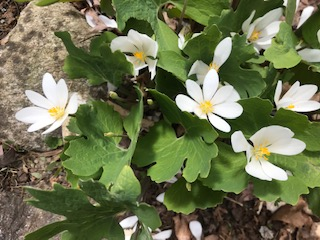
Bloodroot with blossoms opening in the sunlight; not quite fully open.
 |
|
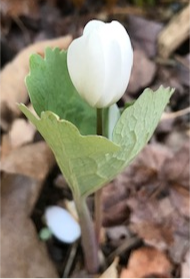
Bloodroot (Sanguinaria canadensis) has been in bloom a few weeks now and some are already starting to go to seed. It is one of my favorite early spring native wildflowers of the Maine woodlands. Arising from humus-rich soil after the snow melts away and before trees leaf-out, the tightly curled white blossoms often appear before the leaf, or with just a miniature leaf curled around the flower stem and also hugging the lower portion of the blossom. Each blossom has its own stem and is paired with just one leaf.
The flower and paired leaf unfurl during the daytime when exposed to full sunlight and re-curl by dusk. The flowers are fragile and the petals are easily blown away by wind. Blossoms usually drop before the end of May.
|
|
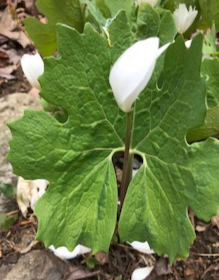
As bloodroot matures it grows taller, from the initial 3 to 4-inch height to up to 14-inches tall. The leaf grows larger as well. I've seen leaves reaching 6-inches across.
Established clumps of bloodroot will form great mounds. It thrives until mid- to late-summer when warm temperatures force it to die back and go dormant to await spring once more.
|
|
 |
 |
|
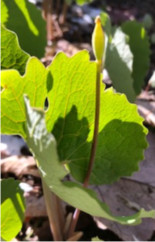
After the blossoms drop, look for the seed pods - one at the tip of each flower stalk. Each pod contains twenty or so tiny brown seeds. They take about four weeks to ripen. Ants collect the seeds as a food source, and in doing so help the plant disperse its seeds throughout the forest.
Interesting Facts:
- Bloodroot is so named because a damaged root will ooze a red sap.
- The red sap was used by First Nations People as a dye and insect repellent. CAUTION: The sap is an irritant and the rhizome (thickened underground root) is poisonous and should not be eaten.
-
Sanguinaria is from the Latin "sanguinarus" which means bleeding.
- Bloodroot is in the Poppy Family.
- Prefers moist, humus-rich, deciduous woodlands with partial shade; grows well at the base of trees.
|
Activities for Children & the Young at Heart
- If you were the first to discover bloodroot, and were to name it just by looking at it and watching it throughout one whole day, what would you call it?
- Watch for ants the next time you are outside and record what they do and carry.
- Draw a picture of your favorite springtime flower, or of a bloodroot from the photos above.
Share Nature Note with your friends, family, teachers, scouts, and anyone you think might be interested. Here is how they can sign up for a free subscription:
Write to me if you have a plant or animal that you'd like covered in a Nature Note. Send an email by using the link below. Be sure to put Nature Note in the subject line.
- Jocelyn Hubbell, Interpretive Specialist, Maine Bureau of Parks and Lands.
www.parksandlands.com
|