Project Canopy
 Travel the rural roads in this part of the country and you’ll see them along roadsides and driveways and in yards. Green in summer, a painter’s palette of orange, yellow and red for a few glorious weeks in the fall.
These giant sugar maples are New England’s signature trees, now that most of the old elms are gone. These maples are large, often behemoths. With heavily fissured bark. Sometimes they are blackened from a lightning strike, hollowed out by rot, or with a crown snapped out. But still alive. Read more...
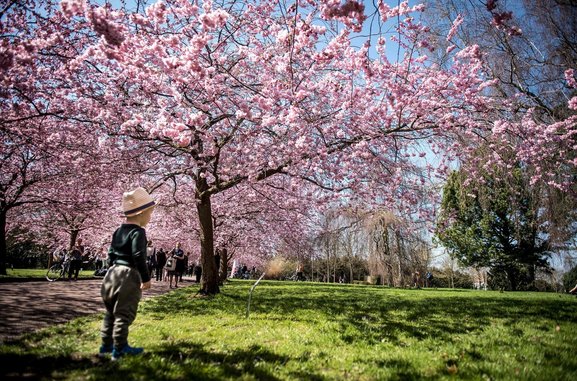 The experience of natural spaces, brimming with greenish light, the smells of soil and the quiet fluttering of leaves in the breeze can calm our frenetic modern lives. It's as though our very cells can exhale when surrounded by nature, relaxing our bodies and minds.
But in a rapidly urbanizing world, green spaces are shrinking as our cities grow out and up. Scientists are working to understand how green spaces, or lack of them, can affect our mental health. Read more...
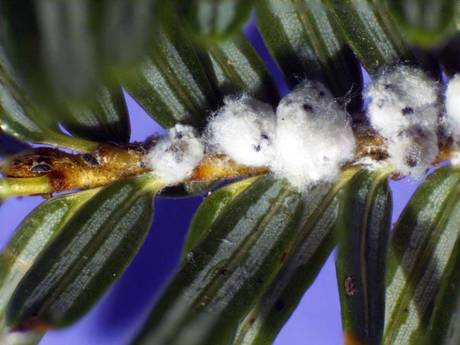 To the casual observer, the tufts of small white fuzz on a hemlock branch might not look like insects. They’re minuscule, they’re covered in a waxy wool-like substance, they don’t move much once they pick their spot on a tree, and most of them can’t fly, either. And yet there are so many of them, spread up and down eastern North America, an existential threat to the region’s vast hemlock forests. Meet the hemlock woolly adelgid.
Adelges tsugae, known as the hemlock woolly adelgid, is a sap-sucking insect originally from Asia but also long-established in western North America, where it is an otherwise unremarkable member of local ecosystems. In eastern North America, however, it is a major pest of eastern hemlock (Tsuga canadensis) and Carolina hemlock (Tsuga caroliniana), neither of which are evolved to resist the pest.
Mark Whitmore, extension associate at Cornell University, does not mince words in describing the hemlock woolly adelgid’s potential impact. “Eastern hemlock is a foundation species and one of the most common trees in northeastern forests,” he says. “I consider the potential loss of this species to be one of the most important ecological disasters our forests face, perhaps second only to climate change.” Read more...
Project Canopy Community Forestry Grant applications due April 12
Visit projectcanopy.me for more info.
New England ISA Arbor Day Grant
The Arbor Day Grant supports small communities in building their Arbor Day programs. This grant awards up to $1,000.00 to a municipality, non-profit organization, or institution that demonstrates need to support their Arbor Day celebration.
Deadline: March 31, 2019.
Find out more: http://www.newenglandisa.org
Pesticide credit opportunities for Commercial Applicators
A Forest Pest, Right of Way Vegetation Management, and General Vegetation Management program will be held in March, 2019.
There are two opportunities to attend:
- 3/12/19 at the Black Bear Inn in Orono from 12pm-4:45pm, or
- 3/13/19 at the Ramada Lewiston Hotel & Conference Center from 7:30am-12:15pm.
Each meeting offers four pesticide recertification credits.
Please preregister by March 8th if possible. The preregistration fee is $40. Registration at the door is $60 (cash or check only). Light refreshments will be served.
You may preregister over the phone by contacting Terri Eldridge at 207.581.3878.
Regional Workshops Set for April
The Recreational Trails Program (RTP) provides up to 80% funding assistance for acquisition and or development of all kinds of recreational trails. Eligible project sponsors can be any land managing agency or organization, even private landowners, as long as the trails developed or improved are open and accessible to the public. This is a very flexible program to help solve a wide range of your trail needs.
While it is not required to attend one of these workshops in order to apply for RTP assistance, the information covered in these workshops is sure to increase your chances of funding. This year staff from the Maine Conservation Corps will also be present at each workshop, providing a great one stop shopping for all things trails, conservation and outdoor recreation.
With six locations across the state, surely you can attend one of them. Follow this link to register now.
2019 RTP workshops:
- Monday, April 1, 1-4pm – Bethel, Mahoosuc Land Trust Offices
- Tuesday, April 2, 1-4pm – Standish Municipal Center
- Wednesday, April 3, 1pm-4pm – Ellsworth City Hall
- Thursday, April 4, 9–noon - Wiscasset Community Center
- Friday, April 5, 1-4pm - Greenville Town Office
- Tuesday April 9, 6-9pm - Caribou Wellness Center
Please pre-register by March 29. Workshops may be cancelled if there is insufficient interest.
Emerald Ash Borer University
April 2, 2019 - Dead Ash Dangers and Considerations for Risk and Removal – Timothy Walsh, The Davey Tree Expert Company
April 16, 2019 - Emerald Ash Borer: Perspective from a Recently Infested State – Dr. Nate Siegert, USDA Forest Service
Visit http://www.emeraldashborer.info/eabu.php
Webinar: Designing & Promoting Urban Forestry Contracts for Municipalities, March 14, 12pm. Visit www.joinwebinar.com and enter the ID code: 525-196-411
(From Karen Bennett, UNH)
Sadly, John Lanier died unexpectedly this week, just shy of his 80th birthday. John was a wildlife biologist who believed in the power of the saw and silviculture to manage and improve wildlife habitat. For foresters, John was the E.F. Hutton of wildlife biologists. He had a long and fruitful career in the Forest Service, N.H. Fish & Game and as a consultant. I had the great fortune to learn from him on many projects, most recently and notably Dirt to Trees to Wildlife—his baby. He always seemed glad to see me—and I expect you too—and was always smiling. I have heard from many of you about the positive impact John had on foresters and New Hampshire wildlife. John did a lot of good and touched a lot of lives.
Mary Reynolds passed away February 21. She had a distinguished career as the Urban Forester with the N.H. Division of Forests & Lands and was the first director of the Urban Forestry Center in Portsmouth. Mary was all about planting the right tree, in the right place, in the right manner. Even though Mary wasn’t well-known in traditional forestry circles, her passing evokes memories and connections. As a UNH forestry student, I interviewed her for a class project—a memory. I vividly remember the spruce Christmas trees on the center grounds. In time, that plantation grew into large trees that mostly blew over in 2010. Harvey Woodward chipped and shipped six loads to the Schiller Station in Portsmouth—a connection.
| 




