Project Canopy
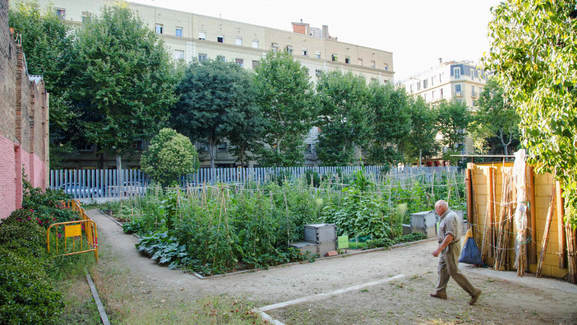
PHILADELPHIA - What’s in a fence? More than you’d think. In neighborhoods where as little as about $1,000 was spent transforming a vacant lot with some grass, a few trees, and a short wooden fence, people felt less depressed and less worthless.
“The beauty of the intervention is that it’s pretty simple,” says Dr. Eugenia C. South, one of the authors on a new study that tracked hundreds of vacant lots across Philadelphia. “Which is good for replication in other cities and being able to scale it up. Also, the cost is relatively inexpensive compared to other types of interventions you might do for health.” Read more...
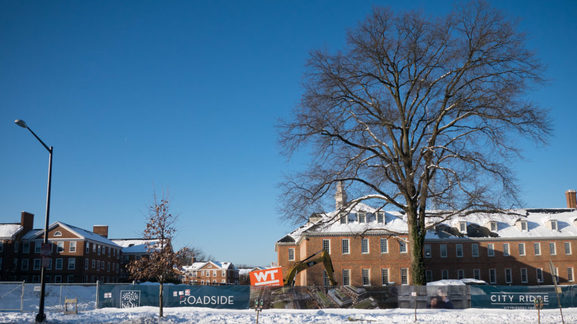 WAMU - If you happened to walk down Wisconsin Avenue earlier this month, you might have noticed a towering oak tree in front of the old Fannie Mae headquarters. In the morning, the 65-foot-tall tree stood on the south edge of the property, where it was planted decades ago. By the end of the day, the tree had moved almost 100 feet north.
“It’s a beautiful day to be moving a tree!” says Paul Cox, on the chilly, slightly windy afternoon.
For Cox, it’s just another day in the office. He works for Environmental Design, a Texas-based company that specializes in relocating large trees.
Cox and his team are moving this pin oak tree to make way for a mixed-use development. Under a 2016 D.C. law, this tree, and others of its size, can’t be cut down, as long as they’re healthy. Any tree with a circumference of 100 inches or more is considered a heritage tree and cannot be removed, under the Tree Canopy Protection Amendment Act of 2016. Read more...
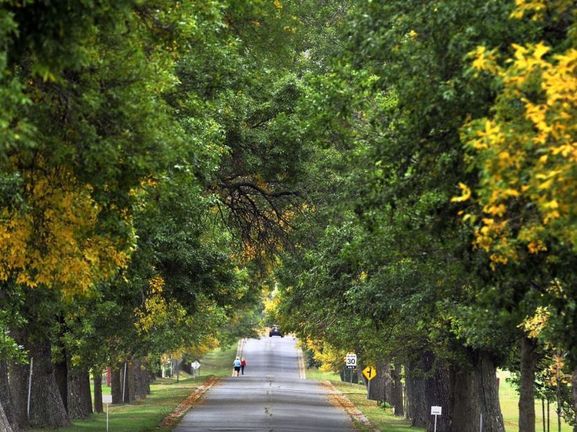 OTTAWA - In analyzing the state of Canada’s urban trees, the Canadian Forest Service visited only half of the 100 communities it studied.
For the rest, it gazed at the digitized trees of Google Street View.
And in the future, it may remove human eyes from the job entirely, and let artificial intelligence handle it.
The forest service wants cities and towns to know what mix of tree species they have, and what the balance of young and mature trees is, because a lot of money is tied up in trees. In particular, they are expensive to cut down and replace if a new type of bug follows the emerald ash borer, a voracious tree-killing beetle.
“We don’t drive the streets. We go down the streets using Google Street View, and we identify any trees within about 10 metres of the edge of the road that way,” said John Pedlar, a research biologist with Natural Resources Canada. “And we put them into rough size categories.” Read more...
Interested in applying for a Community Forestry grant this year?! Have you attended a grant application workshop in the past? If not, sign up today for next Tuesday's workshop! It's required!! 🌳
Planning and education grants have a maximum award of $10,000, while planting and maintenance grants have a maximum award of $8,000. To be eligible to apply for a 2019 assistance grant, all applicants must attend a grant workshop before submitting an application. The grant workshop will be held on February 12, 2019 via the web. The workshop will cover such topics as grant writing, project development, sustainable community forestry management and grant administration.
Grant applications are due by 5:00 p.m., Friday, April 12. To learn more about the Project Canopy Assistance program and to sign up for a grant workshop, contact Project Canopy Director Jan Ames Santerre at (207) 287-4987. Visit projectcanopy.me for more info.
Public Hearings for EAB Quarantine: A state quarantine for movement of ash wood is being proposed by the Maine Department of Agriculture, Conservation and Forestry. Two public hearings are scheduled:
- In Aroostook County - February 11, 2019 @ 6:30 PM, Maine Forest Service Office, 45 Radar Road, Ashland, ME;
- In York County - February 13, 2019 @ 6:30 PM, University of Maine Cooperative Extension Office, 15 Oak Street, Springvale, ME.
Forestry Night: CLIMATE CHANGE: FOREST & ECOSYSTEM IMPACTS
Thursday, March 14, 6:00 – 8:00 pm
Sean Birkel, Research Scientist, Climate Change Institute at UMaine; Dr. Jay Wason, Ass’t Professor of Forest Ecosystem Physiology, UMaine; Dr. Ivan Fernandez, Professor of Soil Science School of Forest Resources, UMaine. Meduxnekeag Ramblers Snowsled Club, Wiley Rd, Littleton. No registration needed. More info: Call the Southern Aroostook Soil and Water Conservation District at 254-4126
- Overview of Maine’s climate and general impacts
- What can we expect in the future?
- Implications of a changing climate on our forests and ecosystems
Credits: ½ day recertification CLP; 2 QLP
Forestry Night: EMERALD ASH BORER
Thursday, April 4, 6:00 – 9:00 pm
Colleen Teerling, Entomologist, MFS; Nate Siegert, Forest Entomologist, US Forest Service; and Gary Fish, State Horticulturist, Maine DACF. Meduxnekeag Ramblers Snowsled Club, Wiley Rd, Littleton. No registration needed. More info: Call the Southern Aroostook Soil and Water Conservation District at 254-4126
- EAB – biology, history and current situation
- EAB management tools and the aftermath forest
- Movement of ash products and quarantines
Credits: ½ day recertification CLP; 3 QLP; SAF & LFP – 2.5 Category 1; 1 Pesticide
Urban Forestry Today Webcast February 7, 2019 | 12:00 – 1:00 p.m. (Eastern) From Seed to Shade: Managing a Municipal Nursery http://www.urbanforestrytoday.org
| 




