|
SOUTH PORTLAND - Entomologists at the Maine
Forest Service (Department of Agriculture, Conservation and Forestry) released parasitic flies (Cyzenis albicans) to combat
winter moth (Operophtera brumata) last fall. The flies were buried as
cocoons in a cage, and the adults (now emerging) will be released into
the forest on Wednesday, May 9, 2018. The release is part of a larger effort to control winter moth across New England.
WHEN: Wednesday, May 9 at 1:30 p.m.
WHERE: 380 Highland Avenue, South Portland, Maine
Adult parasitic flies are attracted to oak
leaves damaged by winter moth, and will lay their eggs on leaves where they
will be eaten by the caterpillars. The
fly eggs will hatch only in the gut
of winter moth caterpillars, parasitizing them. They have been successfully used as a control strategy in Nova Scotia,
parts of western Canada and the US as well in southern New England.
Both the winter moth and their parasites are
originally from Europe. Winter moth defoliation was first recorded in Maine in
2012 and now the moths have been detected from Kittery to Mount Desert Island.
The winter moth caterpillars feed on the leaves of deciduous trees and shrubs
such as oaks, maples, apples and blueberries, in early spring. Heavy
defoliation for several consecutive years leads to branch dieback and tree
mortality. Winter moth defoliation has contributed to tens of thousands of
acres of oak mortality in Massachusetts and now there is oak mortality in Cape
Elizabeth.
This release is part of a larger program,
undertaken in conjunction with the University of Massachusetts, with funding
from the U.S. Department of Agriculture’s Forest Service to control the winter
moth across New England. Flies have been released in five other locations in
south coastal Maine starting in 2013 and are starting to become established in
Kittery and Cape Elizabeth. In many locations in Massachusetts, where the flies
have been released since 2005, the parasitoid numbers have increased to the
point where they are having an impact on the winter moth population.
For more information, contact: Colleen Teerling at 207-287-3096
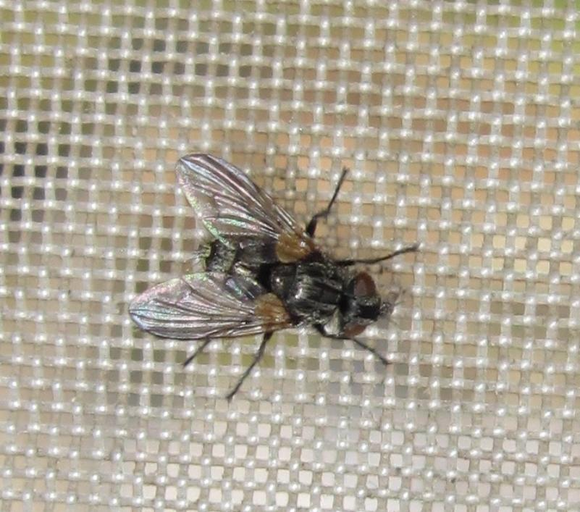 Adult Cyzenis albicans, the parasite of winter moth
| 




