Woods Wise Wire
The
Maine Forest Service (MFS)
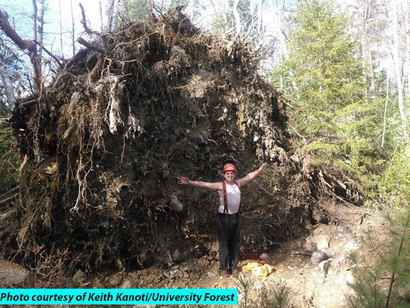
offers the following guidance to woodland owners considering salvage harvesting
trees damaged by the severe wind storm that struck Maine on 30 October 2017.
If
you have any questions regarding a potential salvage harvest, please
contact your District Forester.
Landowners or their Designated Agents must file a complete Forest Operations
Notification with MFS before the salvage harvest begins.
A salvage harvest will not create a
clearcut regulated by the Forest
Practices Act (FPA) rules, provided only those trees damaged by the wind
storm are harvested. Trees that can be salvage harvested are those that
are blown down or so damaged that they are not considered acceptable growing
stock: e.g. trees
that are lying on the ground, snapped off, or leaning more than 30 degrees from
vertical. Trees that meet acceptable growing stock standards must be
retained.
Landowners or their Designated
Agents must document the conditions necessitating the salvage harvest.
Minimum documentation should include photos of the damage and a base map that
shows the specific footprint of the area to be salvage harvested and a
latitude/longitude point for the area. A cruise of the affected area may
also be considered for documentation purposes. Documentation
should be kept on file and be made available to MFS for review.
This advice
does not apply to the opportunistic harvest of standing trees not affected by
the windstorm. If a landowner wants to harvest standing trees within the
salvage harvest area, the entire harvest must comply with all applicable rules,
including but not limited to the FPA.
Salvage
harvesting in
the Land Use Planning Commission’s jurisdiction
requires the necessary permits to operate in protection subdistricts, including
but not limited to P-MA, P-FW, P-UA, etc.
Salvage
harvesting in shoreland areas in organized municipalities may require
additional review before the harvest begins. If your town has adopted the
Statewide Standards for timber harvesting in shoreland areas, please
contact your District Forester for more information. If your town
administers its own shoreland zoning ordinance, please contact the Code
Enforcement Officer.
All salvage
harvesting activities, particularly within shoreland areas, must conform to all
water quality laws. Use proper Best
Management Practices to protect water quality.
Check with
the Maine Natural Areas Program to ensure there is no significant wildlife habitat or rare
or endangered plants in the salvage harvest area that could require special
consideration. If significant wildlife habitat is found within the
salvage harvest area, please contact DIFW for assistance before beginning the harvest.
Again, if you have any
questions or concerns, please
contact your District Forester before the salvage harvest begins.
Return to Top
Each year individuals, foresters, farmers,
community members, and others are tasked with the job of identifying priority
areas of concern in each district (county). Next, the areas of concern
are prioritized as to how USDA funding will be assigned to do work to help
alleviate the problems. Allocation of local funds for the implementation of
conservation programs under the 2014 Farm Bill will come from these
decisions.
If you are an agricultural producer; private
woodland owner; member of an environmental or watershed organization or land
trust; knowledgeable in soil, water, plant, wetland or wildlife sciences;
and/or are familiar with agricultural and natural resource concerns in Franklin
County, please let us know if you plan to attend. Thank you
This year the meeting will be held at 10 a.m.
Mon., Dec. 11, 2017 at the Chesterville Town office -409 Dutch Gap Rd.
For more information, contact Amanda at the NRCS office by Dec. 7th
at 778-4767 x 105 or amanda.burton@me.usda.gov.
Return to Top
|