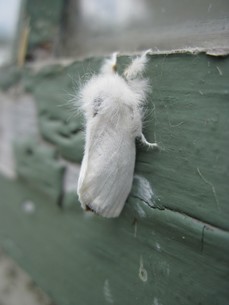
 Have
you seen fat, fuzzy white moths around your lights over the past three weeks?
If so they may be Browntail Moths (they have brown bodies). The Maine Forest Service, a part of the Maine Department of Agriculture, Conservation and
Forestry, would like
your help in tracking the moth flight. Please go to https://www.surveymonkey.com/r/mebrowntail to
fill out a survey on where and how many moths you saw.
The caterpillar stage of this insect feeds on the foliage of many
hardwood trees and shrubs in May and June. They particularly like oak and apple
trees. Caterpillar feeding causes reduction of growth and occasional mortality
of valued trees and shrubs.
While feeding damage may cause some concern, the primary human
impact from the browntail moth is the result of contact with poisonous hairs
found on the caterpillars. Contact of these hairs with human skin causes
a rash similar to poison ivy that can be severe on some individuals. People can
also experience respiratory distress from inhaling the microscopic hairs that
blow around in the air.
Over the past three decades the browntail has been a problem along
the midcoast and islands of Maine. The population is now spreading further
inland and Downeast to communities such as Poland, Belgrade, Burnham,
Eddington, and Deer Isle. Many people in these recently colonized areas are
unaware of the impact browntail can have on them or their trees. Knowing where
moths have been seen in large numbers can help us give people a heads-up as to
what they may have to deal with next spring.
Controlling the moths is
not practical. If you are seeing large numbers of white moths learn about what
you can do if the caterpillars end up in your yard.
For
more information go to: http://www.maine.gov/dacf/mfs/forest_health/invasive_threats/browntail_moth_info.htm,
call the Maine Forest Service at 287-2431 or your local Extension office.
| 




