 New rules prohibit sale of 33
invasive terrestrial plants
AUGUSTA – The Maine Department of
Agriculture, Conservation and Forestry (DACF) has adopted rules to prohibit the
sale and distribution of thirty-three terrestrial plants that were deemed
invasive. The plants were reviewed by a specially-convened committee of horticulture
professionals, land managers, foresters, wildlife biologists and other
scientists. The new rule went into effect on January 14, 2017, but the
prohibition of sales does not begin until January 1, 2018.
“The plants on this list have
invaded farms, fields, forests and wetlands throughout the state,” said
Commissioner Walt Whitcomb. “Although many were originally promoted with good
intentions, such as, the prevention of soil erosion or to support wildlife,
they have spread throughout Maine to the detriment of native species. In many
places they have come to dominate forests, wetlands, fields and local
landscapes, excluding native plants that support our economy and natural
areas.”
“The Maine Forest Service,
Public Lands and the Natural Areas Program have joined with the Bureau of
Agriculture, Food and Rural Resources to locate and eradicate invasive plant
and animal species,’ said Doug Denico, Maine State Forester. “The Public Lands
are a major focus of current efforts, with education of the public also a critical
undertaking in order to extend the department’s statewide effectiveness.”
“All but three of the
prohibited plants have been, or continue to be sold in the nursery trade, said
Gary Fish, Maine State Horticulturist. “Some of them have already been discontinued
by nurseries which recognized their harmful potential. Three are not
intentionally sold, but are “horticultural hitchhikers” which sprout as weeds
in the pots and rootballs of plants sold in the nursery trade. A few of the
plants are still in some demand, including Japanese barberry, burning bush,
privet and Norway maple, especially the crimson king variety. Maine nurseries
and garden centers will have until January 1, 2018, to sell stock already on
hand.”
Many non-invasive
alternatives are available to help homeowners and nursery professionals satisfy
their landscape needs without using the invasive plants on the list.
A copy of the rules and the
plant list are found on the DACF website at:
http://www.maine.gov/…/php/horticulture/invasiveplants.shtml
There is also a list of
resources to help find alternative plants at: www.maine.gov/dacf/php/horticulture/invasiveplants.shtml…
To identify and control
invasive plants, the Department maintains plant fact sheets and a gallery of
photos and management tips at: http://www.maine.gov/…/featur…/invasive_plants/invasives.htm
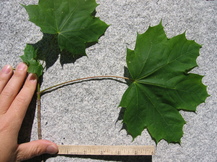
Photo inset: Norway maple leaf (Acer platanoides) is a common invader of native woodlands. While it appears very similar to native sugar maple, the milky sap that exudes from leaves and twigs is a giveaway to its identity.
|