For Immediate Release
December 11, 2015
Contact: Charlene Donahue, (207) 287-2431
Maine prepares for impending outbreak of spruce budworm
Maine
Forest Service report documents steady rise of native defoliator
AUGUSTA – The Maine Department
of Agriculture,
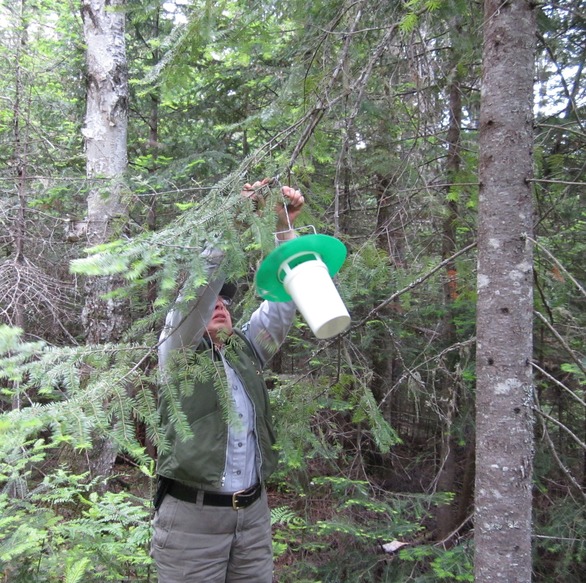
Conservation and Forestry (DACF) today released its 2015 report on spruce budworm in Maine. Entomologists from the DACF’s Maine Forest Service note a
steady rise in the numbers of insects caught in pheromone traps concentrated
along the Canadian border.
Quebec’s infestation now encompasses 15.6 million acres and has spread south onto
the Gaspe Peninsula and toward Maine. The insect’s potential to become an outbreak
over vast regions of commercially valuable spruce-fir forests has scientists
and public official deeply concerned. An infestation can spread rapidly via moths
migrating to new areas.
“The total economic impact of Maine’s forest
industry is $8 billion with direct and indirect employment of 38,789 workers,”
said Governor Paul R. LePage. “Fighting destructive pests like the spruce
budworm is important to help protect Maine jobs and our economy. It is
important that Maine’s forest professionals identified the potential threat
early on, are on top of recent developments and are preparing action steps to
help minimize the damage from a future budworm outbreak.”
Commissioner
Walt Whitcomb stressed the DACF has been busy tracking the budworm by expanding
the program used to determine its potential spread and impact.
“Permanent
pheromone traps have been run annually for the past twenty years,” said
Whitcomb. “In light of the serious nature of the current potential threat to
Maine forests, we significantly expanded our monitoring program last year. We
are also working closely with stakeholders on a response plan to help minimize
damage to our spruce-fir forests in the event of a major outbreak.”
The
report, Spruce Budworm (Choristoneura fumiferana) in Maine 2015, can be
accessed online at: http://www.maine.gov/dacf/mfs/forest_health/documents/2015sbwreport.pdf
Maine’s Response:
Because
the last spruce budworm outbreak during the 1970s-80s grew quickly, killed
millions of acres of spruce-fir stands, and cost the region’s economy many
hundreds of millions of dollars, the Maine Spruce Budworm Task Force was formed
in summer 2013 by the University of Maine’s Cooperative Forest Research Unit
(CFRU), Maine Forest Service (MFS), and the Maine Forest Products Council
(MFPC) to begin the process of preparing for the next outbreak of the eastern
spruce budworm.
Task
teams including more than 65 experts on various aspects of the issue were
assembled to address key aspects of the coming outbreak, including: wood supply
& economic impacts; monitoring & protection; forest management; policy,
regulatory and funding; wildlife habitat; public communications & outreach;
and research priorities. Their pending report (which is in final drafting
stages) includes an initial risk assessment of the coming spruce budworm
outbreak and provides key recommendations for how Maine’s forestry community
can begin preparing for and responding to the coming outbreak.
Spruce Budworm:
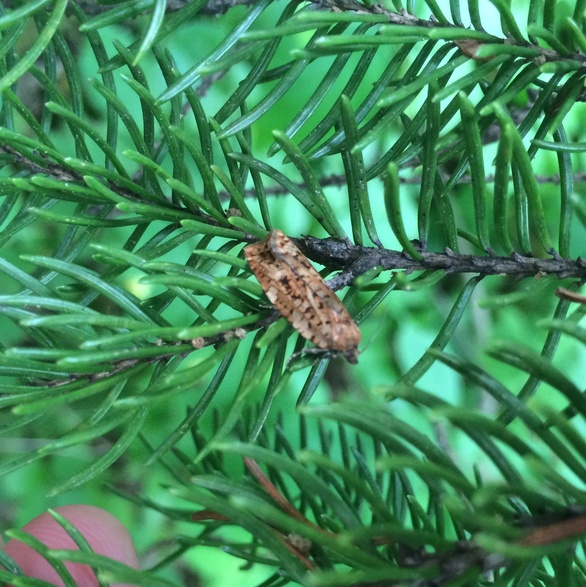
The
native spruce budworm has long been recognized as a regular component of
Maine's spruce-fir forests. Under normal (endemic) conditions populations of
this insect are often so low as to be difficult to detect. Periodically,
however, the budworm undergoes a population explosion (epidemic) and becomes so
abundant that serious feeding damage occurs. Heavily infested stands appear
reddish in July due to masses of dead, chewed needles clinging to the branches.
Tree mortality may occur after several years of heavy feeding.
For more information about the Maine
Department of Agriculture, Conservation and Forestry, go to: http://www.maine.gov/dacf
   ###
| 




