Updated ENERGY STAR Scoring Model
Office of Central Services (OCS) Sustainable Energy wants County building owners and managers to stay well informed and to be aware of industry standards and of their changes over time. There is a new change to the ENERGY STAR certification program structure. ENERGY STAR Portfolio Manager is a no-cost tool that the U.S. Environmental Protection Agency (EPA) developed to help building owners and managers assess and track energy, water, and waste across an entire portfolio of buildings.
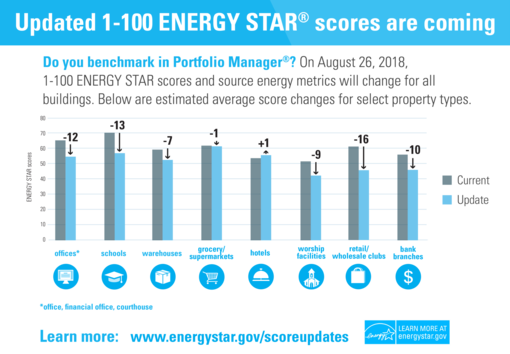
Building managers who benchmark one or more properties within ENERGY STAR's Portfolio Manager will see some changes to their buildings scores and source energy metrics come August 26th, 2018.
This change comes as a part of the EPA's standard process or commitment to keep ENERGY STAR metrics as updated as possible. Reflective of current market performance, the 1-100 ENERGY STAR score compares your building's energy performance to that of national peers and is based on the Commercial Buildings Energy Consumption Survey (CBECS) that is conducted every four years by the DOE. The latest CBECS became available in 2016 and based on 2012's survey results.
Fortunate for intention, the most recent market data indicates overall improvement in the energy performance of the U.S. building stock in recent years. On average, since performance is on the up, this usually correlates to scores and actual performance metrics to therefore be on the down (i.e. better performance = higher standards = lower scores). Your building's ENERGY STAR score may increase or decrease depending on factors such as your energy use, fuel mix, business activity, property type, amongst other variables.
These are the building types with scoring models being updated:
- Bank branches
- Courthouses
- Financial offices
- Hotels
- Houses of worship
- K-12 schools
- Offices
- Retail, including retail store and warehouse club/supercenter
- Supermarkets
- Warehouses, including refrigerated, non-refrigerated, and distribution centers
The release date for all updated scores is August 26, 2018; users will see the updated metrics when they login to the tool on Monday, August 27th to ensure that mixed-use buildings experience only one change.
This will indeed impact historical scores. When ENERGY STAR metrics are updated on August 26, 2018, the new calculations will be applied across all time periods, which means your scores and metrics for all historical benchmarking data will also shift. By applying this update across all time periods, you’ll continue to be able to analyze changes that are a result of your own activities, rather than changes in underlying market data. When EPA updates the methodology, the new calculations will be applied to all time periods so
Other changes coming out of this update is the date center energy estimates, new use details, and an update to the source energy factor. beginning on the 26th of August, there will be a new option to estimate energy that is designed for small data centers, within another property type where it's not as practical to measure actual IT energy consumption (capped at 10% of building area). To add equity to diverse fuel types, source energy factors will be dropping from 3.1 to 2.8 which calls for a more efficient grid. The source energy factor traces the heat and electricity requirements of the building back to the raw fuel input type.
There is also new use details for four building types:
1. Warehouse
- Percentage of gross floor area used for cold storage.
- Percent that can be cooled and percent that can be heated (New in August for refrigerated warehouses).
2. Worship Facilities
- Gross floor area used for food preparation.
- Percent that can be cooled and percent that can be heated.
3. K-12 Schools
- Number of workers on main shift (exists now, but will be required in August).
4. Supermarket
- Number of open or closed refrigeration/freezer units (exists now, but will be required in August).
It is also important to note the EPA cannot give "before and after" score changes for individual buildings or portfolios; you'll need to download the report prior to the update and re-download again after the August 26th update date. One-time rule change: If you earned 2017 ENERGY STAR certification for your building, you may apply for 2018 certification using a period ending date of April 30, 2018, or earlier.
The EPA is hosting webinars including "Ask the Expert" sessions which gives users the opportunity to interact directly with EPA experts in an open forum. All webinars are publicly announced, recorded, and available to watch at any time on the ENERGY STAR Training Portal. Click to sign up below for the no-cost webinars:
EPA has a dedicated section of frequently asked questions about the 2018 metric updates in the ENERGY STAR Buildings help desk. If your question is not among the FAQs, submit a question by clicking the “Ask a Question” tab.
Learn more at www.energystar.gov/scoreupdates.
Check out our Sustainable Energy Programs
Please visit OCS Sustainable Energy website to learn more about the County’s clean energy efforts including the TNI Clean Energy Grant Program and Energy Star Certification & Green Leasing Grant Program.

PRINCE GEORGE’S COUNTY IS #1
IN THE D.C. METRO REGION FOR CLEAN, SOLAR ENERGY GENERATION!
|
Follow us on Social Media
We have launched our social media sites, follow us to stay informed of County sustainable energy efforts (you can also click the icons at the bottom of this page).
@MyPGCenergy
|