Baltimore Gas and Electric customers facing new distribution rate increases, atop already high rates
BALTIMORE – The gas and electric distribution rates of Baltimore Gas and Electric increased again on January 1, 2026, exacerbating already high energy bills and compounding the impacts of high levels of energy consumption amid cold winter temperatures, the Office of People’s Counsel said in a customer alert issued today.
The rate increases stem from BGE’s second multiyear rate plan (MRP) approved in 2023 and are separate from the “reconciliation” increase the Public Service Commission just approved in December 2025. The current base rate increase, effective January 1 under BGE’s second MRP, adds to the more than 10 rate increases that BGE customers have experienced since the utility's acquisition by Exelon Corporation in 2012—in sharp contrast to the far fewer rate increases for Maryland’s largest for-profit utilities that are not owned by Exelon.
OPC’s alert informs customers of actions they can take to reduce consumption, such as turning their thermostats down and weatherizing their homes. It also provides resources for those struggling to pay their energy bills.
“BGE’s rapidly escalating distribution rates reflect the business strategy of its owner, Exelon Corporation,” said Maryland People’s Counsel David S. Lapp. “Exelon is promising its investors annual earnings that cannot be accomplished without continuous rate increases from its utilities, including BGE. BGE customers cannot afford and should not pay for distribution rate hikes that are needed to meet Exelon’s shareholder growth targets.”
BGE’s electric supply rates will be lower this winter than in the fall due to a Commission decision that placed all the recent increases in capacity market costs on BGE customer bills in the fall and spring months when energy bills tend to be lower. Electric supply rates will again increase for service starting March 1, 2026.
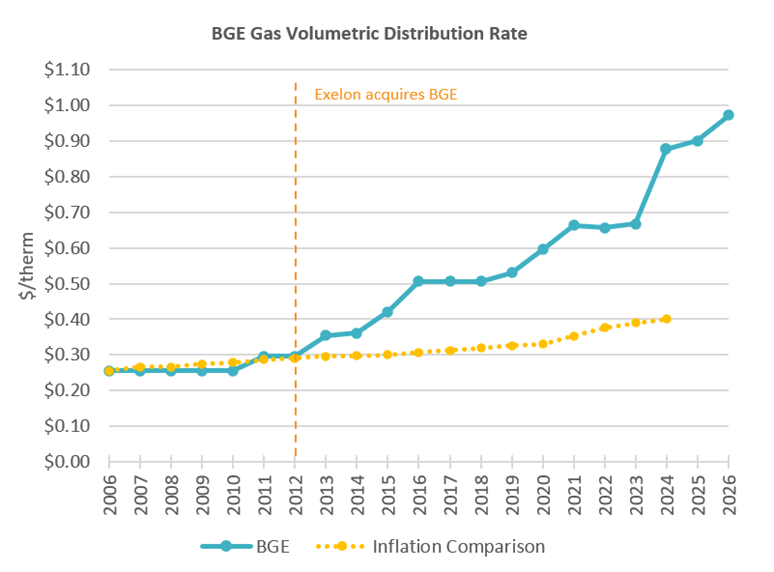
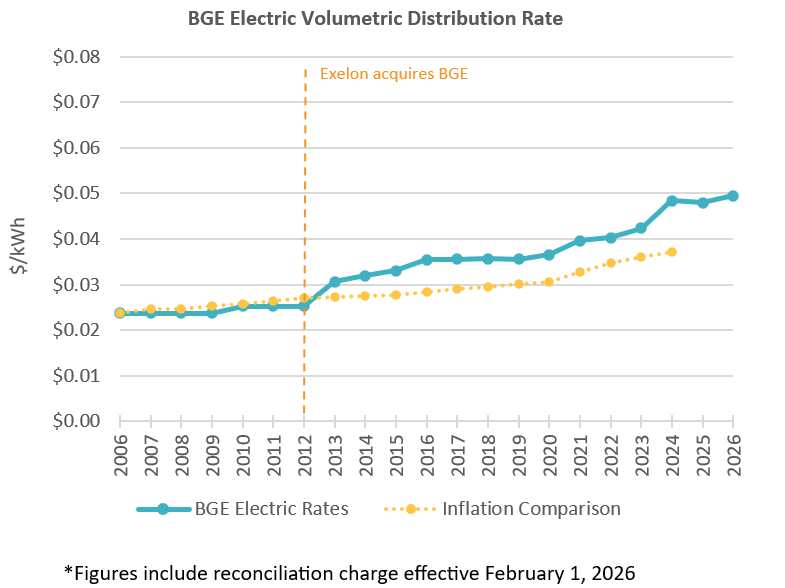
Effective January 1, 2026, BGE’s base gas distribution rates increased by 4.2 cents per unit of gas consumed (measured in therms) to 94 cents/therm, and BGE’s base electric distribution rates increased by 0.1 cents/kilowatt hour (kWh) to 4.9 cents/kWh. In addition to the base rate increase which took effect January 1, BGE’s rates will also be increasing February 1 under last month’s separate Commission order approving a “reconciliation” charge related to BGE’s overspending in 2023 during its first MRP. The Commission denied about half of BGE’s $152 million reconciliation proposal. The reconciliation charge adds an additional 3.5 cents/therm to gas rates and 0.1 cents/kWh to electric rates. The reconciliation charge remains in rates only until the approved amount is recovered—almost two years under the Commission’s order—while the base rate increase effective January 1 approves costs that are likely to be built into rates for decades into the future.
Since Exelon’s acquisition of BGE in 2012, BGE’s base gas distribution rates have more than tripled, rising from 30 cents/therm in 2012 to 94 cents/therm in 2026. Its base electric distribution rates have almost doubled, rising by 92 percent, from 2.5 cents/kWh in 2012 to 4.9 cents/kWh in 2026. BGE’s rapidly escalating costs for delivering gas and electric service are illustrated in the figures below.
The other Maryland utilities owned by Exelon—Pepco and Delmarva Power—have also seen steady base distribution rate increases since Exelon acquired their owner, Pepco Holdings, Inc. in 2016. Delmarva Power has had eight rate increases since the acquisition, with rates growing by 65 percent, from an annual average of 4.3 cents/kWh before the acquisition in 2015 to 7.1 cents/kWh in 2025. Pepco has also had eight rate increases since the acquisition and is now seeking approval for another overall rate increase of 23 percent. Pepco’s latest request, if approved, would make nine rate increases since Exelon’s 2016 acquisition, with annual average rates growing by 132 percent from 3.3 cents/kWh in 2015 to 7.6 cents/kWh in 2026. The three Exelon utilities serve 80 percent of Maryland customers.
The Maryland Exelon utilities’ distribution rate increases have helped drive up profits. Before Exelon’s acquisition in 2011, BGE’s annual profits were less than $150 million; in 2024 its profits totaled $527 million. Exelon’s 2024 profits totaled $2.46 billion. To explain BGE’s, Pepco’s, and Delmarva Power’s 2024 profit levels, Exelon’s federal regulatory filings point to “[f]avorable impacts of rate increases.”
The Exelon utilities’ frequent rate increases contrast sharply with those of Maryland’s largest for-profit utilities not owned by Exelon. In 2015, both BGE and Washington Gas had gas distribution rates of about 42 cents/therm. With the February 1 increase, BGE’s gas distribution rate will be 97 cents/therm, more than double Washington Gas’s current rate of 46 cents/therm. That means an average BGE customer will pay about $500 more in 2026 for the same distribution service as Washington Gas customers. (On December 29, 2025, Washington Gas filed a request to increase its distribution rate to 55 cents/therm.) Potomac Edison, the state’s only other large for-profit electric utility, has had just two rate increases in the last 25 years and has a current rate of just 2.3 cents/kWh—less than half of BGE’s 2026 rate and less than a third of Pepco’s recently proposed average rate of 7.6 cents/kWh.
BGE’s January 1 rate increase is the last increase stemming from its second MRP, which the Commission approved in late 2023. Under the order approving that plan, BGE must file another rate case before 2027.
“Customers should make every effort to use energy wisely to keep down their bills,” Lapp said. “Meanwhile, the State must make every effort to advance the public’s overwhelming interest in affordable energy by effectively regulating the spending of our profit-seeking utilities, especially as they continue to push for further rate increases that serve the interests of their corporate owners.”
TIPS TO LOWER YOUR ELECTRIC BILL
The Maryland Office of People’s Counsel is an independent state agency that represents Maryland’s residential consumers of electric, natural gas, telecommunications, private water and certain transportation matters before the Public Service Commission, federal regulatory agencies and the courts.
* * *
|