Pepco proposes 23 percent distribution rate hike—on top of massive rate increases over last decade, OPC Consumer Guide shows
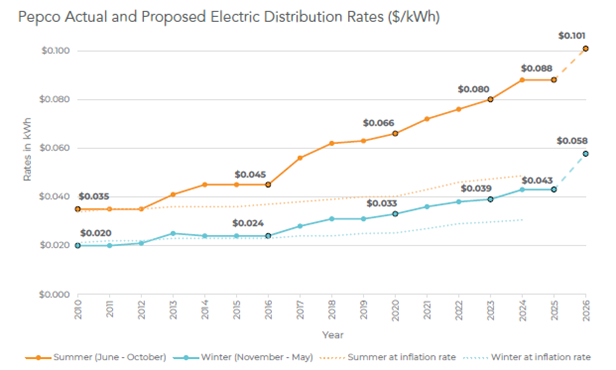
BALTIMORE – Pepco’s proposed distribution rate increase would grow existing summer rates by 15 percent and winter rates by 33 percent, for an overall increase of 23 percent, following a decade of steadily rising distribution rates, according to a Consumer Guide on Pepco’s rate hike request that OPC released today. The increase—if approved by the Public Service Commission—would mean distribution rates will have increased an average of 63 percent since 2020 and 132 percent since 2016. (See chart below.)
“Pepco’s proposal would further exacerbate the affordability crisis Marylanders are experiencing from rapidly increasing distribution rates that started following Illinois-based Exelon Corporation’s 2016 acquisition of Pepco,” said Maryland People’s Counsel David S. Lapp. “Pepco’s proposal would lock in higher costs for decades into the future, further driving up energy bills for residential customers.”
Under the proposal, Pepco’s summer distribution rate would increase by 1.3 cents per kilowatt hour and its winter rate by 1.4 cents/kwh. Because Pepco’s summer rates apply for 5 months of the year and its winter rates apply for 7 months, the overall increase of 23 percent reflects a weighted average of those two seasonal rates. The monthly customer charge would increase from $8.44/month to $8.67/month. The average customer’s bill would rise by more than $11/month, and customers that use more energy would see substantially higher increases, according to OPC’s guide.
Pepco is proposing a new method for setting its distribution rates based on forecasted costs, OPC’s Consumer Guide explains. Similar to multi-year rate plans, the proposal would have customers pay for projects the utility has yet to start working on and allow faster cost recovery than do standard rate cases. Under normal practices, rates are set based on proven, actual costs. In contrast, using forecasted costs increases rates faster and shifts risks of utility overspending to customers and away from investors, OPC’s guide explains.
OPC is asking the Public Service Commission to reject Pepco’s request to adopt rates based on forecasts and apply standard ratemaking policies to evaluate Pepco’s proposal. An OPC filing explains that Pepco’s proposal poses the same or even greater risks to customers as multi-year rate plans. (The Commission declined to immediately adopt OPC's request to reject Pepco's forecasted costs approach but did not rule out rejecting the approach later in the case.)
“Pepco again is asking the Public Service Commission to adopt novel rate setting practices that benefit Exelon investors, but harm its customers,” Lapp said. “We hope the Commission rejects that approach.”
OPC is evaluating Pepco’s proposal and will advocate in the rate proceeding to keep residential rates as low as possible while maintaining safe and reliable service. The Consumer Guide provides information on how customers can stay informed and give input into Pepco’s proposal.
 The Maryland Office of People’s Counsel is an independent state agency that represents Maryland’s residential consumers of electric, natural gas, telecommunications, private water and certain transportation matters before the Public Service Commission, federal regulatory agencies and the courts.
* * *
|