OPC asks PJM Board to intervene to protect customers from billions in costs from new forecasts of massive data center growth
BALTIMORE – Customers could be on the hook for billions of dollars in added costs above what they are already paying for data centers if PJM does not act decisively to address the most recent requests for new projections of data center electricity demand growth, the Office of People’s Counsel said this week in a letter to the PJM Board of Managers.
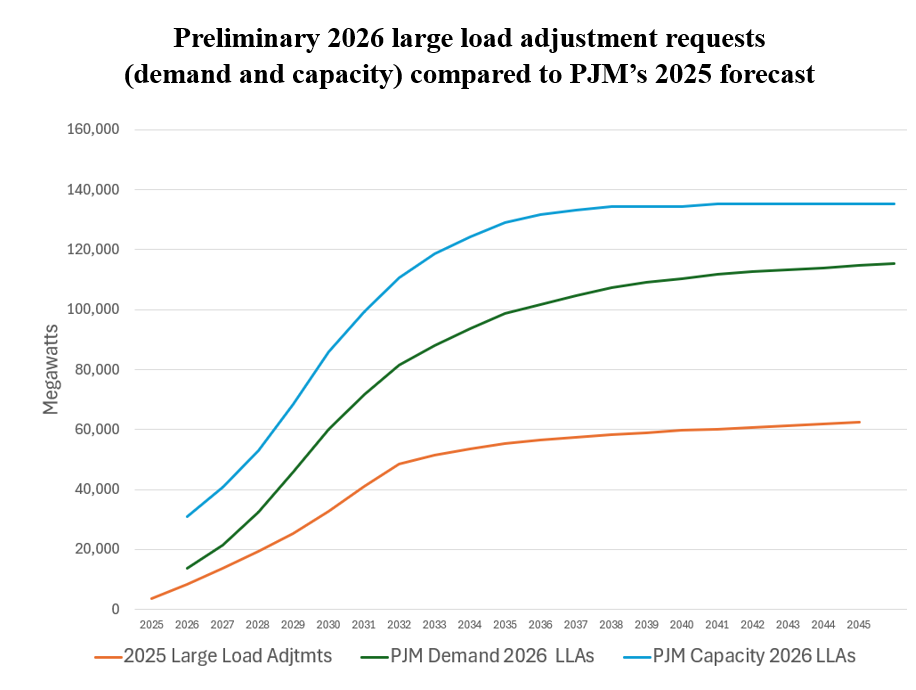
OPC’s letter responds to the PJM utilities’ recent submissions of new projections for data center load growth for PJM’s 2026 forecast. The submissions would approximately double, to about 60 gigawatts by 2030, the planned increases in demand for data center growth already in store based on the 2025 forecast (33 GWs). (See illustration below.) In comparison, Maryland’s total peak demand built up over a century is about 12 GWs; the submissions thus project adding demand that would be the equivalent of about five states the size of Maryland in just the next five years.
“There are huge signs that the submissions to add more data centers to the forecast are wildly overstated,” Maryland People’s Counsel David S. Lapp said. “PJM needs to apply much greater scrutiny to protect customers and avoid imposing billions of dollars for data center load growth that is highly unlikely to be fully realized.”
PJM will use the utilities’ projections to develop its 2026 forecast that sets the rules for upcoming capacity market auctions and for transmission planning, impacting existing customers with potentially billions of dollars in new costs. The forecast is being developed in a PJM process now, and when it is finalized, it will drive transmission expansion plans and be used to establish the “demand” used for upcoming capacity market auctions. Under current rules, Maryland’s residential customers, along with other customers across the PJM region, foot the bill for the billions in costs resulting from the capacity market and transmission expansion necessary to support projected data center growth.
OPC’s letter, supported by a detailed memorandum, highlights numerous reasons why the new projections for massive data center growth are unlikely to materialize. Among the points raised:
- The utilities’ projections for electric demand growth in PJM alone roughly equal estimates for electric demand data center growth for the entire country.
- The projections of data center investment growth—requiring more than $1 trillion in estimated capital expenditures by data center developers by 2028, all in PJM—rival national and even global estimates of projected levels of data center investment.
- Recent trends in artificial intelligence (AI) and data center deployment indicate less of a need for concentrated data center deployment in small areas, such as Northern Virginia, making other areas of the U.S. likely competitive alternatives to data center buildout within PJM.
- Technological developments are driving rapid changes to data center infrastructure that may put downward pressure on data center energy use, including improvements in energy efficiency and flexibility.
Data center requests to utilities to stake claims for interconnection to the electric system are akin to the Oklahoma land rush of 1889, OPC explains. Data centers are seeking to lay claim to limited electric industry resources, often having little to no downside for the data center companies making the request. The land rush is enabled by the incentives utilities receive for building more transmission, which adds to their profits. Existing captive utility customers bear huge risks of having to pay for unnecessary overbuilding of the system if the data centers do not materialize as projected.
“It is bad enough that Maryland residential customers are already paying the price of policies that have them subsidizing some of the world’s wealthiest corporations,” Lapp said. “They shouldn’t have to pay for inflated estimates of projected growth that is unlikely to ever occur.”
To reduce risks for customers, OPC asked the PJM Board to develop a more rigorous, fully transparent, and uniform process to review data center requests; establish specific requirements for inclusion in the forecast, including required contractual terms and financial requirements; and specify project milestones before allowing the data center to be connected to the system.
 The Maryland Office of People’s Counsel is an independent state agency that represents Maryland’s residential consumers of electric, natural gas, telecommunications, private water and certain transportation matters before the Public Service Commission, federal regulatory agencies and the courts.
* * *
|