Funding Opportunities: Grant Rounds
Historic Preservation Non-Capital Grant Program
All Intent to Apply (ITA) forms for the Historic Preservation Non-Capital Grant Program are due TODAY, June 24, 2026 at 11:59 PM. Full applications are available once the ITA is submitted and are due on July 31, 2026 at 11:59 PM. For full details, visit the program webpage.
African American Heritage Preservation Program (AAHPP)
Applications for the FY27 AAHPP grant round are now open. Before you begin, applicants should review grant guidelines, watch a general overview webinar, and contact program staff with questions. All of this, in addition to information on how to apply for a grant, can be found on the program webpage. Applications close on July 1, 2026 at 11:59 PM.
Maritime Heritage Grant Program
Federal funding is available through the Maryland Historical Trust (MHT) for projects related to maritime heritage. Before applying, please review all grant materials on the program webpage and reach out to program staff with any questions. Applications close on July 31, 2026 at 11:59 PM.
|
Apply Now: Maryland Historic Revitalization Tax Credit Program
Applications are now live for the FY27 competitive commercial tax credit! Capped at $5 million per project, the application deadline is August 31. We encourage applicants and prospective applicants to contact MHT tax credit staff with any questions, to facilitate preliminary consultation, and to schedule a site visit. For more information, contact details, and to download the new application forms, visit the program webpage.
By Lauren Canty (Jefferson Patterson Park & Museum Curator) and Brenna Spray, PhD (MHT/MHAA Outreach & Communications Officer)
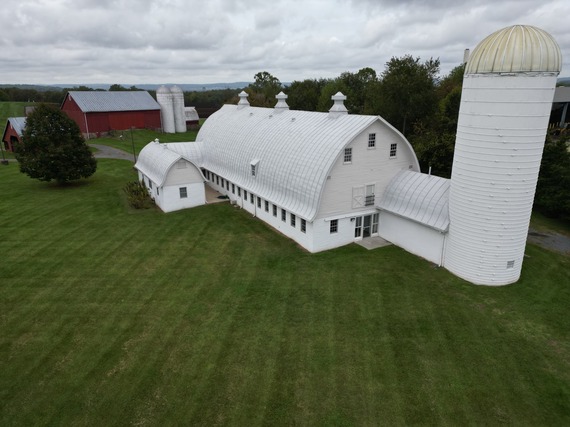 A Gothic-style dairy barn with silo and attached milk barn at Linden Farm (Montgomery County), documented as part of the University of Delaware’s Center for Historic Architecture and Design non-capital grant project.
While we celebrate Pride Month in June, it’s also National Dairy Month, a fitting time to explore Maryland’s dairy heritage. Before the late 19th century, most Maryland farms were mixed-use operations that produced milk, butter, and cheese alongside other crops and livestock.
By the early 20th century, dairy production had become a defining part of Maryland agriculture, reshaping farmsteads with adaptations of older barns, and the construction of new buildings and infrastructure designed specifically for milk production and distribution.
Through the Historic Preservation Non-Capital Grant Program, MHT has supported a multi-year effort to document historic dairy farm complexes and agricultural landscapes for the Maryland Inventory of Historic Properties. Survey work has now covered parts of Carroll, Cecil, Frederick, Harford, Montgomery, and Washington counties, with additional documentation underway in Baltimore and Howard counties.
Today, Marylanders and visitors can still encounter this agricultural heritage in the landscapes, buildings, and working farms that remain across the state — including some that operate on-site creameries. One place where this history remains visible is the dairy barn at Jefferson Patterson Park & Museum (JPPM) in Calvert County. Part of MHT, JPPM invites visitors to consider their relationship with the Chesapeake landscape as they explore the human stories behind Maryland’s agriculture, architecture, and artifacts. JPPM was once known as Point Farm, the working farm and rural retreat of Jefferson Patterson, a Diplomatic Officer with the US Department of State. In 1983, his wife, Mary Marvin Breckinridge Patterson, a WWII radio correspondent, filmmaker, and philanthropist, donated Point Farm to the State of Maryland so the public could learn about the 9,000 years of human occupation on the landscape.
A Dairy Barn at Point Farm
On August 9, 1935, Jefferson Patterson feverishly wrote to his mother, Julia Shaw Patterson Carnell, from his post as Consul in Breslau, Germany. He had recently purchased Point Farm in Saint Leonard, Maryland, and would soon purchase a dairy farm in Clarksburg. Although we do not have his mother’s original letter, she obviously did not approve of his foray into farming and had made those thoughts clear. Patterson writes:
“I am a little short of FLABBERGASTED over your tirade against the farm life, for I had considered my acquisition of some broad acres as an evidence of the best kind of common sense.”
For Patterson, “common sense” meant tying one’s wealth to something tangible: property. He went on to develop the active agricultural estate that later became JPPM.
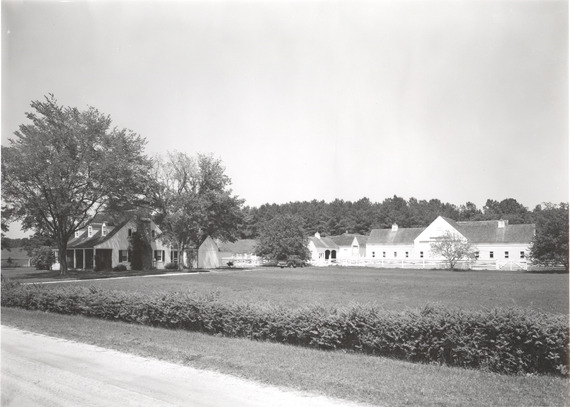 The farm manager’s complex at JPPM in 1954. James R. Dunlop Photography Studio. Patterson Collection.
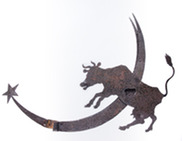
Built in 1932, Patterson’s 3,318-square-foot dairy barn appears in architect Gertrude Sawyer’s original drawings as the “Cow and Horse Barn.” It is the largest and most central building in a complex that included the farm manager’s residence, smokehouse, chicken house, and granary. The dairy barn features a cross-gable roof above white weatherboard siding, with wings extending from each end and distinctive cupolas originally topped with custom weathervanes designed by Sawyer (pictured right).
|
The barn reflects broader early 20th-century changes in Maryland’s dairy industry. As farms expanded dairy production, they invested in purpose-built infrastructure such as dairy barns, milk houses, and silos designed to support more efficient operations. Even as dairying became a central focus for many farmsteads, most remained mixed-use landscapes, with buildings continuing to support crop production, livestock management, and storage.
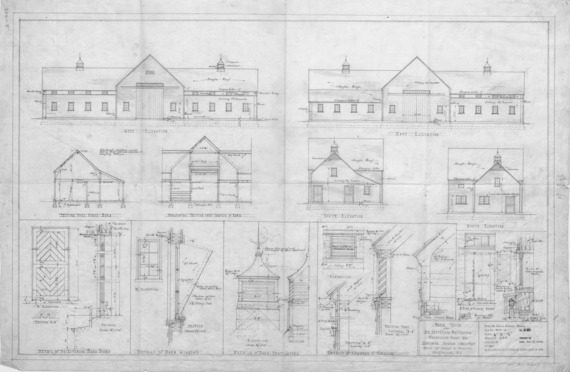 Gertrude Sawyer’s original 1932 elevation drawings for the “Cow & Horse Barn” on Point Farm. Patterson Collection.
When the farm opened to the public, the dairy barn was transformed into the Exhibit Services Program building, housing a workshop and offices for maintenance staff. Although visitors typically cannot go inside the barn, you can still view it from the outside on your walk south toward the Patterson House, Jefferson Patterson’s home at Point Farm, and Peterson Point, the site of the Battle of St. Leonard Creek during the War of 1812.
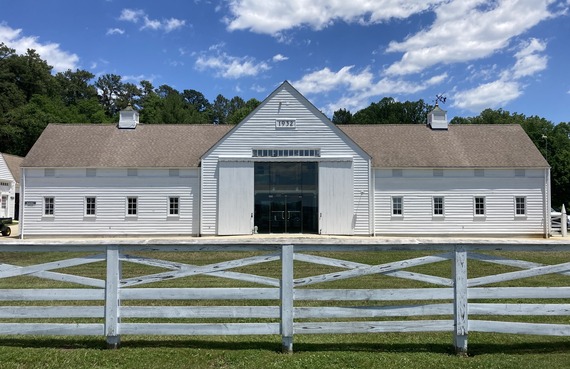 The Patterson dairy barn in 2026.
Modern Dairy Production in Maryland
After World War II, shifting economic pressures led Maryland’s dairy industry to embrace larger herds, mechanization, and consolidation across the agricultural landscape. As production costs rose and milk prices fluctuated, many smaller dairy operations closed or diversified. Yet the buildings they left behind remain visible reminders of the industry's historic importance. Today, the same economic and agricultural forces that reshaped Maryland’s dairy industry continue to threaten historic dairy barns, milk houses, silos, and farm complexes, leading to their adaptation (as at JPPM) or their loss.
At the same time, Maryland’s dairy industry continues to change, including a shift toward more localized forms of production such as on-farm creameries and small-scale dairy operations. Although often located in modern buildings, these businesses have created place-based experiences that remain connected to working farms and regional agricultural traditions. Together, these shifts reflect a dairy industry that continues to shape Maryland’s landscapes, from historic farm complexes to working creameries today.

You can connect with that tradition first hand with Maryland’s Best Ice Cream Trail. Stops along the trail include Prigel Family Creamery (Baltimore County), a multi-generational farm in the Long Green Valley; Misty Meadows Farm Creamery (Washington County), a family dairy with roots dating to the early 20th century; and Scottish Highland Creamery (Talbot County), where Old World ice cream-making meets a modern creamery experience on the Eastern Shore. This summer, explore Maryland’s dairy heritage that is still so close at hand — whether in the landscape or the freezer case.
|
In Case You Missed It...
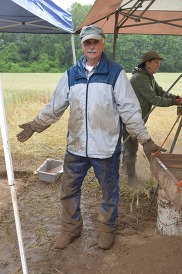
Annual Tyler Bastian Field Session
After 11 days in the field — some of it very rainy — the MHT archaeologists have started processing the artifacts discovered during the Annual Tyler Bastian Field Session in Maryland Archaeology. Staff and 155 volunteers persevered through rock-hard dirt and weather cancellations to excavate approximately 11 new units, sift for artifacts, and record finds. Work included the partial excavation of the brick-and-daub feature and surrounding area, testing of a potential cellar feature, and reaching the bottom of the shell-lined feature. Artifacts as large as the barrel hoops and as small as straight pins were recovered from all units, including the second half of an artifact recovered last year that continues to puzzle us. While some of the artifacts were washed in the field lab, the remaining artifacts will be washed in the lab at Crownsville this summer, followed by cataloguing of the entire collection. Volunteers interested in assisting with this work can reach out directly to Dr. Zac Singer at Zachary.singer@maryland.gov.
|
 Mystery bone- or wood-carved artifact
Announcing the FY26 Museum Assistance Program Grants!
Documenting 35 years of Marcia Miller: Looking back at her career at the Maryland Historical Trust
Documenting Aquasco’s African American Heritage by Daria Gasparini, Architectural Historian with Robinson and Associates (Guest Blog)

Reach Out!
There are many ways you can learn more about MHT, its programs, and the work it does. The latest news is updated regularly on our website. You can "like" and "follow" us on Facebook, Instagram, and YouTube or sign up for our e-blasts to have our quarterly newsletters and other preservation news delivered straight to your inbox! If you are interested in joining the team at MHT, check the most recent job listings.
|
|