Maryland State Fire Marshal urges all Marylanders to use caution when purchasing Smoke Alarms and Carbon Monoxide Detectors
State
Fire Marshal Brian S. Geraci reminds everyone of the concerns when purchasing
life safety devices, for instance, smoke alarms and carbon monoxide (CO)
alarms. “It is imperative to be sure the
devices are properly tested by an authorized testing laboratory”,
stated Geraci. Smoke alarms and CO alarm
products sold in the United States are required to be tested in
accordance with the Underwriters Laboratories (UL) 217 and 2034 standards. Manufacturers are required to submit these
life saving devices to approved testing laboratories, such as, UL or
Intertek/ETL for testing and review. Approved
laboratories test these devices to the industry-accepted standard. When devices
are not tested to this standard, they may not accurately detect the presence of
smoke and fire in the appropriate time and thusly not allow occupants to escape
the effects of fire or a carbon monoxide incident.
For
example, online sales of these life saving devices becomes a concern as the
sale of unapproved devices have been located on website retailers like
Amazon.com. The Office of the State Fire
Marshal has been in contact with representatives from Amazon.com to address the
importance of vetting electronic devices and appliances to ensure they are only
selling approved products. “The
safety of the consumer is paramount and our primary concern”, stated
Geraci.
The
National Association of State Fire Marshals (NASFM), an association whose
principal membership comprises the senior fire officials in the
United States and
their top deputies, is asking the country's largest online retailer to stop the
sale of smoke alarms that are not tested to nationally-recognized standards and
which may not comply with applicable building codes in many states and
municipalities. NASFM is also asking the Consumer Product Safety
Commission (CPSC) to take action to ensure consumers are protected and
purchasing safe products. In question,
are smoke alarms that do not carry the testing labels from a Nationally
Recognized Third Party Testing Laboratory such as Underwriter Laboratories (UL)
or Intertek/ETL – the two largest independent safety testing companies for
electrical products. Products with these marks are evidence that the
smoke alarm has been independently tested and complies with UL 217, Standard
for Smoke Alarms, the industry-accepted standard for smoke alarms.
“Perhaps
no other items sold to consumers today play a more critical role in protecting
their families against fire than smoke alarms,” said NASFM President Butch
Browning, who also serves as the Louisiana State Fire
Marshal. “Consumers can buy products bearing trusted third party laboratory
marks with confidence, knowing that they have been subjected to the prescribed
review process and can expect their smoke alarms to perform as promised when
needed. Often, that performance can mean the difference between life and
death. We are asking the CPSC to
investigate this matter and urge Amazon and other online retailers to stop
selling smoke alarms and other fire safety products that do not carry the UL or
ETL marks, or marks from another third party that has tested the alarms to the
UL 217 standard,” he added. “We
are also asking that retailers review their smoke alarm products and remove any
non-listed products from their websites immediately.”
NASFM identified multiple smoke alarm brands lacking
third party testing laboratory marks on Amazon.com including: X-Sense, Arikon
and Bovon.
Safety tips and
best practices:
·
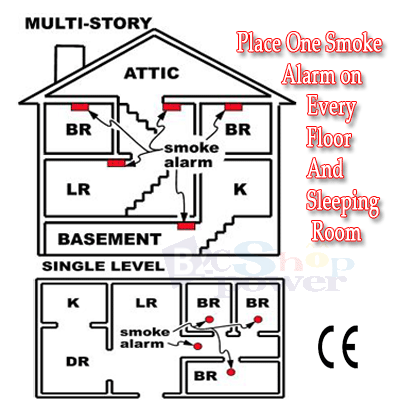
Install at least one smoke alarm on every
level of the home, including the basement. For best protection, smoke alarms
should be installed inside and outside sleeping rooms. Make sure everyone can
hear the alarm, knows what it sounds like and what to do when it activates.
. Keeping bedroom doors closed while sleeping will help prevent smoke and toxic gases from entering the room, allowing more time for the occupant(s) to escape or be rescued.
·
People who may be hard-of-hearing or deaf can
use specialty alarms. These alarms have lower decibel 520 mhz alarms, lights
and/or bed shakers.
·
Install photoelectric smoke alarms near the
kitchen to prevent nuisance alarms. Generally, the device should be a minimum of
10 feet from a cooking appliance.
·
For the best protection, equip your home with
a combination of ionization and photoelectric smoke alarms or dual-sensor
alarms.
·
Smoke alarms with non-replaceable 10 year long-life
batteries are available and are designed to remain effective for up to 10
years. These devices are now required
where battery-only devices are in use in the State of Maryland. If the alarm chirps on these units, warning
that the battery is low, replace the entire smoke alarm right away.
·
For smoke alarms with any other type of battery,
replace batteries at least once a year (preferably twice a year during daylight
saving time). If the alarm chirps, replace only the battery.
·
Remember, even alarms that are hard-wired into
your home electrical system need to have their battery maintained in case of an
electrical power outage.
·
Follow the manufacturer’s instructions for
cleaning to keep smoke and CO alarms working properly. The instructions are
included in the package or can be found on the internet.
·
Test alarms once a month using the test button.
All smoke and CO alarms should be replaced every ten years to ensure the
earliest notification in the event an incident occurs.
·
Devise a fire escape plan with two ways out of
every room and a designate an outside meeting place. Share and practice the plan with all who live
in the home, including children. Be sure
guests are aware of the plan as well.
. Ensure everyone is aware of the importance of closing doors as you leave individual rooms and the home.
·
When a smoke alarm sounds, get out of the home
immediately and go to your pre-planned outside meeting place to call 911.
The
Office of the State Fire Marshal is an agency of the Department of
State Police dedicated to helping protect citizens from fire and
explosion through a comprehensive program of education,
inspection, investigation and fire protection engineering. For more
information on fire safety call 1-800-525-3124, log onto our website at: Maryland State Fire Marshal and/or our Facebook Page.
|