|
Recreational Release Catch Card Project
Recreational fisheries data collection is not possible without the cooperation of anglers.
When you return from your saltwater fishing trip at public access sites around the state, you may be approached by a field interviewer with the Access Point Angler Intercept Survey (APAIS). During the voluntary survey, you’ll be asked for information about your fishing trip as well as about any fish you caught that day.
While the interviewers can see and measure fish harvested, it’s important for fisheries stock assessments and management to also have information on the fish released, including the depth at which they were released and their lengths.
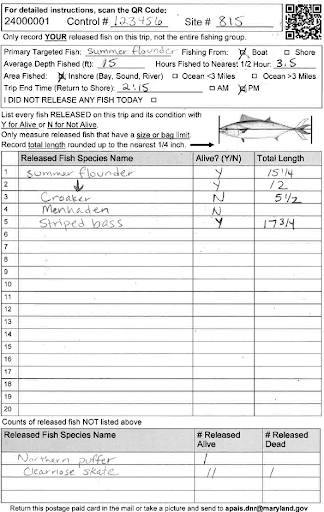
Maryland is one of 8 states on the Atlantic coast conducting a state-led pilot project this year to collect additional information on released fish using a catch card. At some of our APAIS interview assignments, we’ll be handing out a catch card (left) to private boat and shore anglers before they start their fishing trip. In addition to information about your trip, you will be asked to record every fish you release on the catch card and to measure the total length of every fish released, rounded up to the nearest quarter inch, that has either a size or bag limit. Cards need to be filled out for the trip you take that day and should only include the fish that you personally released.
You can either mail back the pre-paid postage card to MD DNR or take a picture of the card and email it to us using the email address listed on the bottom of the card. The information about released fish on the catch card that you fill out will be examined to determine if this type of information could be helpful to fisheries management in the future.
|
Note: This released fish catch card does not replace the Highly Migratory Species (HMS) catch card that is required when recreationally landing bluefin tuna, swordfishes, billfishes and sharks in Maryland.
|