Mayor Scott and Council President Cohen Announce New Agency to Serve as Third Branch of Public Safety and Emergency Services in Baltimore City
Legislation to Establish the Department of Neighborhood Safety (DNS) Will Codify MONSE’s Violence Prevention Work and Expand the City’s Alternative Response Ecosystem
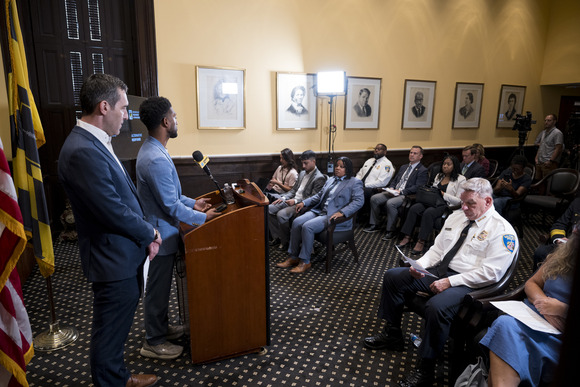 BALTIMORE, MD (Monday, September 14, 2026) – Today, Mayor Brandon M. Scott and Council President Zeke Cohen announced legislation to establish a new agency which will serve as the third branch of public safety in Baltimore City. The Department of Neighborhood Safety (DNS) will operate alongside the Baltimore City Fire Department (BCFD)/Emergency Medical Services (EMS) and the Baltimore Police Department (BPD).
Over the past five years, the City of Baltimore has made historic progress on public safety, thanks to close partnership between the Baltimore Police Department, law enforcement partners, the Mayor’s Office of Neighborhood Safety and Engagement (MONSE), prosecutors, Baltimore’s community violence intervention ecosystem, and residents. Homicides and nonfatal shootings have fallen by 60% over the past five years, with Baltimore’s homicide reductions significantly outpacing national averages. The city recorded 133 homicides last year, the fewest in roughly 50 years. Nonfatal shootings also declined 24% in 2025.
The creation of the Department of Neighborhood Safety will codify the critical work of MONSE and Baltimore’s existing community safety programming. MONSE’s staff, work, and mission will remain unchanged as part of this broader, coordinated, and sustainable approach to neighborhood safety.
Additionally, as part of this significant expansion of Baltimore’s public safety infrastructure, DNS will establish a formal, coordinated alternative response system, focused specifically on response to nonviolent emergency calls.
“The Department of Neighborhood Safety represents the future of public safety in Baltimore,” said Mayor Brandon M. Scott. “It codifies the work of MONSE, which will continue unchanged under the new banner of DNS, and will create a new, comprehensive alternative response system to ensure that when residents call 911, they receive a response that meets their needs. Building on years of work—including 911 diversion pilot programs—we are formally establishing this third branch of our public safety and emergency services to strengthen our response capacity, continue the critical work of MONSE and our community partners, and sustain the historic public safety progress we've made together with our residents. I am grateful to Council President Zeke Cohen, our state and federal partners, and all of the individuals who have worked together to make this announcement possible.”
“After years of historic declines in violent crime, we know that neighborhood safety is about more than just punitive measures. It requires addressing trauma and investing in our residents' well-being,” said Council President Zeke Cohen. “Police officers should be primarily focused on reducing violent crime, not solving mental health crises. I was proud to pass the Healing City Act in 2020, which made Baltimore the first city in America to legislate Trauma Responsive Care. The Department of Neighborhood Safety will take this work to the next level by sending trained mental health professionals to answer calls our officers were never equipped to handle alone. I am grateful for Mayor Scott’s partnership in our shared effort to build this agency and make Baltimore a safer and healthier city for all.”
When passed, the legislation introduced today will formally establish the agency and outline a timeline for its implementation. The Mayor’s 2027 Fiscal Year budget allocates more than $16 million to support the establishment of DNS, including $12.4 million to replace the outdated CAD system, supplemented by $8 million in State funding; $3.4 million in Opioid Restitution Fund dollars to support the initial planning phase; and $1 million in federal funds to expand alternative response team capability.
MONSE and Community Violence Intervention Ecosystem
The Mayor's Office of Neighborhood Safety and Engagement has been a leading force behind the strategies that have brought homicide rates in Baltimore to record lows. The creation of the Department of Neighborhood Safety will solidify MONSE’s work as a core function of the City of Baltimore’s public safety apparatus. Baltimore is positioned to pursue expansion of alternative response infrastructure in large part because of MONSE’s success in addressing violence as a public health issue, laying the groundwork to successfully reshape Baltimore’s approach to public safety.
Existing MONSE programs will continue without interruption under the DNS banner, both during the initial establishment of the new agency and once it is fully operational. MONSE staff will maintain their current reporting structure, with no significant changes to day-to-day workflow anticipated at this time.
Alternative Response
Per LEAP (Law Enforcement Action Partnership), each year, approximately 22,000 calls are made to 911 within Baltimore City which could be best served by a variety of alternative responders, such as mental health counselors and social workers. These include calls for a range of non-violent offenses such as public nuisances, welfare check-ins, and loitering. Roughly one third of these calls involve those experiencing homelessness.
As part of Baltimore’s first Comprehensive Violence Prevention Plan, Mayor Scott introduced a pilot 911 diversion program in 2021, which directs eligible 911 calls to a clinician within the 911 center, 988, or the city’s co-response team, comprised of a police officer and a licensed clinician.
The alternative response system housed within DNS will significantly expand and institutionalize the City’s diversion capacity, allowing rapid emergency resources to be deployed for critical situations that do not require BPD, BCFD or EMS response. DNS responders will be trained professionals, coequal with emergency responders within the Police and Fire Departments, and will be held to the same high standards for response time and service. Calls for DNS service will be treated as emergency responses, not simply referrals. DNS responders will be trained both in their area of expertise—which could include social work, recovery counseling, or similar social service fields—and as true emergency responders, able to effectively communicate with and work seamlessly alongside their peers within other public safety agencies.
Baltimore has a responsibility under the Consent Decree to establish comprehensive 911 behavioral health crisis diversion. DNS and its alternative response service, once fully implemented, will bring Baltimore closer than ever to finally meet that responsibility.
Additionally, DNS will oversee the creation and management of care continuity teams, comprised of peers and social workers, who will provide case management support following a resident’s engagement with the community-based response team. These teams will collaborate across City agencies to ensure residents who engage with response teams can access the full scope of available follow-up services relevant to their needs.
Next Steps
Today, September 14, 2026, Council President Zeke Cohen is introducing legislation on behalf of, and in partnership with, the Scott administration, which would establish the Department of Neighborhood Safety as an official third branch of public safety and emergency services in Baltimore City.
Alongside passage of this legislation, the City will conduct a nationwide search for an Executive Director to oversee the Department, who will go through a formal City Council confirmation process, and a Deputy Director to oversee the alternative response service within DNS. MONSE Director Stefanie Mavronis will remain in her role within the new agency, overseeing violence prevention and neighborhood engagement, and her staff’s work will continue uninterrupted during this process.
The incoming Executive Director and Deputy Director for Alternative Response will work alongside Director Mavronis and key partners, including fellow public safety agencies and service providers, to shape the structure of the agency. This process will include robust community engagement to ensure residents' voices are incorporated into the new agency and build understanding about the new agency’s role in Baltimore’s public safety sphere. Just as Baltimoreans helped to shape MONSE and both Comprehensive Violence Prevention Plans, they will have a central role in the creation and growth of DNS.
###
|