Dear Beyond Recycling Readers,
January’s storm was a good reminder of how climate change is reshaping winter in Baltimore. As the climate shifts, weather events are becoming harder to predict, and the recovery time is taking longer. As a result, preparedness today is less about knowing exactly what will happen and more about how well we can respond when conditions change.
Permaculture teaches us systems are more resilient when they don’t rely on a single solution or a single actor. Systemic diversity acts as an insurance policy against environmental instability, reducing vulnerability and preventing total system collapse. During this storm, that principle showed up in real time.
While the Department of Transportation (DOT) and Office of Emergency Management (OEM) lead the City’s snow response, Department of Public Works (DPW) crews stepped in with extended overtime to support citywide clearing efforts. DPW also took on alley clean-ups as the situation evolved, recognizing that this storm created environmental conditions outside of typical snow removal due to the heavy ice – snowcrete. As we continue to arrange alley clean-up for homes with rear-collection services, please ensure that your trash can and recycling bins are moved as close to your property lines as possible so that we can navigate through alleyways with trucks and machinery.
These kinds of on-the-ground decisions show what climate adaptation looks like in practice. When weather doesn’t follow the plan, resilience depends on the ability to adjust quickly — across agencies, neighborhoods, and households — often in real time.
Climate preparedness isn’t just about forecasts or infrastructure, it's about how systems and communities respond when conditions change. As climate impacts become more frequent, resilience will depend on a mix of citywide coordination, neighborhood-level action, and shared responsibility. We are deeply grateful to our frontline teams who continue to put in long hours to help Baltimore recover, and to our residents who stepped in to support their neighbors and communities.
The Office of Waste Diversion
Baltimore City Department of Public Works
 Help Baltimore Meet Its Recycling Goal
Report Your Recycling Data
Baltimore City is required to report how much recycling is collected each year to the Maryland Department of the Environment (MDE) under the Maryland Recycling Act (MRA). The City’s mandated goal is to recycle at least 35 percent of its waste.
We’re asking businesses, multi-family buildings, office buildings, and other entities that don’t receive recycling collection from DPW to report their recycling and waste totals (weights) for the year. Your participation helps Baltimore reach its recycling target and gives your facility a better understanding of its waste habits—an important first step in reducing waste.

Highlights from EcoLoop: From Scraps to Solutions
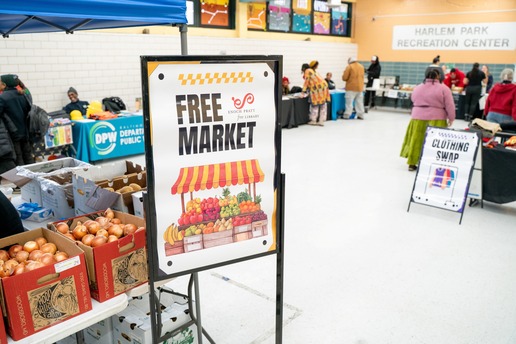
Hosted at Harlem Park Recreation Center in West Baltimore, the event was designed as a hands-on, family-friendly experience centered on access, joy, and practical learning, bringing together residents and local organizations.
Throughout the day, attendees were invited to learn, play, fix, taste, swap, and connect. Highlights included a Mending Clinic with Station North Tool Library, where volunteer menders worked alongside residents to repair clothing; a clothing swap that helped many items find new homes; two compost workshops; a cooking class; and smoothie bikes, where attendees made their own smoothies using rescued fruit and enjoyed them while hanging out at the event. A free food market also provided residents with a variety of fresh fruits and vegetables to take home.
Despite cold weather ahead of an impending storm, community members showed up, connected, and shared resources. We’re thankful to everyone who braved the cold to join us, it was a meaningful way to come together before the storm and a reminder that when we close the loop, everyone benefits. Be on the lookout for the next EcoLoop event, Spring 2026!
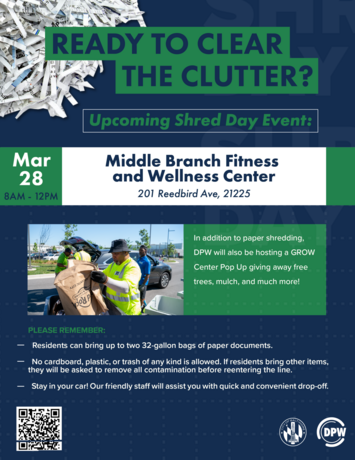
FREE Shred Event Returns This March – Don’t Miss It!
✅ Up to two 32-gallon bags of paper documents
❌ No cardboard, plastic, or trash—paper only!
Plus, don’t miss the GROW Center Pop-Up, where you can pick up free trees, mulch, and more!
Mark your calendar and spread the word!

Extra to Share? Keep It in the Community
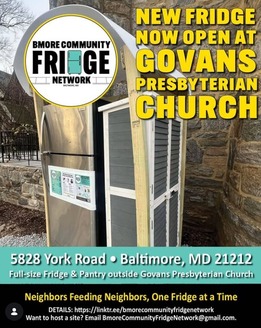
If you have extra shelf-stable food or unopened consumables you won’t use, consider sharing them through Baltimore’s Community Fridge Network. Community fridges are free, public refrigerators where neighbors can give and take what they need. Sharing excess items helps prevent waste while supporting food access across the city.
|

Can I compost flowers?
Yes! Flowers can be composted instead of thrown away. Fresh or dried flowers (no plastic wrap, foam, or containers) are accepted with food scraps at any Residential Recycling Center in the food scrap drop-off bins. Composting flowers keeps organic material out of the trash and puts it to good use.
 Do you have an upcoming sustainable event that you'd like to showcase? Share the details with us at recycling@baltimorecity.gov, and we'll feature it in our newsletter!
Events
Date: Tuesday, March 10, 2026
Time: 5:30 p.m. - 7:30 p.m.
Location: Leidy Atrium – 1301 W. Mt Royal
About: Sewists, artists, and crafters can bring unwanted sewing/fiber art/craft materials and leave with new materials at no cost. Find out more info here.
Date: Sunday, March 15, 2026
Time: Step off is at 2:00 p.m.
Date: Saturday, March 28, 2026
Time: 8:00 a.m. - 12:00 p.m.
Location: Middle Branch Fitness and Wellness Center - 201 Reedbird Ave. Baltimore, MD 21225
Job Opportunities with the Department of Public Works
Job Opportunities with Baltimore City Recreation and Parks
Job Opportunities with the State of Maryland
 Daylight saving time begins, Sunday, March 8, 2026. Make sure to turn your clocks forward one hour.
For all inquiries, residents should call 311.
|