Planning News
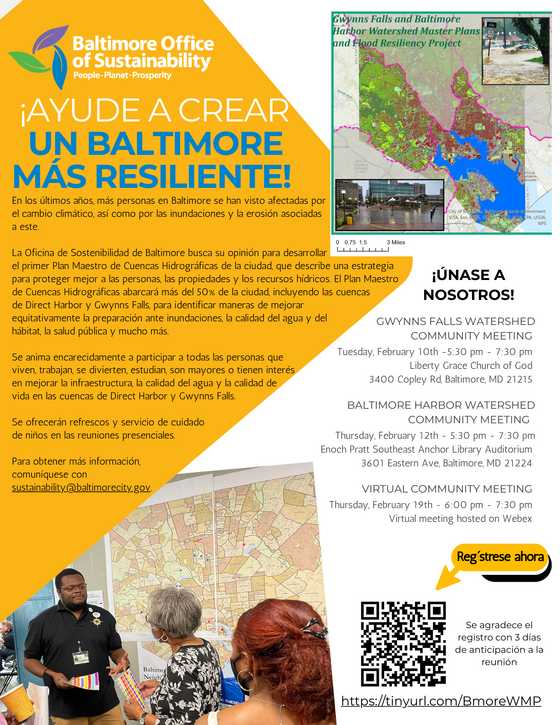
Office of Sustainability Hosting Community Meetings for Watershed Master Plan
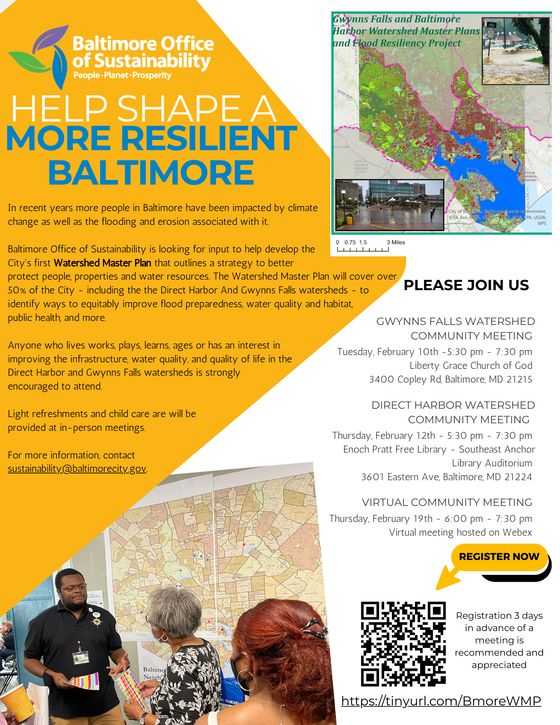 The Baltimore Department of Planning’s Office of Sustainability is developing Baltimore’s first-ever Watershed Master Plan to guide land use, infrastructure investments, and community partnerships that reduce flooding and strengthen neighborhoods. Public input will help inform strategies that improve flood preparedness citywide, enhance water quality and habitat, support public health, and advance equitable flood risk management. The plan may also increase Baltimore’s FEMA Community Rating, potentially lowering flood insurance costs for residents.
Upcoming Community Meetings:
• Gwynns Falls Watershed – Feb 10
• Direct Harbor Watershed – Feb 12
• Virtual Meeting (Webex) – Feb 19
All meetings run from 6:00 to 7:30 PM (doors open at 5:30 PM for in-person events)
RSVP required at least 3 days in advance. To register, visit: https://tinyurl.com/BmoreWMP
Learn more about the Capital Improvement Program in New CIP 101 Sessions - March Session
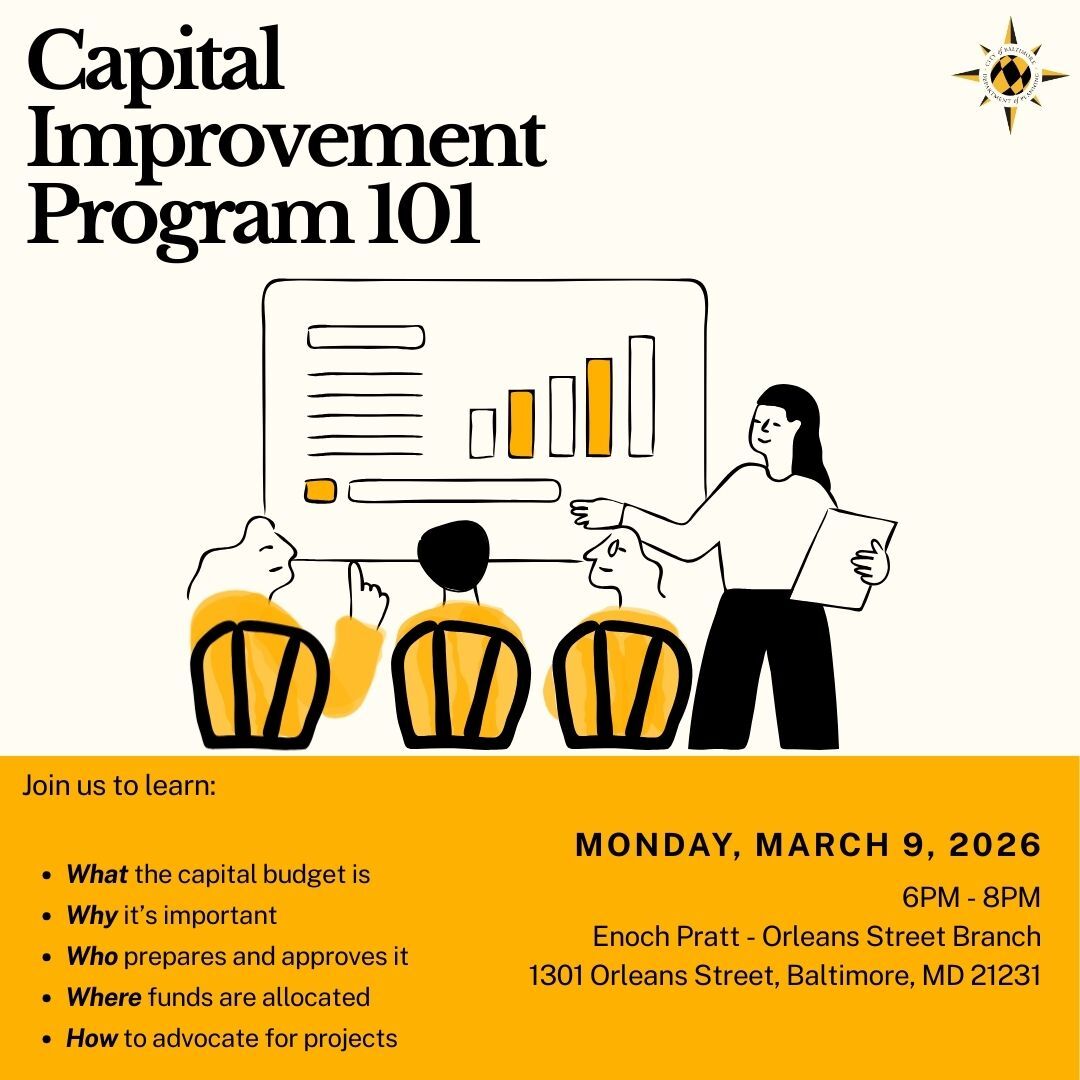
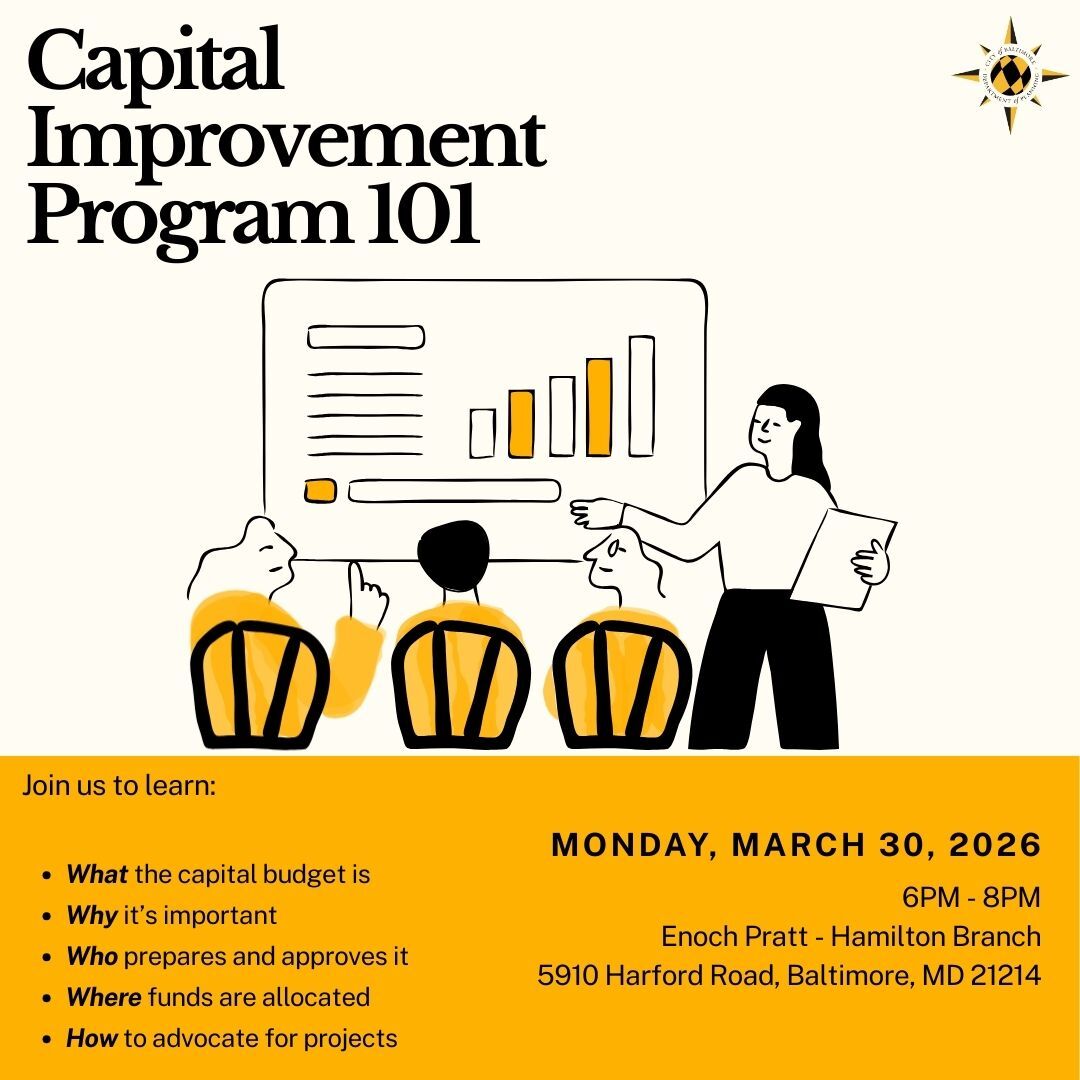
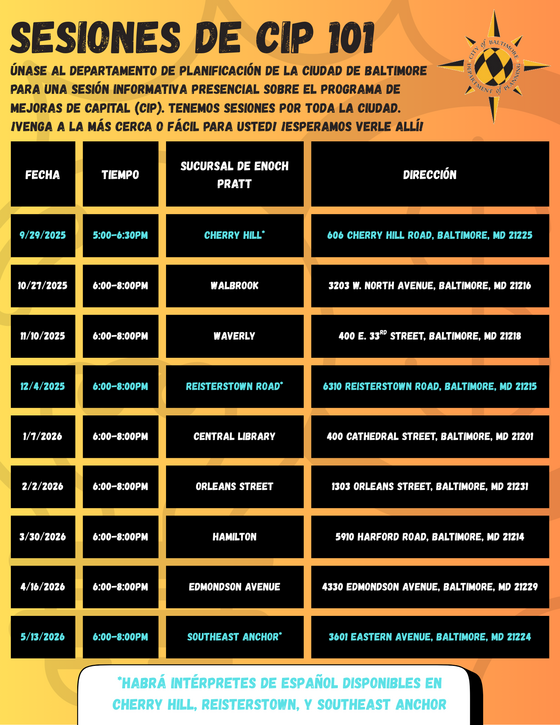
Join us to learn about the Capital Improvement Program (CIP) and its budget. Each year, the City plans spending on infrastructure and development, and we want to make sure residents know about this work, so that you all can help inform it moving forward. The CIP 101 sessions will cover the basics of what the CIP is, an overview of the budget, and allow time for questions. We are holding one session in each planning district and encourage you to attend!
There will be two sessions in March (one reschedule from February due to inclement weather).
-
Enoch Pratt - Orleans Street Branch (1301 Orleans St., Baltimore, MD 21231) on Monday, March 9, from 6:00PM - 8:00PM.
- Enoch Pratt - Hamilton Branch (5910 Harford Rd., Baltimore, MD 21214) on Monday, March 30, from 6:00PM - 8:00PM.
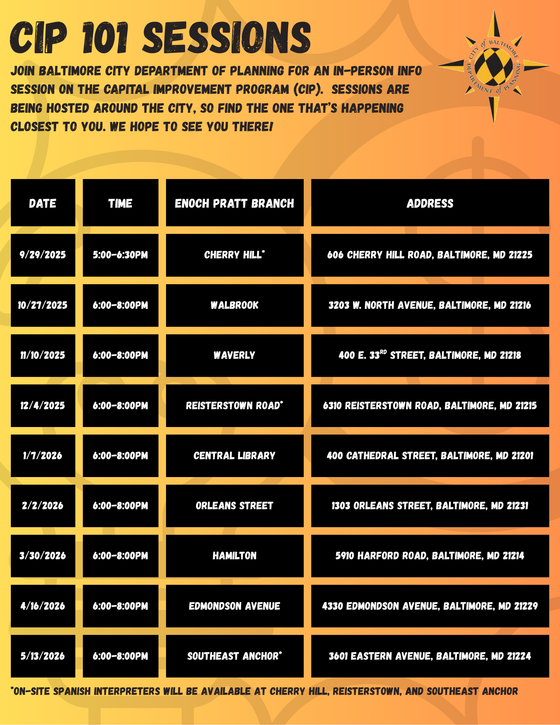
If you can't make the March sessions, take a look at the schedule below to find the session you can attend!
Data Gallery Public Meeting for Montebello INSPIRE Plan
 Join us on February 24, 2026 at Montebello Elementary/Middle School (2400 E. 32nd St, in the Cafeteria, entrance at the back of the building off the driveway farthest to the east) for a "Data Gallery" Public Meeting for the Montebello INSPIRE Plan. We look forward to your input!
This meeting will be open-house style events with an opportunity for community residents to look at maps and graphs about information about the area around the school and provide an opportunity for attendees to review the maps with City staff, think about whether the maps reflect their understanding of existing conditions, and what should be some of the recommendations included in the plan.
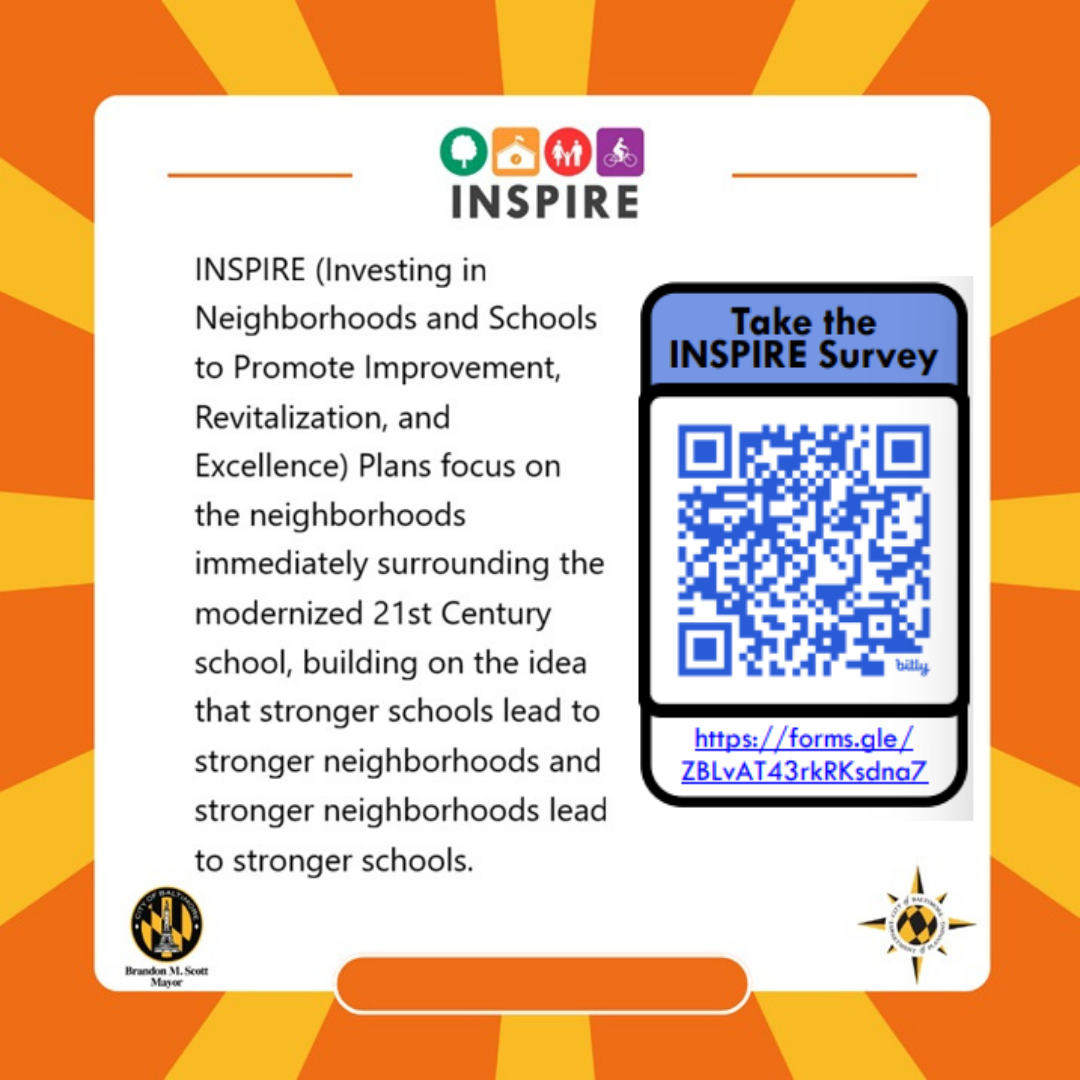
INSPIRE focuses on the neighborhoods surrounding each newly renovated “21st Century School” in order to develop a community plan that builds off of the investment in the schools. INSPIRE Plans include:
*Primary Walking Routes – City investments in sidewalks, crosswalks, and curb ramps on a number of streets to improve pedestrian access to the school.
*Recommendations Report – A list of recommendations to improve quality of life in the neighborhoods around the schools, some to be implemented by City agencies and others to be led by community organizations.
*Community Project – Capital funding of $100,000 per school for a community selected project(s) that benefit the residents and school community.
Howard Street Community Visioning Meeting
B'More Fresh DSS Tabling Events
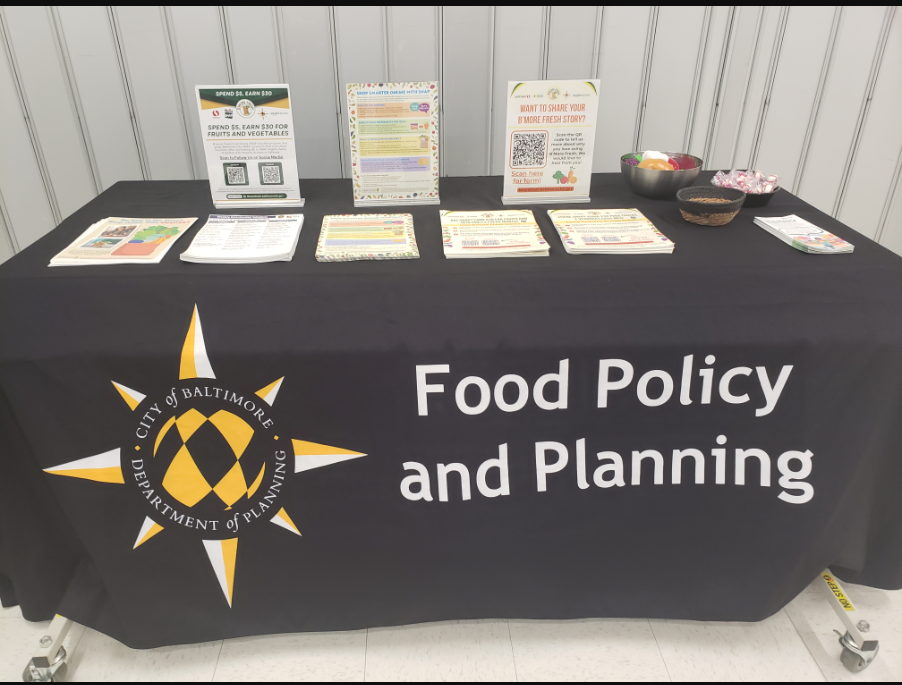 B’more Fresh will be tabling at Baltimore City Department of Social Services Offices on the following days in February:
Wednesday, February 11, Penn North DSS Office Visit
- Time: 10am - 3pm
- Location: 2500 Pennsylvania Ave, Baltimore, MD 21217
Friday, February 20, Dunbar-Orangeville Center DSS Office Visit
- Time: 10am - 3pm
- Location: 2919 E. Biddle St, Baltimore, MD 21213
We are looking forward to continuing to connect with Baltimore City residents through these office visits!
Free Lecture from the Baltimore City Historical Society on the Legacy of Trailblazing African American Attorneys of Baltimore City
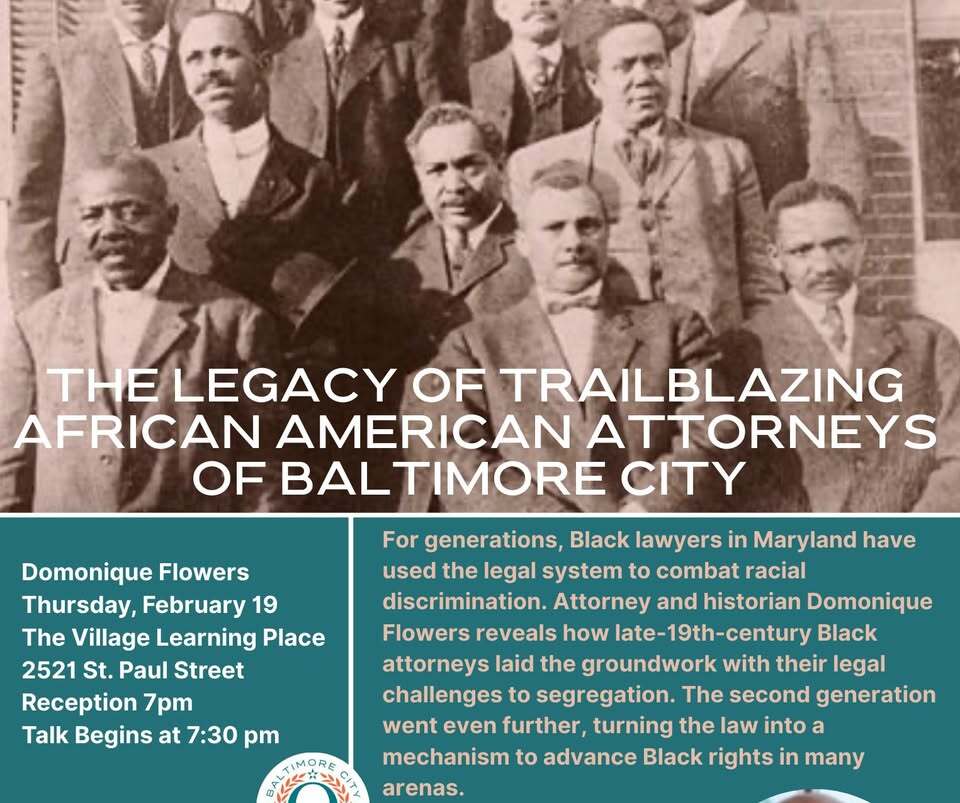 Date: February 19, 2026
Time: 7 pm - 8:30 pm (Reception at 7 pm, lecture at 7:30 pm)
Where: Village Learning Place, 2521 St. Paul Street
Register here
Join the Baltimore City Historical Society for a free in-person lecture on the "The Legacy of Trailblazing African American Attorneys of Baltimore City" presented by Domonique Flowers. For generations, Black lawyers in Maryland have used the legal system to combat racial discrimination. Attorney and historian Domonique Flowers reveals how late-19th-century Black attorneys laid the groundwork with their legal challenges to segregation. The second generation went even further, turning the law into a mechanism to advance Black rights in many arenas. Domonique Flowers is an attorney whose experience spans the public, private, and nonprofit sectors.
Baltimore National Heritage Area Offering a Free Virtual "Hands on History" Tour of the Life and Legacy of Henry Harden
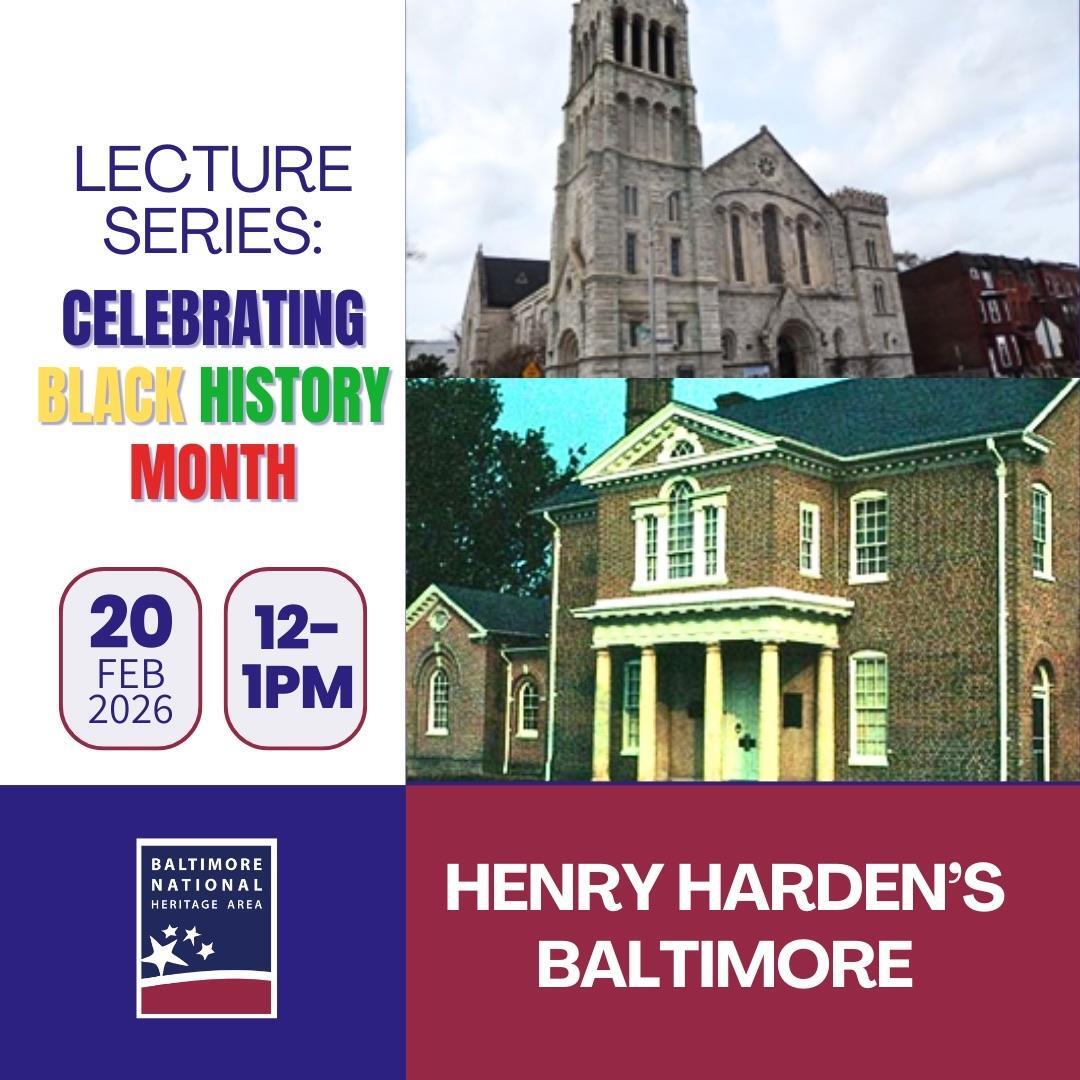 Date: February 20, 2026
Time: 12:00 PM – 1:00 PM
Where: Virtual
Register through Eventbrite
Join the Baltimore National Heritage Area for a free virtual "Hands on History" tour of the life and legacy of Henry Harden. A founding leader of the African Methodist Episcopal Church, Harden’s journey from enslavement to freedom is a pivotal—yet often untold—chapter of Baltimore’s history.
Researcher Teresa S. Moyer will use archival maps and historic accounts to trace the places that defined Harden’s story and the broader Black community in the 18th and 19th centuries.
As we observe Black History Month, the Baltimore City Planning Department invites you to look beyond the textbooks and into the very streets, rowhomes, and public squares that define our city. In Baltimore, Black history isn't just a chapter in a book—it’s the foundation of our urban fabric.
From the jazz echoes of Pennsylvania Avenue to the organizing power of Marble Hill, African American history is etched into the architecture and geography of every neighborhood. This month, we reflect on how the past informs our work in creating a more equitable and vibrant future for all Baltimoreans.
Preserving the "Soul" of the City
Our Commission for Historical and Architectural Preservation (CHAP) works year-round to ensure that the landmarks of Black excellence are protected. These aren't just old buildings; they are monuments to resilience.
-
The Black Arts & Entertainment District: Once the "Great Black Way," Pennsylvania Avenue remains a focal point for cultural planning and economic revitalization.
-
Old West Baltimore: Home to some of the city's most significant historic districts, this area served as the epicenter for the Civil Rights movement in Maryland beginning in the 1800s.
-
Morgan State University: Designated as a National Treasure by the National Trust for Historic Preservation, this HBCU continues to be a cornerstone of educational and architectural significance in Northeast Baltimore.
Notable African American Historic Districts
Baltimore is proud to host several districts specifically recognized for their contributions to Black heritage and culture:
| District Name |
Key Significance |
| Upton's Marble Hill |
Home to icons like Juanita Jackson, Mitchell and Clarence Mitchell Jr., and institutions such as Bethel A.M.E. Church and Union Baptist Church. |
| Sharp-Leadenhall |
One of the oldest African American communities in the city, dating back to the 1700s. |
| Sarah Ann Street |
CHAP's newest district, this is a block of modest alley houses in Poppleton that has been a Black enclave since the 1870s. |
| Mount Vernon (Select Sites) |
Historically significant for the Black professionals who broke barriers in the city's core. |
Planning with Equity in Mind
We must also acknowledge that urban planning has not always been a friend to Black communities. Historical practices like redlining and "highway to nowhere" projects created structural barriers that we are still working to dismantle today.
"To plan for the future of Baltimore, we must be honest about its past. Equity isn't just a buzzword; it’s a commitment to ensuring that every zip code has the resources to thrive."
Our current initiatives—including neighborhood-specific revitalization plans—are designed to empower residents to take the lead in shaping their own environments. By centering Black voices in the planning process, we ensure that the "Charm" in Charm City is accessible to everyone.
Get Involved
History is being made every day in our neighborhoods. We encourage you to explore the rich heritage in your own backyard:
-
Visit: The Great Blacks in Wax Museum or the Reginald F. Lewis Museum.
-
Walk: Take a self-guided tour of the Pennsylvania Avenue Heritage Trail.
-
Engage: Join your local neighborhood association meeting to help shape the next chapter of Baltimore’s story.
.
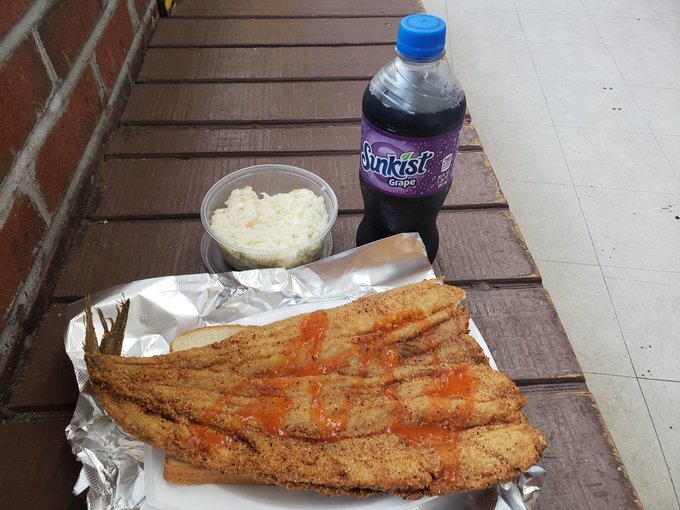
Baltimore Style Lake Trout
Photo courtesy of @soulfoodscholar on X.
There is no main dish more iconic to the city’s Black history than Lake Trout.
Despite the name, it is neither trout nor from a lake—it is Atlantic Whiting, a saltwater fish. For over a century, Lake Trout has been a staple of Black-owned carryouts and markets (like Lexington Market). It gained legendary status through spots like The Roost, where Doris Williams served lines of people that stretched around the block for decades. It is a "working person's" meal: affordable, high in protein, and deeply communal.
Baltimore-Style Lake Trout
Historically, the fish is served "bone-in" to keep the meat moist, and it is always eaten with plain white bread to soak up the hot sauce.
Prep time: 15 mins | Cook time: 10 mins | Serves: 4
Ingredients
-
2 lbs Atlantic Whiting fillets (Headless, tail-on, bone-in is traditional, but boneless works too)
-
1 cup yellow cornmeal (Fine ground)
-
1/2 cup all-purpose flour
-
2 tbsp Old Bay Seasoning (The Baltimore essential)
-
1 tsp cayenne pepper (Or "Fish Pepper" powder if you can find it)
-
1 tsp garlic powder
-
Vegetable or Peanut oil (For frying)
-
6 slices of thick white bread (For serving)
-
Hot sauce (To taste)
Instructions
-
Prep the Fish: Rinse the whiting and pat it very dry with paper towels. If using bone-in fish, ensure any scales are removed.
-
The Dredge: In a shallow bowl or a large brown paper bag, combine the cornmeal, flour, Old Bay, cayenne, and garlic powder. Shake well to mix.
-
Coat: Working in batches, toss the fish in the cornmeal mixture until it is fully and evenly coated. Press the breading into the fish so it sticks.
-
The Fry: Heat about 1 inch of oil in a heavy cast-iron skillet to 180°C (350°F).
-
Cook: Carefully lay the fish into the hot oil. Fry for about 3–5 minutes per side until the crust is a deep golden brown and the fish flakes easily.
-
Drain: Remove the fish and let it rest on a wire rack or paper towels for a minute.
-
Serve: Place 2–3 pieces of fish directly on top of 2 slices of white bread. Douse generously with hot sauce and extra Old Bay.
The "Plate" Tradition: In Baltimore's history, the white bread wasn't just a side; it served as the "plate" for the fish, absorbing the steam and spicy oil, making the bread the most flavorful part of the meal at the end.
|