Planning News
B'More Fresh December Tabling Schedule

In December, the Food Policy and Planning program, B’more Fresh, will be tabling at a few events throughout Baltimore. The focus of these events will be on sharing about food resources that are more crucial this time of year than ever. We look forward to continuing to connect with Baltimore City residents while sharing how to access food easier and more affordably.
B’more Fresh’s December tabling schedule is below:
Saturday, December 6, Christmas Gift Registration and Resource Event
-
Host: Bea Gaddy Family Center
-
Location: 2324 McElderry St, Baltimore, MD 21205
Monday, December 8, Perkins Homes Quarterly Meeting
-
Hosts: Housing Authority of Baltimore City (HABC) and Urban Strategies Inc.
-
Location: 210 S Caroline St, Baltimore, MD 21231
Friday, December 12, Hilton Heights Center Visit
-
Host: Baltimore City Department of Social Services
-
Location: 500 N Hilton St, Baltimore, MD 21229
Friday, December 19, Office of Workforce Development Visit
-
Host: Baltimore City Department of Social Services
-
Location: 1510 Guilford Ave, Baltimore, MD 21202
Environmental Offset Grants Program NOW OPEN!!
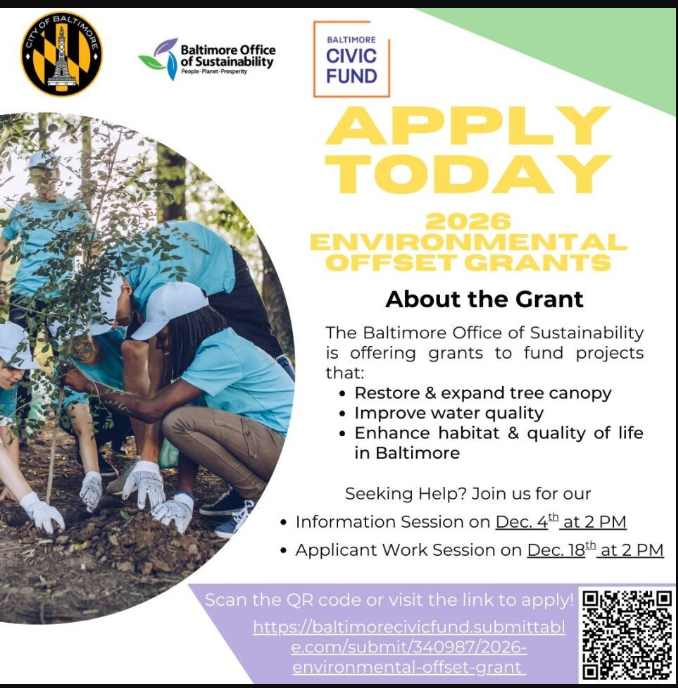 The Office of Sustainability's 2026 Environmental Offset Grants Program is now open! To learn more about the grants, please visit the Baltimore Civic Fund's website: https://www.baltimorecivicfund.org/environmental-offset-grant-program. If you have questions about the grants or the application process, check out either of the two sessions below. Both sessions are great opportunities to ask questions directly to our grants team.
Register for the Dec. 4 Info Session:
https://ow.ly/LAAu50XypR4
Register for the Dec. 18 Application Work Session:
https://ow.ly/HL6X50XypR5
We look forward to supporting Baltimore’s organizations in developing projects that restore natural systems, expand tree canopy, protect habitat, and advance environmental justice in our city!
Learn more about the Capital Improvement Program in New CIP 101 Sessions - January Session
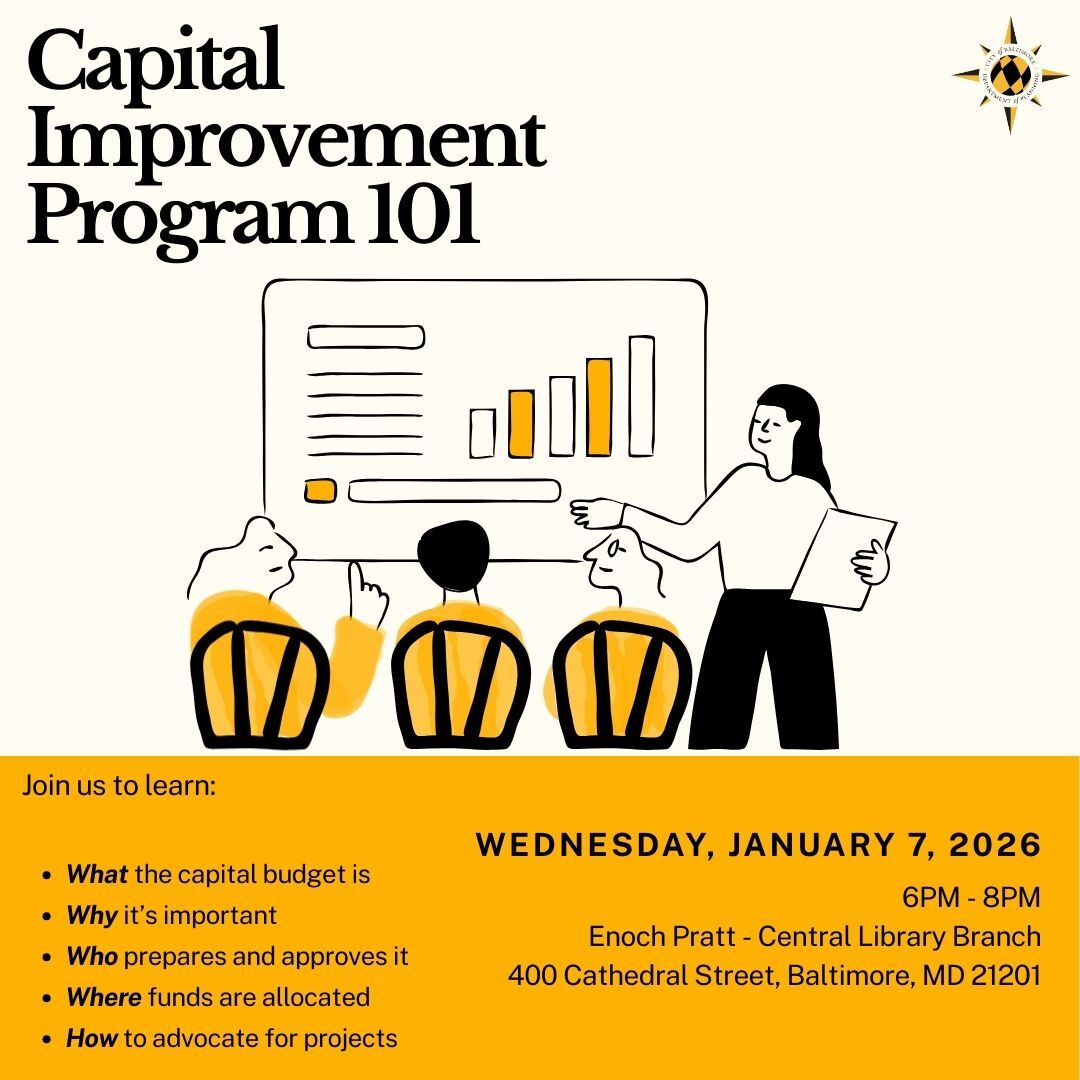
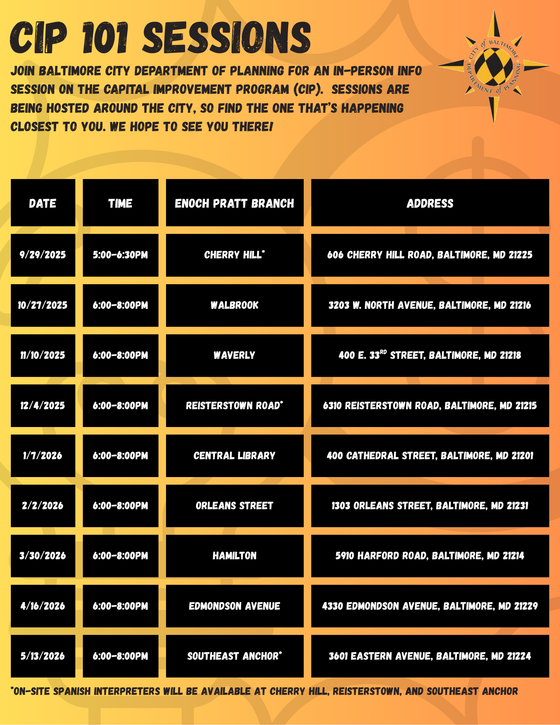
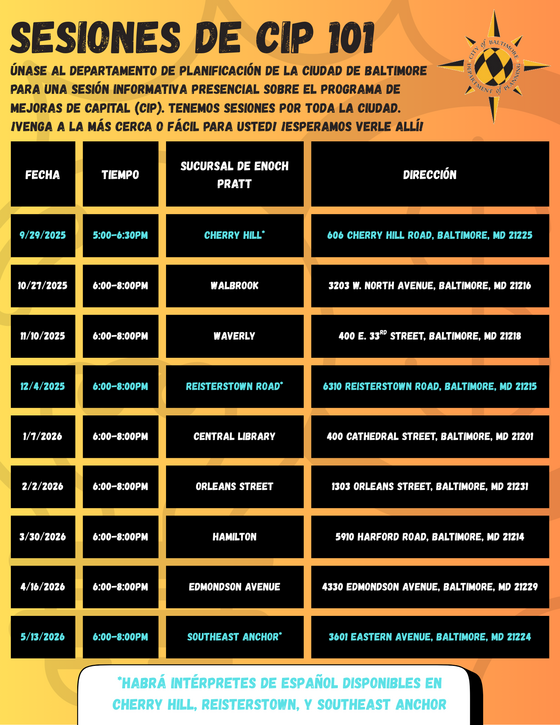
Join us to learn about the Capital Improvement Program (CIP) and its budget. Each year, the City plans spending on infrastructure and development, and we want to make sure residents know about this work, so that you all can help inform it moving forward. The CIP 101 sessions will cover the basics of what the CIP is, an overview of the budget, and allow time for questions. We are holding one session in each planning district and encourage you to attend! The January session will be held at the Enoch Pratt - Central Library Branch (400 Cathedral St, Baltimore, MD 21201) on Wednesday, January 7th, from 6:00PM - 8:00PM.
If you can't make the January session, take a look at the schedule below to find the session you can attend!
Agency CIP Presentation Schedule Available Now
The process to develop the Capital Improvement Program starts with agencies, so one of the best ways to get involved is to engage directly with agencies. This can take many forms. Agencies frequently engage the public in planning processes to identify priorities. Agencies also engage stakeholders through plans focused on particular neighborhoods, such as INSPIRE plans and LINCs plans.
In addition to engaging stakeholders through planning processes, agencies value input from residents about failing infrastructure, whether through 311 or direct outreach. Residents can also work directly with agency representatives on particular project ideas. Once agencies have submitted their capital requests there is an extensive process of public hearings related to the development of the capital budget. The Planning Commission, Board of Estimates, and City Council votes all include opportunity for public comment. Stakeholders are encouraged to attend and participate in these hearings. Stakeholders can also communicate support for a particular project or priority by sending a letter to the Planning Commission, care of the Director of Planning.
The process kicks off in the fall each year. See the table below for the schedule of agency presentations.
|
Date
|
Location
|
Event/Milestone
|
|
September 2025
|
N/A
|
FY2027-2032 Kickoff
|
|
December 2025
|
N/A
|
Agency requests published
|
|
January 8, 2026
|
417 E. Fayette St., 8th Floor
|
Agencies brief Planning Commission.
9:00 AM: Finance and Planning Overview
10:15 AM: Deprtment of General Services
11:30 AM: Department of Public Works (Solid Waste)
1:30 PM: Department of Public Works (Water, Wastewater, Stormwater)
2:45 PM: Baltimore City Information Technology (BCIT)
|
|
January 15, 2026
|
417 E. Fayette St., 8th Floor
|
Agencies brief Planning Commission.
10:00 AM: Baltimore Development Corporation
11:15 AM: Department of Transportation
1:15 PM: Department of Housing and Community Development
2:30 PM: Baltimore City Recreation and Parks
|
Resident Food Equity Advisor (RFEA) Kickoff
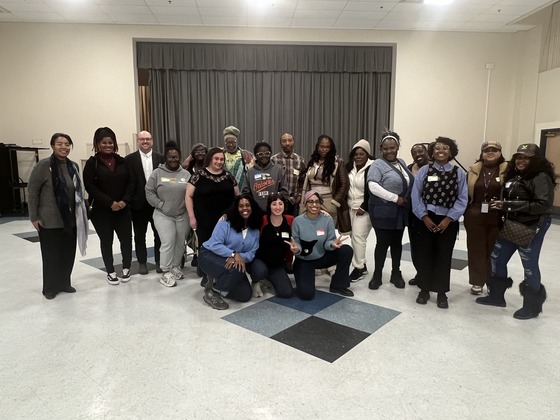 Our Food Policy and Planning Division was excited to launch the 5th cohort of Resident Food Equity Advisors (RFEA)!
RFEA is a paid, six-month program where Baltimore City residents collaborate with the Department of Planning to help shape future food policy and planning efforts. This year, in partnership with the Housing Authority of Baltimore City, they are working with 14 residents who were selected through an application and interview process.
They held their first meeting on November 19th, and are looking forward to working together to improve Baltimore City’s food system in meaningful ways.
For more information, you can visit https://planning.baltimorecity.gov/resident-food-equity-advisors
Celebrating the Legacy of Eric Holcomb: A CHAP Director's Retirement
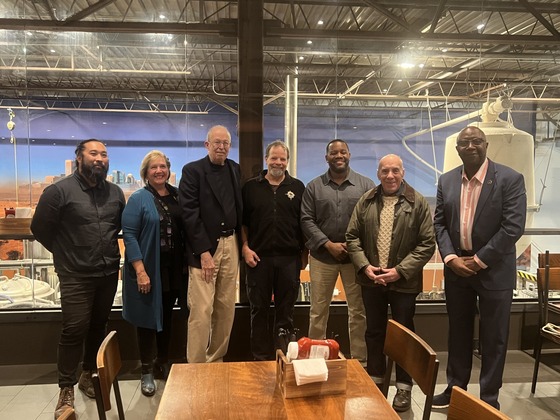 The Baltimore City preservation community recently gathered to honor former Commission for Historical and Architectural Preservation (CHAP) Director, Eric Holcomb, as he celebrated his retirement after years of dedicated service to the city.
The special celebration brought together Eric's family, friends, former colleagues, and current/former CHAP Commissioners to recognize his significant contributions to the preservation of Baltimore's rich architectural heritage.
A Champion for Preservation
During his tenure, Eric Holcomb was a steadfast advocate for Baltimore's historic districts and landmarks. His leadership helped guide CHAP's efforts in reviewing development projects, designating new historic properties, and ensuring that changes to the city's historic fabric were done responsibly and thoughtfully. He navigated complex preservation issues with a balance of expertise, diplomacy, and a deep commitment to the city's unique character.
Tributes and Well Wishes
Attendees shared heartfelt anecdotes and praised Eric's professionalism, collaborative spirit, and unwavering passion for history. Colleagues spoke highly of his mentorship and guidance, while Commissioners lauded his dedication to upholding CHAP's mission. The outpouring of gratitude underscored the positive impact Eric had on both the physical landscape and the professional community of Baltimore.
We wish Eric Holcomb a long, happy, and fulfilling retirement! His legacy will continue to shape how Baltimore values and protects its invaluable architectural history for generations to come.
The Black-Eyed Susan Initiative: Storytelling to Validate Baltimore’s Future
 |
The Black-Eyed Susan Initiative (BESI) is the Department of Planning’s strategic effort to publicly align the perspectives of young Baltimoreans with the Our Baltimore, Your Baltimore Comprehensive Plan. Recognizing that young adults (aged 18-30) are the critical future stakeholders, BESI uses a series of intimate, in-depth multimedia interviews to generate compelling content that validates the direction of the City’s planning goals. This initiative is the thought-child of Brooke Gibson, Morgan University Graduate and Communications & Engagement Fellow of the HBCU Emerging Leaders Fellowship.
Showcasing Alignment with City Pillars
The core interview questions are specifically designed to gather input that echoes the four major themes of the Comprehensive Plan—LIVE, EARN, PLAY, and LEARN:
-
Community & Culture (LIVE): Questions like "What does 'Community' mean to you as a Baltimore Native?" and "Are there parts of your community’s culture you’ve reinterested or made your own?" capture the community pride and social capital that reflect the Plan's objectives to strengthen neighborhoods.
-
Built Environment Vision (PLAY & LEARN): By asking, "What kind of public spaces do you want to see more of in Baltimore?" and "How has your neighborhood changed from when you were younger?", BESI gathers personal stories that underscore the need for quality of life improvements defined in the Plan.
-
Future City Development: The question, "Imagine Baltimore 10 years from now - what do you hope it looks like?", provides a powerful, future-oriented vision that demonstrates the real-world impact and aspirations tied to the Comprehensive Plan's mandate.
The BESI ensures that the Comprehensive Plan is not just a document, but a set of values supported by the city’s youth. Furthermore, each interview is published in conjunction with a spotlight on active initiatives, planning projects, and events that are currently shaping the interviewee's neighborhood. By centering their stories and connecting them to tangible action, the initiative champions the Plan’s call for a new era of Equitable Neighborhood Development.
Culture of Clean Challenge!!
Enter for your chance to win $500!!
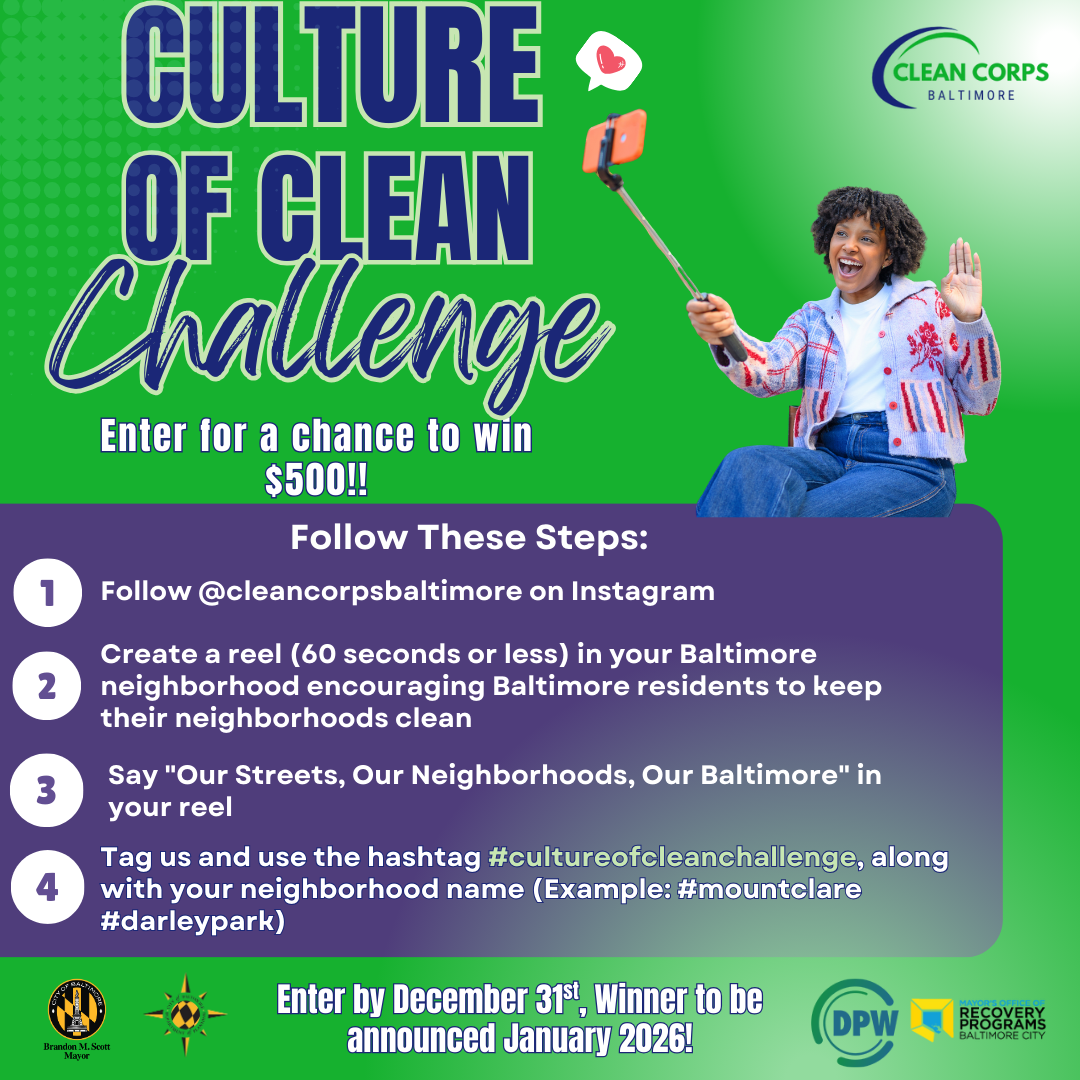
Clean Corps is pleased to introduce their Culture of Clean Challenge! Enter for a chance to win $500! If you’re passionate about living in a clean and beautiful neighborhood, this challenge might be for you. All you have to do to enter is follow these 4 steps:
- Follow @cleancorpsbaltimore
- Create a short reel (60 seconds or less) in your Baltimore neighborhood encouraging Baltimore residents to keep their neighborhood clean
- Say “Our streets, Our neighborhoods, Our Baltimore” in your reel.
- Tag us and use the hashtag #cultureofcleanchallenge, along with your neighborhood name (Example: #mountclare #darleypark)
Enter by December 31st! Winner will be announced in January 2026.
Planner Chat: Nick Chupein

1. What area of the city do you serve?
I wear a couple different hats within the Department of Planning’s Community Planning and Revitalization division. I am the community planner for the Central Southwest District, which covers 7 dynamic neighborhoods just west of downtown. I am also the City’s Greenway Trails Planner, where I work on implementing the Baltimore Greenway Trails Network initiative citywide, alongside folks from our sister agencies DOT and BCRP and the Mayor’s office. Additionally, because I have a background in architecture and construction, I sometimes help out the Land Use and Urban Design team with some of our design review processes.
2. How long have you been with DOP?
I started at DOP in summer of 2023, so I recently completed my second year and I still feel like I learn something new every day.
3. What inspired you to pursue a career in city planning?
I have been interested in geography and cities since I was a kid. During the pandemic, after spending several years launching and running a small construction business, I decided to pivot my career towards city planning and enrolled in the city and regional planning program at Morgan State. I had become frustrated with some of the processes and risks that are intrinsic in owning a business and trying to rehab property, and I wanted to think bigger than individual homes and focus on neighborhood improvement. Around that same time, during the protests after George Floyd was killed, I was also inspired to look at root causes of inequity and focus my work on community development. Planning was a natural choice to work at the neighborhood scale to make our city more livable, walkable, safe, healthy, and inviting.
4. What are your favorite ways to engage with the community?
The best part of the job is a site visit with residents and stakeholders to see an interesting historic or important community asset. I enjoy looking for opportunities to build upon a neighborhood’s strengths and plug gaps that need a creative approach through collaboration.
5. How do you promote equity as a City Planner?
One of the important roles of the community planning division is to try to increase access to information about polices and procedures. I take pride in talking to residents about planning, zoning, transportation, and development in plain language that folks can understand. If people are better educated about the system, they are better equipped to speak up and add their voices to the conversation.
6. What advice would you give anyone interested in becoming a City Planner?
The most important quality that makes a good planner is curiosity about your place and environment. Ask questions, such as
- “What makes a neighborhood great?”
- “What are the barriers to improving my community and who has the most to gain from investment?”
- “Who is already doing the work in service to their community?”
And then read as much as you can (local news, planning- and community-related books and journals, online discussion groups about urbanism, etc.) to try and answer these questions. Often, the answers lie at the intersection of equity, access, investment, and information. You don’t need a particular background to work in planning, we have folks on our team who come from the fields of design, history, activism, housing and construction, community organizing, and non-profit work.
7. What actions do you feel are important for residents to take to engage more with city planners and DOP?
Don’t be shy about reaching out to your community planner with questions. Most of us like nerding out over our area of focus and every conversation we have helps us to learn about the needs, concerns, and desires held by residents. The only way to solve problems is to talk about them, and each small interaction helps to inform a community-based vision that we try to support. Like some of the other district planners, I have a monthly newsletter that highlights some of the work and events going on in and around the Central Southwest district and I encourage anyone to join my mailing list to be better informed.
|
 |
As the year draws to a close and the crisp winter air settles over Charm City, the Baltimore City Department of Planning extends its warmest wishes to all our residents, partners, and stakeholders. December is a time for reflection, gratitude, and—most importantly—celebration.
Baltimore is a city rich in cultural diversity, and this month brings a beautiful array of traditions and holidays to our neighborhoods. Whether you celebrate Christmas, Hanukkah, Kwanzaa, or simply enjoy the festive atmosphere of the season and the promise of a New Year, we hope this time brings you peace, joy, and a strong sense of connection with your community.
Looking Back and Moving Forward: Planning Updates
At the Department of Planning, our mission is to create a more equitable, resilient, and thriving Baltimore for everyone. As we wrap up the year, we want to share a few highlights of the progress made and look ahead to the new year:
-
"Our Baltimore" Comprehensive Plan: We continue to ground our work in the vision set forth by the City's Comprehensive Plan. This document is our roadmap, ensuring that strategic investments, land use policies, and community planning efforts are aligned with the collective aspirations of all Baltimoreans.
-
Neighborhood Improvement Projects: We are proud of the progress made on several neighborhood plans and the continuing work of the INSPIRE program, which leverages school investments to drive community revitalization. These efforts are about creating safe, walkable, and opportunity-rich environments for our families.
-
Food Policy and Planning Division: Our FPP Division has seen over $212,000 in voucher redemptions for their B'More Fresh Program, and their Food Rx program was selected for a Milan Urban Food Policy Pact Special Mention Award in the Sustainable Diets and Nutrition category.
- Planning continues to convene its Planning Academy and can count nearly 500 alumni among its ranks. Alumni are serving on Planning Commission, City Council, and leading dynamic projects from Johnston Square and Baybrook to Harlem Park and Park Heights.
- Following several years of study, robust community engagement with over a dozen neighborhoods, and seven public hearings, the enabling legislation allowing for the creation of Conservation Districts was passed, with an effective date of September 2026. The creation of conservation districts will allow for the creation of historic districts with more limited design review requirements than local historic districts. Property owners in conservation districts will be eligible for the Historic Tax Credit for Historic Rehabilitations and Restorations (aka the CHAP Tax Credit).
Advancing Strategic Leadership
As we look toward the New Year, the Department of Planning is energized by the focused leadership of Director Tim Keane.
We are dedicated to solidifying the Department as the city’s planning expert, providing essential technical guidance, policy oversight, and a clear, forward-thinking vision for Baltimore’s physical development.
Director Keane's leadership will be concentrated on three critical areas:
- Curating regulations and development processes that most quickly enable the building we need in Baltimore,
- Planning and design at every scale, from the whole city to individual blocks, the public realm and public spaces, and
- Delivering on the community’s plans by implementing what is envisioned at every scale.
We look forward to working collaboratively with you to achieve these goals and shape a beautiful, prosperous future for Baltimore.
Celebrating All the Lights of the Season
December is a time when the many lights of Baltimore truly shine. We encourage you to safely enjoy the cultural activities and traditions taking place across the city:
-
Explore Local Markets: Check out local craft marketplaces and business districts to support our local entrepreneurs and find unique holiday gifts.
-
Enjoy the Festive City: Take advantage of the seasonal activities downtown and in your own neighborhood, which offer fun and community engagement for all ages.
-
Community Traditions: We encourage you to participate in and appreciate the variety of celebrations—Christmas, Hanukkah, Kwanzaa—that reflect the diverse tapestry of our city.
Please Note: City offices will observe holiday closures for Christmas Day and New Year’s Day. Please check the Baltimore City website for adjusted schedules for City services, including trash and recycling collection.
Our Commitment to You
The Department of Planning remains committed to a transparent, engaged, and equitable planning process. We value your input and partnership as we work together to build a future where every neighborhood in Baltimore can flourish.
From all of us at the Baltimore City Department of Planning, we wish you and yours a very safe, warm, and happy holiday season, and a prosperous New Year!
Cozy Comfort: Luxurious Dark Hot Chocolate
As the weather cools down and the holiday season draws near, there is no better way to find comfort than wrapping your hands around a steaming mug of hot chocolate. Forget the packets—this recipe uses real melted dark chocolate for a velvety, rich, and truly decadent experience. We've included simple instructions for a non-alcoholic treat, plus suggestions on how to easily turn it into a warming adult indulgence for those chilly evenings. Get ready to stir up some liquid bliss!
Ingredients
-
2 cups Milk (Whole milk or half-and-half recommended for richness)
-
3 oz Dark Chocolate (High-quality, 60-75% cacao, roughly chopped or chipped)
-
1 tbsp Unsweetened Cocoa Powder (To intensify the chocolate flavor)
-
1-2 tbsp Granulated Sugar (Adjust to your preferred sweetness)
-
1/2 tsp Vanilla Extract
-
A small pinch of Salt (To balance and enhance the chocolate)
Instructions
-
Warm the Base: In a small saucepan over medium heat, whisk together the milk, cocoa powder, sugar, and salt. Heat the mixture until it is hot and steaming, but do not allow it to boil.
-
Melt the Chocolate: Reduce the heat to low. Add the chopped dark chocolate to the saucepan. Whisk continuously until the chocolate is fully melted and the liquid is smooth, glossy, and slightly thick.
-
Finish: Remove the saucepan from the heat and stir in the vanilla extract.
-
Serve: Pour into mugs and garnish as desired (e.g., whipped cream, marshmallows).
Adult Option: Spiked Hot Chocolate
To make this a warming adult drink, add your preferred spirit or liqueur directly to each mug of hot cocoa.
Suggested Spiking (Per Serving)
| Spirit/Liqueur |
Quantity |
Flavor Notes |
| Peppermint Schnapps |
1 to 1.5 oz |
Creates a classic mint-chocolate flavor. |
| Kahlúa (Coffee Liqueur) |
1.5 to 2 oz |
Adds a pleasant, sophisticated mocha twist. |
| Dark Rum |
1.5 to 2 oz |
Provides depth and notes of caramel and molasses. |
| Baileys (Irish Cream) |
1.5 to 2 oz |
Adds extra creaminess with a hint of Irish whiskey. |
DOP December Birthdays!
|