New Orleans Mosquito, Termite and Rodent Control Board to Conduct Adult Mosquito Abatement Tonight
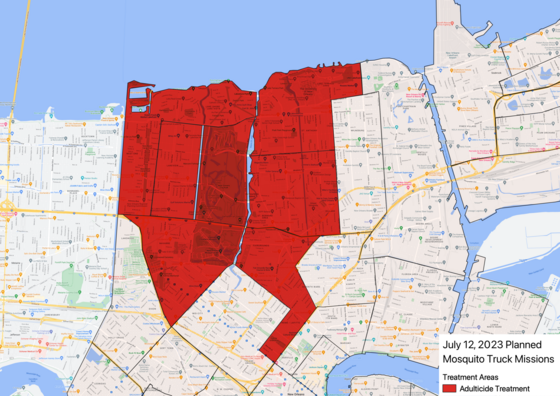
NEW ORLEANS — The New Orleans Mosquito, Termite and Rodent Control Board (NOMTRCB) will conduct mosquito abatement tonight. Treatments tonight will target adult Culex mosquitoes, the primary vectors of West Nile virus (WNV) in our region. Treatments will be conducted by truck from 8:15 p.m. to 12 a.m., weather permitting, in the following areas:
- Fairgrounds bounded by Esplanade Avenue, North Galvez Street, Canal Street, I-10, St. Bernard Avenue, North Broad Street and I-610
- Lakeview/West End/Lakeshore bounded by Lakeshore Drive, Bellaire Drive, I-610, Orleans Avenue and Beauregard Avenue
- City Park bounded by Marconi Drive, City Park Avenue, Wisner Boulevard and Allen Toussaint Boulevard
- Navarre/Mid-City bounded by I-610, I-10 and North Carrollton Avenue
- Fillmore/St. Anthony bounded by Lakeshore Drive, Bayou St. John, I-610, Elysian Fields Avenue, Leon C. Simon Drive and Franklin Avenue
West Nile and other mosquito-borne viruses are more active in the summer and early fall. Although no West Nile activity in mosquitoes or in people has been detected in Orleans Parish so far this year, positive mosquito pools and human cases have been detected in the state. While the majority of WNV infections are asymptomatic, the virus can cause serious symptoms, especially for those above 65 years old or in immunocompromised people.
The City of New Orleans has experienced several days of heavy rainfall in several areas of the parish. This can significantly increase mosquito populations by creating habitats for floodwater and container-breeding species. Mosquitoes can lay eggs in nearly anything that can hold water, such as tires, buckets, wheelbarrows, clogged gutters, unkept swimming pools, tarps (and other plastics), kiddie pools and trash cans. It takes only a few days for these mosquitoes to develop from eggs to adult mosquitoes. NOMTRCB asks residents to remain vigilant and to tip over or toss out any items that hold water to prevent mosquito breeding. In containers that cannot be removed, such as bird baths, sugar kettles, pools and ponds, NOMTRCB urges residents to drain and replace water weekly.
Residents should expect elevated mosquito activity in the next days and weeks with frequent summer storms and rainfall. NOMTRCB asks all residents to take 10 minutes a week when taking out their garbage to inspect their property for any potential mosquito breeding sites.
Protect Yourself
- Reduce mosquito exposure by limiting outdoor activities between dusk and dawn.
- Use air conditioning or sit in the air stream of a fan outdoors when possible.
- Make sure window and door screens are in good condition to prevent mosquitoes from getting inside the home.
- Use CDC-approved repellents containing EPA-registered active ingredients such as DEET, picaridin, IR3535 or oil of lemon-eucalyptus.
- When using repellent, always follow the recommendations on the product label.
Protect Your Home
- Eliminate standing water where mosquitoes breed around your home and yard by tipping over all outdoor containers at least weekly.
- Make sure swimming pools and fountains are functional and circulating.
- Remove trash and clutter and turn over any object that can hold water, such as kiddie pools, buckets, empty trash cans, children's toys or plant pot trays.
- Change water weekly in containers that cannot be removed, such as bird baths, pet water bowls or non-functional fountains.
- Scrub the sides of the containers to remove mosquito eggs that may have been deposited.
- Rain barrels and other water collection devices must be screened, and collected water should be used within one week.
- Aerate ornamental pools, fountains and sugar kettles, or stock them with fish or mosquito dunks.
- Store outdoor toys, trash cans, empty plant vases and other water-holding containers upside down when not in use.
Report Mosquito Issues
Please report mosquito-related issues using one of the following methods:
For more information on WNV, visit the CDC website:
www.cdc.gov/westnile/index.html
For information on guidelines followed by NOMTRCB for integrated pest management, visit the Louisiana Mosquito Control Association (LMCA) website:
www.mosquito.org/page/training
For pest management tips, abatement announcements, spray maps and general information, follow NOMTRCB on Facebook, Instagram and Twitter @nolamosquito.
# # #
|



