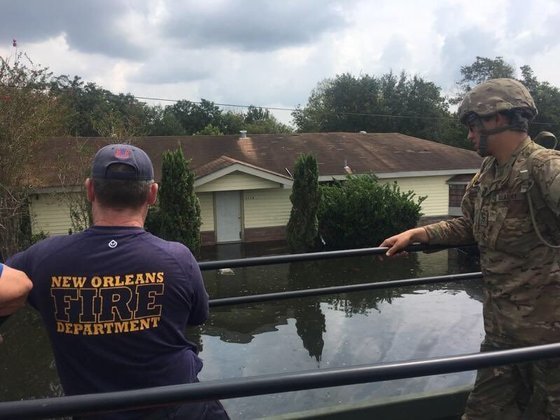
The New Orleans Office of
Homeland Security and Emergency Preparedness (NOHSEP) and the New Orleans Fire
Department (NOFD) are continuing to support the Hurricane Harvey recovery
efforts in Texas.
Post-Harvey Recovery
New Orleans is no stranger to hurricanes and powerful storms. Our community hopes to provide all the help it can to the city of Houston and other cities in Southeast Texas and Southwest Louisiana as they continue to recover from the flooding experienced during Hurricane Harvey.
"As we remember the tough times of Hurricane Katrina, we continue to pray for those affected by the hurricane in Texas and Southwest Louisiana. Many New Orleanians are mobilizing to ensure we return the generous support given to us in our time of need," said Mayor Mitch Landrieu. August 29 was the 12-year anniversary of Hurricane Katrina's landfall in southeastern Louisiana.
In partnership with the Greater New Orleans Foundation, Mayor Landrieu reactivated the NOLA Pay it Forward Fund to provide support to areas in Texas and southwest Louisiana impacted by Harvey. The funds raised will help support the deployment and operations of local non-profits conducting volunteer relief efforts.
For those interested in donating to the fund, go to:
https://nola.gov/city/pay-it-forward/
For other ways to assist in post-Harvey recovery, visit: http://ready.nola.gov/incident/harvey/texas-recovery/
The City of New Orleans has been in contact with our peers in Houston but also with our counterparts in Miami and Tampa as they begin their recovery from Hurricane Irma.
 ORS Participates in Flood Recovery Efforts
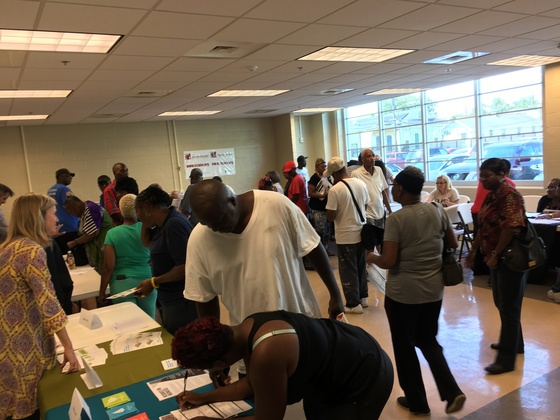
The City of New Orleans has entered recovery mode following
the major storm events on July 22nd and August 5th that
left a large portion of the city in several feet of floodwater for many hours. The
City hosted a Flood Recovery Resource Center from Wednesday, August 16th
to Saturday, August 19th, at which information and resources were
made readily available for flood-affected residents and businesses. Recovery
efforts are ongoing with a SBA Disaster Loan Outreach Center now open in the
Mid-City Library through September 14.
In addition to helping staff the resource center throughout
its four-day duration, the Office of Resilience and Sustainability is further
collaborating with the City’s Office of Homeland Security and Emergency
Preparedness (NOHSEP) to further spread the word on steps that residents can
take to help mitigate street flooding with the use of green infrastructure. Suggested
interventions include the installment of rain barrels, rain gardens, gravel
trenches, and more. These interventions help absorb and detain water, instead
of having it quickly rush into the City’s drainage system.
ORS and NOHSEP are also urging residents to help clear the
entrances of the catch basins (storm drains) in front of their homes if litter
and debris are blocking them. A blocked catch basin does not allow for storm
water on the street to enter the drainage system, which results in a flooded
street. A blocked, but functioning catch basin can easily be cleared using a
shovel, broom, and dust bin!
For more information and resources in regard to flood
recovery, please visit http://ready.nola.gov/incident/august-flood/recovery/
 Mirabeau Water Garden project enters Design Phase 2
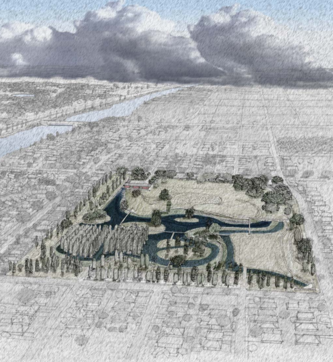
On August 5th, the Office of Resilience and Sustainability hosted the second community workshop for design of Phase 2 of the Mirabeau Water Garden project in Gentilly: a 25-acre open space that is being redesigned as a storm water management site, while also serving as a recreational and educational amenity for the neighborhood and city. Phase 1 of the park’s design, funded by a FEMA Hazard Mitigation grant, is focused on the storm water management portion of the project. The design of Phase 2 is focused on the recreational and educational amenities of the site, for which the vision will be primarily driven by community input. This phase is funded by an award received from the US Department of Housing and Urban Development in the National Disaster Resilience Competition.
After welcomes, introductions, and overviews were provided by ORS Resilience Outreach Manager Charles Allen, longtime Gentilly resident Walterine Griffin, and co-principal of the project’s design firm Waggonner and Ball Architects, the 50+ attending community members were then split into working groups to begin discussions on envisioning the project’s Phase 2 component. Facilitated by an ORS team member, members of the working group shared priorities, concerns, and holistic visions for how they hoped the Mirabeau Water Garden site could be experienced as a visitor.
This second workshop for Mirabeau Water Garden’s design Phase 2 was successful, as feedback received was both positive and productive. There was also incredible excitement and enthusiasm for the simple fact that this 25-acre site that has been left vacant for the past 10+ years will be transformed to serve as an all-around amenity for the surrounding Gentilly community.
Project construction is estimated to start in Summer 2018.
For more information and updates, please visit: nola.gov/resilience
|
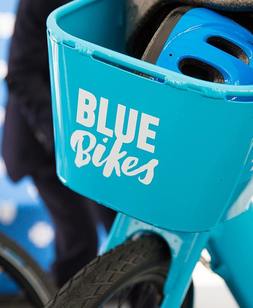 Blue Cross Blue Shield of Louisiana named as official New Orleans Bike Share sponsor
The City of New Orleans and Social
Bicycles have announced Blue Cross Blue Shield of Louisiana
is the title sponsor of the City’s new bike share system.
The system, called Blue Bikes, is slated for launch in fall of 2017 and
will be funded entirely with private dollars, including sponsorships
and user fees. The first wave of Blue Bikes will have a fleet of 700
bicycles in 70 locations around the downtown jobs core and surrounding
neighborhoods. The initial locations were selected from analysis of population
and transportation needs and were planned
with community input from workshops to online
polling. Future waves will expand service to even more
neighborhoods. The bikes, acting like a transit network, can be used with
a flexible array of plans, including $15 per month and $8
per hour, accessed through a website, app and kiosks. Blue Bikes will
also offer a reduced-fare pass, $20 per year, based on qualifying
incomes as well as cash payment options.
Bike share programs have already been
successfully implemented in major metropolitan areas across the country, and
the City of New Orleans has taken note of the benefits: reliable and
low-cost transportation, improved public health, reduced carbon
emissions, support local businesses, and more. The Blue Bikes program
serves as another forward step towards improving urban mobility and social
equity in New Orleans.
|
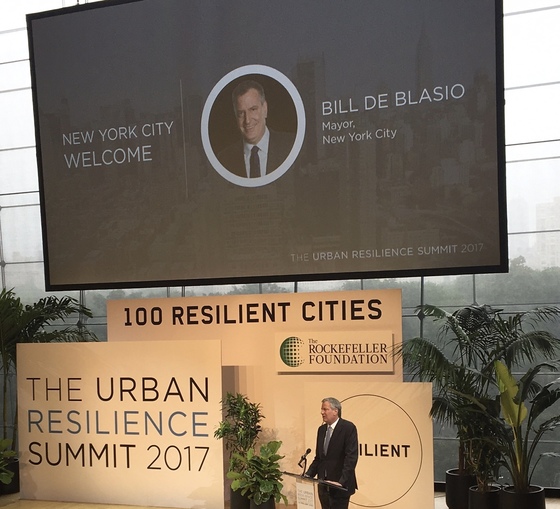 Mayor Bill De Blasio opens the 2017 Urban Resilience Summit in New York City.
ORS represents New Orleans at 100 Resilient Cities Summit in NYC
From July 24th to July 28th, over 500 urban resilience professionals, including 80 Chief Resilience Officers (CRO), gathered in New York City to share and discuss new ideas and innovations at the annual 100 Resilient Cities Global Summit. The Summit provided an opportunity for attendees to use New York City, one of the largest cities in the world, as a classroom for urban resilience challenges. The four-day summit featured several panels at which leaders from all across the 100 Resilient Cities network led discussions on urban resilience topics.
Workshops included a day-long session at the Brooklyn Navy Yard focused on post-industrial urban revitalization, led by New Orleans CRO Jeff Hebert, Pittsburg CRO Grant Ervin, and Glasgow CRO Duncan Booker. Jeff’s perspective from serving as the CRO and Deputy Mayor of an almost three-century old port city, rich in culture and forcing itself to rethink its relationship with water, served as a context for attendees. Other panel topics included food system vulnerability, social inclusion, urban biodiversity, and more. Jeff also represented New Orleans at the City Managers convening to discuss leadership and support for resilience practice in city government operations.
In addition, David Lessinger participated in a workshop on biodiversity that focused on how coastal restoration can build urban resilience and also provide wildlife habitat that enhances biodiversity. The workshop featured New York City's coastal restoration projects in Jamaica Bay and included case studies shared by participants from Melbourne, Australia; Durban, South Africa; and Semarang, Indonesia.
Also during the summit, discussions were held with several peer cities on advancing issue-specific partnerships; Rotterdam (Urban Water Management), Medellin (Violence Reduction), Singapore (Climate Adaptation), and St. Louis (Blight & Revitalization).
This year’s 100 Resilient Cities Summit is the third to have occurred since the City of New Orleans hosted the first in 2014.
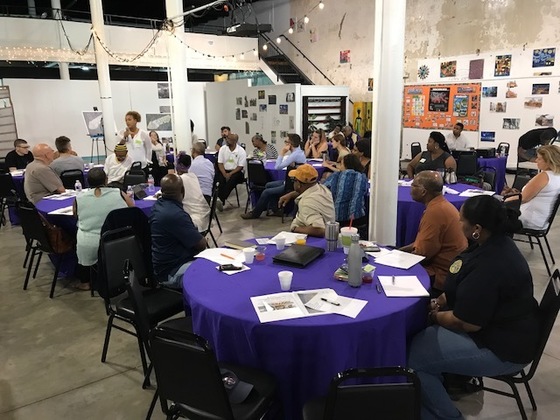 ORS Participates in Claiborne Corridor Cultural Innovation District Charrette
On July 21-22, the Office of Resilience & Sustainability (ORS) participated in a community charrette that was hosted by the City’s Network for Economic Opportunity. The focus of this 2-day community meeting was to garner input from residents and others in the Treme’ neighborhood in regard to developing the Claiborne Corridor Cultural Innovation District (CID). The CID is a 19 block transformation of space underneath the elevated Interstate 10 expressway along N. Claiborne Avenue between Canal Street and St. Bernard Avenue. The vision for the CID is a space developed with green infrastructure, featuring amenities such as classrooms, exhibit space, interactive technology, and a world-class market selling arts, crafts, produce, and seafood.
Charles Allen, who serves as Resilience Outreach Manager in ORS, participated in a panel program on the charrette’s opening day, where he presented on the City’s Climate Action Strategy which was launched on July 7th. On the second day, Charles represented the ORS team in a workshop, where Treme’ residents shared ideas on how they envision using and experiencing the CID.
The CID will be a “culture-based economic driver” for the Claiborne Avenue corridor, helping serve as another stepping stone towards building an even more equitable and sustainable New Orleans. For more information on the Network for Economic Opportunity and the Claiborne Corridor CID, go to: https://www.thenetworkneworleans.org/.
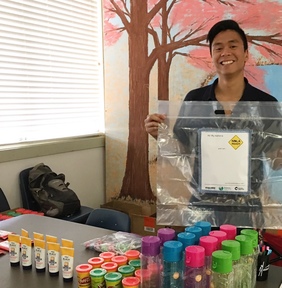 ORS AmeriCorps VISTA leads preparedness activity with children in New Orleans East
We are no stranger to hurricanes and other severe storm
events here in New Orleans; preparedness is a must, whether you are four years
old or seventy years old. In conjunction with Evacuteer, ORS team member Sam
Gordon ran an “Evacuation Toolkit Building” activity for kids who attended the
New Orleans East Community Fair on August 6. Sam is a Resilience AmeriCorps
VISTA Member, sponsored by Cities of Service, serving in our office for the
duration of 2017 as a vital community outreach arm.
Participating kids had the opportunity to label and decorate
their “evacuation toolkit,” a large bag, with colors and stickers, before
filling it with items that they would find necessary to have with them in the
event of having to shelter in place or evacuate during a major storm. Items
included a flashlight, hand sanitizer, a water bottle, and lotion. Sam then
urged the participating kids to continue filling their emergency toolkits with
more items once they returned home. In light of the recent major flooding
events, the message of preparedness becomes even more paramount.
We look forward to continue collaborating with NOLA Ready,
the City’s emergency preparedness compaign, as well a Evacuteer, towards
building resilience for New Orleans as a whole.
|
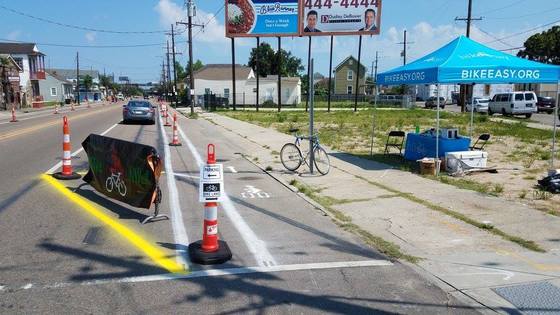
ORS working towards implementing permanent bikeway reconfigurations in New Orleans
The successful completion of the
St. Bernard Avenue protected bike lane trial is signaling a new era of urban mobility
in New Orleans, in which we are rethinking how we move through our streets and
neighborhoods and how we implement change. Executed by local
bike advocacy group, Bike Easy, with the City of New Orleans, the
temporarily reconfigured bikeway was installed on a five block stretch of St.
Bernard Avenue between St. Claude and N. Claiborne Avenues for the first three
weeks of August. The reconfiguration involved swapping the bike lane with the
parking lane, and separating the two with a 4-foot buffer. As opposed to having
the original configuration of having the bike lane running alongside moving
vehicular traffic, the reconfiguration had the bike lane running alongside the
curb, “protected” from the vehicular traffic by the parking lane providing them
with a more stress-free ride, and with fewer safety concerns than before. By
using a short-term, temporary approach, the City can evaluate the effectiveness
and community response based on direct experience before moving forward
with permanent transformations improving both design and desirability.
The Office of Resilience and Sustainability
views improved urban mobility as a means towards improving social equity here
in New Orleans: one of the three main goals laid out in the Resilient New
Orleans strategy plan. Safer and more affordable ways to move across the city
allow for stronger and more efficient connections to opportunities. Making
biking a more desirable everyday transportation option also benefits our health
and works to achieve the City’s Climate Action goals to reduce carbon
emissions.
ORS and Bike Easy look forward to showcasing
the positive results and feedback received from the St. Bernard Bikeway, and to
continue building a more connected and sustainable New Orleans!
 Benchmarking of New Orleans buildings underway
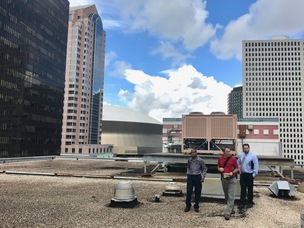
Greg Nichols from the Office of Innovation has been working with sustainable contractors Green Coast Enterprises and the City’s facilities and maintenance teams to assess the energy efficiency of key municipal buildings. Recently, long-time City employee Lyndon Wright gave a tour of the heating and cooling equipment at the Civil Court building located at 421 Loyola. As with any older building, the operation of the Heating, Ventilation and Air Conditioning (HVAC) systems can require significant upkeep with the passage of time. The first thing these buildings need are advanced controls and replacement equipment that can run at variable speeds so that they can run more efficiently.
In order to save on its utility bills, the City plans to identify opportunities for energy reduction at the Civil Court and several dozen other city-owned properties. These cost-saving measures can help the city manage its budget (and tax-dollars!) more effectively, as well as reduce New Orleans’ impact on the environment. After Green Coast Enterprises completes its benchmark study of the Court’s current energy use, Greg and the Office of Resilience and Sustainability can determine the best way to make significant, targeted upgrades to the City’s HVAC systems.
Similar upgrades have already made an impact on the Coroner’s Office, which is expected to reduce its energy use by 15% over the next year.
|
Resilient New Orleans in the News
Resilience News Elsewhere
|