 Friday, June 27, 2025
Your questions answered: How food inspectors
keep safety in stock at grocery stores
 From grocery stores and restaurants to daycare centers, our 13 active food inspectors at the Louisville Metro Department of Public Health and Wellness (LMPHW) are tirelessly working behind the scenes to make sure what we eat is clean, safe and up to code.
Here’s a glimpse of how our inspectors evaluate grocery stores.
How many grocery stores do we inspect each year and how often?
Currently, our inspectors have 4,605 active food permits in our system, which includes everything from grocery stores, daycare facilities, schools, hotels and mobile food trucks.
Out of those 4,605, there are 947 permits that are considered retail or food service with retail.
Food service within retail includes grocery stores where food is prepared, served, and packaged on-site, such as Kroger, Walmart, ValuMarket, and Meijer. These stores are inspected twice a year. Some grocery stores do not offer food service, such as Aldi and Target. They serve prepackaged items and are only inspected once a year.
When someone looks at the most recent inspection report for a grocery store and sees they got an A, but then hears inspectors are investigating the store for an issue like a rodent infestation, how is it possible they got an A?
The only part of the grocery store that gets an inspection with a letter grade is the deli/food service area. Our inspectors are most concerned with the area where food is being handled, chopped, cut, cooked and prepared. For most grocery stores, that’s the deli area where ready-to-eat meals are prepared, as well as pasta salads, chicken salads, and other types of salads; meats and cheeses are sliced and packaged for sale. This area is a top priority due to its elevated risk of food-borne illnesses spreading if sanitation and safety regulations are not followed.
The rest of the store, which the inspectors classify as retail, does not get a letter grade.
Do we conduct a regular inspection of the retail area of the grocery stores?
Yes, the retail area of a grocery store receives an inspection twice a year. When an inspector conducts a retail inspection, we check for adulterated products and dented cans. We check cooler temperatures. We look to see that food is properly stored, and we look at overall cleanliness.
How many food safety complaints do we investigate each year?
As of July 1, 2024, we have received 958 complaints. It’s important to know that our food safety inspectors conduct routine inspections of grocery stores twice a year. That’s only 2 days out of 365. We rely on the public to let us know if they see unsanitary conditions the other days of the year. We investigate every complaint we receive.
How many of those complaints are related to grocery stores?
172 of those complaints were related to a retail/prepackaged facility.
How do you contact food inspectors if you have a complaint?
Anyone can report a complaint to us via Metro311’s website, social media, mobile app or by calling 502-574-5000. They can also share it with us via the Department of Public Health and Wellness social media channels or by calling 502-574-6650. To learn more about grocery store inspections and complaint investigations, watch our recent media briefing. For more information about food safety, please visit our website.
Prevent sexually transmitted infections
 Sexually transmitted infections (STIs) like chlamydia, gonorrhea and syphilis have been increasing in the United States and in Jefferson County. The CDC estimates approximately 1 in 5 people in the U.S. have an STI, and the cases continue to show there are no signs of slowing down.
STIs are infections that can be passed from one person to another during all types of intimate sexual contact (anal, oral, and vaginal). Examples of STIs include chlamydia, trichomoniasis, herpes, gonorrhea, and HIV. Signs of STIs may include pain while urinating, burning, itching, sores, discharge and bumps or blisters in the genital area. However, a person may be infected with an STI and have no symptoms.
Put yourself to the test. Knowing your status is an important step to stopping infections. The best way to know is to be tested. The Louisville Metro Department of Public Health and Wellness (LMPHW) Specialty Clinic, 914 E. Broadway, Suite #102, provides STI testing, treatment and counseling services. The clinic operates Monday through Friday from 8 a.m. to 4 p.m.
For more information about our Specialty Clinic, please view our brochure (Spanish version) to learn more about our services.
Learn more about STIs: who’s at highest risk, causes, symptoms, treatment and prevention.
Extreme hot weather can affect your health
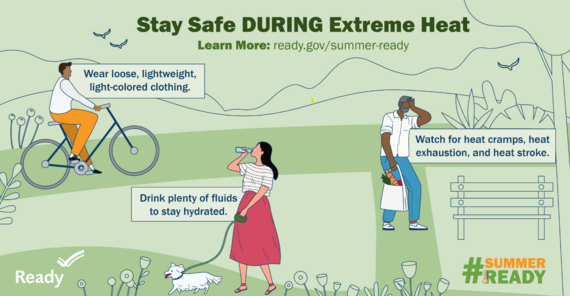 More than 265 million people have been facing temperatures over 90°F for days with little overnight reprieve. As a result, some of the most important health risks aren’t always obvious. It’s not just about the temperature you see on your weather app, and believe it or not, cranking up a fan can sometimes make things worse.
To prevent risks from excessive heat, here are a few reminders:
-
Seek air-conditioning: If your home does not have air-conditioning, seek areas that do, including libraries, shopping malls, community/senior centers, grocery stores, and movie theaters during the warmest period of the day. If you must stay in a home without air-conditioning, stay on the lowest floor out of the sunshine.
-
Sign up for alerts and warnings: LENSAlert
-
Avoid strenuous activities: This is particularly true during the hottest time of the day. Individuals who perform strenuous work during the heat of the day are especially at risk. Take more breaks, do less intense activities. Be watchful for symptoms such as coughing or shortness of breath.
-
Wear lightweight, light-colored clothing: Light colors reflect the sun’s rays better than dark colors, which absorb the heat. Protect the face and head with a wide-brimmed hat.
-
Check on family members, neighbors and friends who are vulnerable. Move them to air-conditioned places if possible.
-
Drink plenty of fluids: Increase fluid intake even if you are not thirsty.
-
Never leave pets or people, especially children and infants, unattended in cars.
If heat risks do occur, cool the body as soon as possible, and call 9-1-1 for symptoms of heat stroke. For guidance about extreme heat, visit our digital library on our Emergency Preparedness webpage to access guides in a variety of languages.
Webinar addresses self-care and empowerment
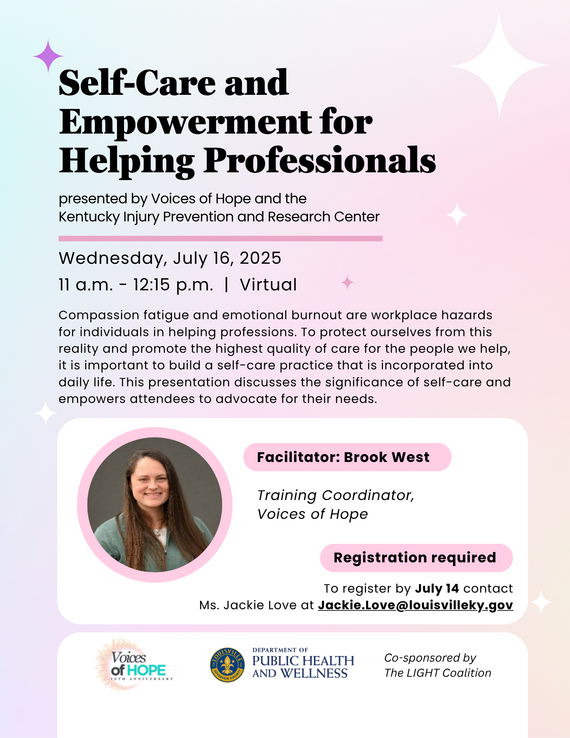
Compassion fatigue and emotional burnout pose significant risks for those in helping professions. To safeguard ourselves from these challenges, we invite you to join our free virtual webinar, "Self-Care and Empowerment for Helping Professionals," at 11 a.m. on Wednesday, July 16.
Facilitated by Training Coordinator Brook West, this session will explore the importance of self-care and provide strategies for advocating for your needs.
For further details and to register by July 14, please reach out to Jackie Love at Jackie.Love@louisvilleky.gov.
|