 Friday, May 30, 2025
May highlights the importance
of National Hepatitis Awareness Month
 May is National Hepatitis Awareness Month, a time to bring attention to a serious but often overlooked health issue. In the United States, an estimated 2.4 million people have hepatitis C, and about 900,000 have hepatitis B. Viral hepatitis is sometimes called a “silent epidemic” because these infections can go unnoticed for years, quietly damaging the liver and leading to serious conditions such as cirrhosis, liver failure, and liver cancer.
The most common forms of hepatitis are Hepatitis A, B, and C:
-
Hepatitis A lives in a person’s intestines and is often spread when someone who has it doesn’t wash their hands properly after using the toilet. This virus causes acute symptoms and is self-limiting, meaning it will go away on its own with time, but it can still lead to significant health problems. You can protect yourself against hepatitis A by getting a vaccine.
-
Hepatitis B spreads through contact with infected blood, sexual contact, or from mother to baby during childbirth. Hepatitis B can clear on its own, but it can also result in a long-term, or chronic, infection. There is a vaccine available to prevent hepatitis B infections, and chronic infections can be managed with medication.
-
Hepatitis C is spread mostly through blood, often from shared needles or unsterile equipment. Most people who get hepatitis C develop a chronic infection. There is no vaccine for hepatitis C, but it can now be cured with medication.
Many people living with hepatitis B or C don’t know they’re infected because symptoms can take years to develop. That’s why getting tested is so important. The CDC recommends one-time testing for hepatitis B and C for anyone age 18 years or older. If you have never been tested before, speak with your doctor about getting tested at your next visit. You should also consider testing more frequently (once or twice per year) if you inject drugs or have unprotected sex with multiple partners. If you test positive, effective treatments are available that can prevent serious health problems from developing down the road.
There are simple steps we can all take to reduce the spread of hepatitis:
- Get vaccinated against hepatitis A and B
- Avoid sharing needles, razors, toothbrushes, or other personal items
- Practice safe sex by using condoms
- Get tested and encourage others to do the same
Be sure to learn more information about the types of hepatitis, management, treatment and prevention.
Learn how to navigate conflicts
and manage daily challenges
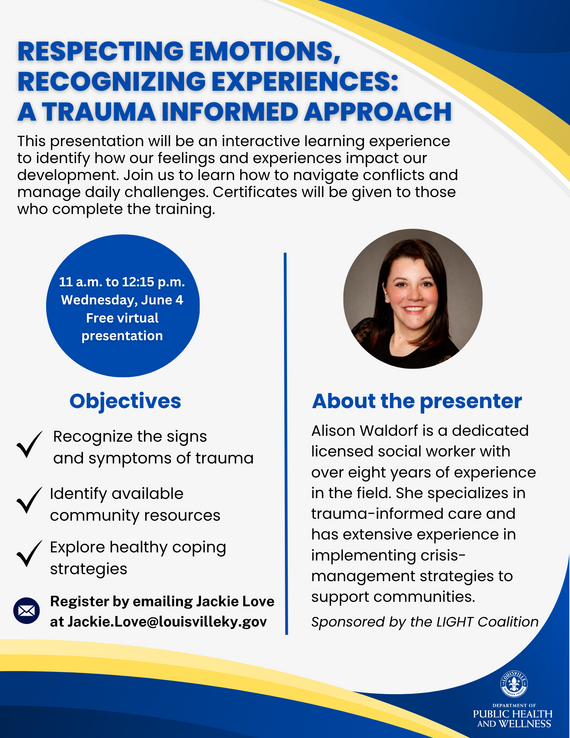 The Louisville Metro Department of Public Health and Wellness and several community partners are sponsoring "Respecting Emotions, Recognizing Experiences: A Trauma Informed Approach" virtual presentation, which will be held at 11 a.m. on Wednesday, June 4. Registration is free.
Led by Alison Waldorf, an experienced social worker with over eight years in the field, this session will focus on the ways our emotions and experiences shape our lives. Participants will gain insights on how to:
- Recognize the signs and symptoms of trauma
- Identify available community resources
- Explore healthy coping strategies
Certificates will be given to participants who complete the training.
For more information and to register, please email Jackie Love at Jackie.Love@louisvilleky.gov.
Gray Street Farmers Market returns on June 5
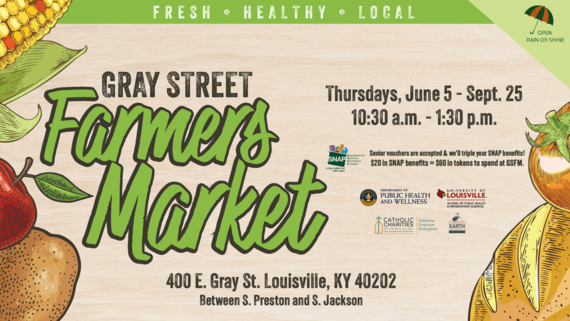 Beginning Thursday, June 5, the Gray Street Farmers Market returns at 10:30 a.m. every Thursday (rain or shine) until September 25 at 400 E. Gray Street.
The goal of the market is to increase access to fresh, locally grown food in the downtown area. Additionally, the market is continuing its matching program for SNAP recipients. However, this year, recipients will be able to triple the value of the benefit. For example, if a SNAP recipient spends $10, they will receive an additional $20 to spend at the market. This benefit applies to those who spend between $1 and $20.
The market is a joint effort between the Louisville Metro Department of Public Health and Wellness, the University of Louisville School of Public Health and Catholic Charities Common Earth Gardens.
Apply now: Fall internships are available
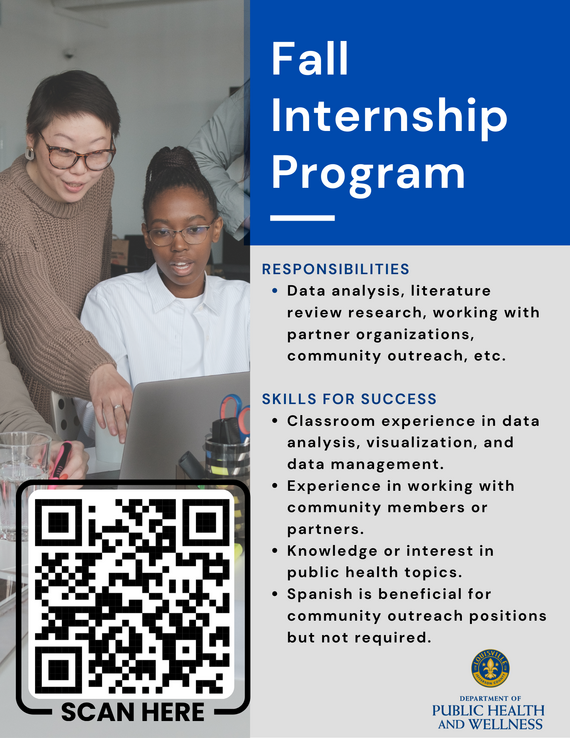 LMPHW is accepting applications for internships between now and June 13 for the fall semester. We have a variety of projects within our agency related to epidemiology, harm reduction, maternal child health, and many others.
For further inquiries, please reach out via email at LMPHWCareers@louisvilleky.gov
|