 Friday, February 7, 2025

Louisville Metro sees a spike
in flu cases and outbreaks
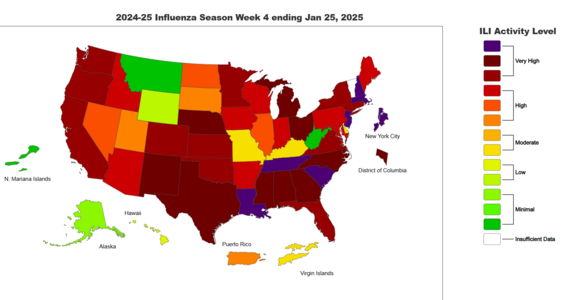 Source: CDC
The Louisville Metro Department of Public Health and Wellness’ Influenza Surveillance Dashboard shows reported cases of flu in Louisville Metro have jumped from over 6,000 cases last week to nearly 9,000 cases this week; however, this data does not reflect a total number of cases because not everyone gets tested for flu and individual cases are not required to be reported.
So far this season in Jefferson County, there have been six reported flu-related deaths and at least 32 outbreaks in residential congregate settings, which include schools, child care and long-term care facilities.
Dr. Kris Bryant, associate medical director for the Louisville Metro Department of Public Health and Wellness (LMPHW) and pediatric infectious disease specialist at Norton Children’s, said flu season is in full swing and children are especially being impacted at this time.
"In a typical year, 8% to 10% of kids get the flu. That's just normal. What's unusual this year is we are seeing multiple outbreaks in schools and childcare centers," said Dr. Bryant during an interview with WLKY.
Dr. Bryant adds influenza immunization rates have been falling in children since 2020. At the end of January, the CDC reports only about 44.5% of eligible children were immunized against the flu in the U.S. Additionally, the Kentucky Department for Public Health immunization coverage dashboard shows that only 30 percent of Jefferson County residents have received an influenza vaccine this year.
According to the CDC’s Weekly Influenza Surveillance Report, a majority of states are either experiencing “very high,” to “high” or moderate flu” activity. Nationwide, the CDC estimates there have been at least 20 million flu illnesses, 250,000 hospitalizations and 11,000 flu-related deaths, including more than 45 pediatric deaths, so far during the 2024-2025 season.
“In terms of numbers, this is the worst flu season we’ve seen in recent years. As far as this flu season’s severity, that story is still being written,” Dr. Bryant said.
Dr. Bryant said the best way to protect yourself from influenza is to get a flu vaccine. Flu vaccines can prevent many cases of severe flu, including many influenza-related deaths. Flu vaccine is recommended for all people 6 months and older.
“Getting a shot today can protect you in the weeks to come. Respiratory viruses, including flu, will continue to circulate. We sometimes see flu go throughout the spring,” said Dr. Bryant.
Other preventative measures to protect yourself, and others, from respiratory illnesses include:
- Staying away from sick people
- Good hand washing
- Wearing a mask in public/crowded spaces, especially if people are at higher risk for developing severe illness
- Staying home if you’re sick to avoid exposing others to illness
To find vaccines near you, visit vaccines.gov. For more information about flu, COVID and RSV visit our “respiratory viruses” page on louisvilleky.gov. You can also check out the CDC’s respiratory virus guidance.
Celebrate National Black HIV/AIDS Awareness Day: Learn more ways to protect yourself
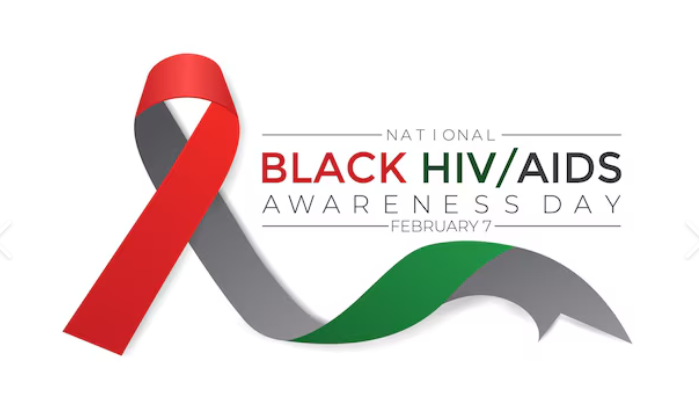 National Black HIV/AIDS Awareness Day (NBHAAD) is Friday, February 7. Black Americans continue to be disproportionately affected by HIV compared to other racial/ethnic groups. One of the goals of the National HIV/AIDS Strategy is to reduce HIV-related disparities and health inequities.
-
Basic HIV facts about HIV prevention, diagnosis, and treatment are also available. Know the facts and spread the word with family members and friends who have not been tested for HIV, might be at risk, or are living with HIV.
- The HIV Services Locator can help you find HIV services.
- Find information about self-testing on HIV.gov. (Be sure to call ahead to inquire about the availability of self-testing.)
-
HIV treatment helps people with HIV stay healthy and live longer. There is also a major prevention benefit: People with HIV, who take HIV medicine daily as prescribed, can keep an undetectable viral load.
The Louisville Metro Department of Public Health and Wellness' Specialty Clinic is also available to anyone seeking confidential counseling and testing. Patients are seen by appointment only. To schedule an appointment, call 502-574-6699.
To learn more about HIV prevention, please visit our website.
Score big food safety points on Super Bowl Sunday
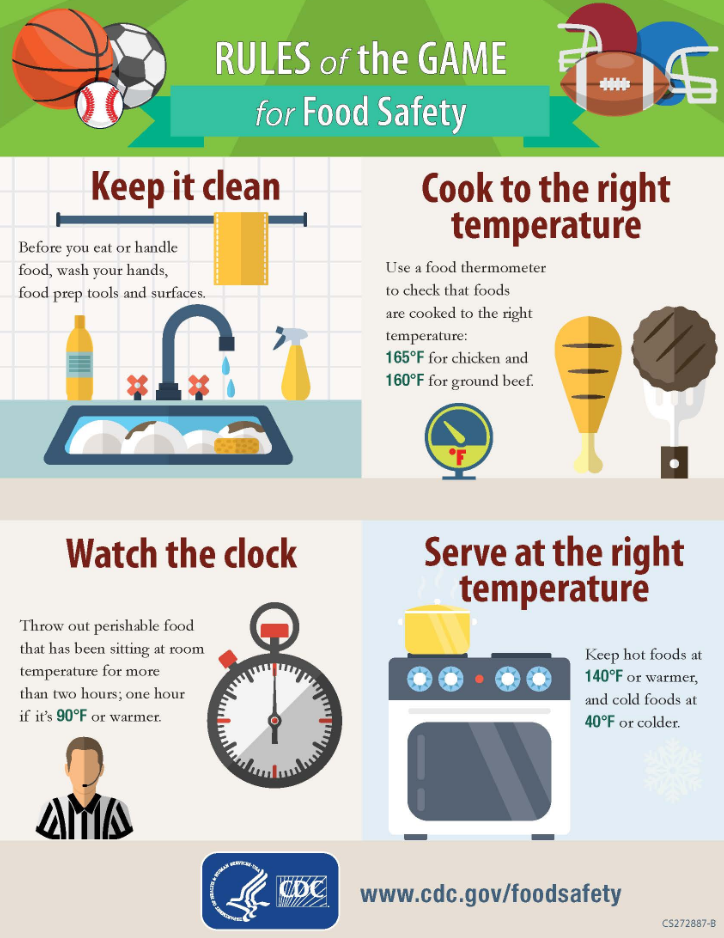 If you’re hosting a Super Bowl party, keep food safety in your playbook to make sure that bacteria doesn’t run out the clock. The U.S. Department of Agriculture’s (USDA) Food Safety and Inspection Service (FSIS) has a game plan to keep your Super Bowl servings penalty free.
Don’t fumble your takeout or delivery
- Place your takeout in insulated bags while transporting home if your commute takes longer than an hour.
- Whether it’s takeout or delivered food, serve promptly or divide food into smaller portions, place in shallow containers and refrigerate until ready to reheat and serve. Or keep food heated (above 140 degrees Fahrenheit) in a preheated oven, warming tray, chafing dish or slow cooker.
- Reheat food containing meat or poultry to an internal temperature of 165 degrees Fahrenheit as measured by a food thermometer.
- If reheating food in the microwave, evenly disperse it and stir the food so it reaches a safe internal temperature throughout.
- Reheat liquid foods like soups and sauces to a boil.
Avoid the danger zone
- If you plan to keep food out for more than two hours:
- Keep cold foods at a temperature of 40 degrees Fahrenheit or below by keeping food nestled in ice.
- Keep hot foods at a temperature of 140 degrees Fahrenheit or above by placing food in a preheated oven, warming trays, chafing dishes or slow cookers.
Focus on safe minimum internal temperatures
- Use a food thermometer to ensure your food reaches a safe minimum internal temperature when cooking at home:
- Meat (whole beef, pork and lamb) 145 degrees Fahrenheit with a three-minute rest;
- Ground meats 160 degrees Fahrenheit;
- Poultry (ground and whole) 165 degrees Fahrenheit;
- Eggs 160 degrees Fahrenheit;
- Fish and shellfish 145 degrees Fahrenheit; and
- Leftovers and casseroles 165 degrees Fahrenheit.
- If chicken wings are on the menu, use a food thermometer on several wings to gauge the doneness of the entire batch. If one is under 165 degrees Fahrenheit, continue cooking all wings until they reach that safe internal temperature.
- Following four simple steps at home can help protect you and your loved ones from food poisoning.
If you have food safety questions, call the USDA Meat and Poultry Hotline at 1-888-MPHotline (1-888-674-6854), email MPHotline@usda.gov or chat live at ask.usda.gov 10 a.m. to 6 p.m. Eastern Time, Monday through Friday. For more information about foodborne illness, please visit our website.
Impact the field of public health
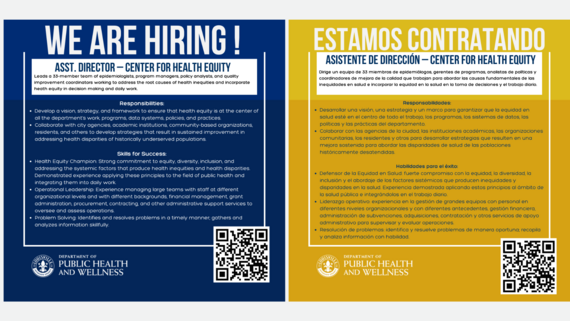 Enlarge the graphic to learn more about this career
Do you want to enhance the health and wellness of everyone in our city? If so, we'd love for you to join our committed team.
Visit our Metro job opportunities webpage to learn more about this role and various career opportunities in public health. You can also scan the QR code.
For more information, please email LMPHWCareers@louisvilleky.gov.
|