 Friday, April 12, 2024

Eviction expungement: A tool to reduce homelessness and improve health
 What is an eviction?
An eviction is a permanent record that follows a renter for the rest of their life and impacts their chances at securing housing, regardless of the outcome of the eviction proceeding even if the eviction order was dismissed or happened many years ago. This increases their risk of homelessness, housing instability, and negative health outcomes.
Ninety percent of landlords rely on third-party companies to conduct background checks on potential tenants and will frequently deny applicants whose reports show an eviction filing regardless of when it happened. Research has found that approximately 22% of eviction records contain inaccurate information.
Who’s most impacted?
Black renters were much more likely to receive an eviction filing (one in five) and be evicted (one in 10) than White renters. Only one in 24 White renters were filed against and only one in 40 were evicted.
Evictions are a major driver of child homelessness nationally and in Kentucky. According to the Kentucky Department of Education, there were 21,121 homeless students across all districts for the 2022-2023 school year. Of these, 3,319 were from Jefferson County, where Black students made up the demographic with the highest incidence of homelessness.
One study found that when controlling for age, individuals from birth to 19 years old were more likely to be evicted and receive an eviction filing in the U.S. than any other group from 2007-2016.
Evictions impact health and well-being
Eviction filings are associated with an increase in homelessness. Homelessness is proven to worsen health outcomes such as depression and substance use disorder, as well as increase hospitalization and death rates. Even when an eviction filing does not result in homelessness, residents are still susceptible to worse health outcomes due to displacement or housing instability due to frequent moving, falling behind on rent, spending most of their income on housing, or living in poor quality housing. Housing instability and threat of eviction are associated with high blood pressure, poor self-reported health, and negative mental health including depression, anxiety, psychological distress, and suicide.
What is eviction expungement?
Eviction expungement is a policy that removes certain qualifying eviction records from public view (either automatically or by petition) and adds restrictions on who can access an individual’s case. Policymakers can pursue eviction expungement as a method to mitigate long-term harm caused by eviction filings and improve access to housing and health outcomes for Kentuckians.
To learn more about how eviction expungement is linked to positive health outcomes, read our policy brief.
Learn more about who we are and what we do
Don't let radon move into your home
 The Louisville Metro Department of Public Health and Wellness is offering free radon test kits while the supply lasts.
Radon is an odorless, colorless, radioactive gas. It is also the second leading cause of lung cancer in the United States. The U.S. Environmental Protection Agency (EPA) and the Surgeon General’s office estimate radon is responsible for more than 21,000 lung cancer deaths each year. Since it is difficult to identify any immediate symptoms related to radon exposure, it may take years before health problems appear.
You should test your home’s radon levels:
- If it’s never been tested or radon levels are unknown.
- When preparing to buy or sell.
- Before and after any renovations, especially after making any repairs to reduce radon levels.
- Before making any lifestyle changes in the home that would cause someone to spend more time in the basement or lower level (like converting a basement to a bedroom).
Having your home tested is the only effective way to determine whether you or your family is at risk of radon exposure.
For more information about receiving a free radon test kit, please contact us at loumetrohealth@louisvilleky.gov or visit our radon website.
The CDC also provides information on testing and reducing radon in your home. Contact your state radon control office for resources and help finding a qualified radon reduction contractor.
Virtual seminar explores the stages of grief
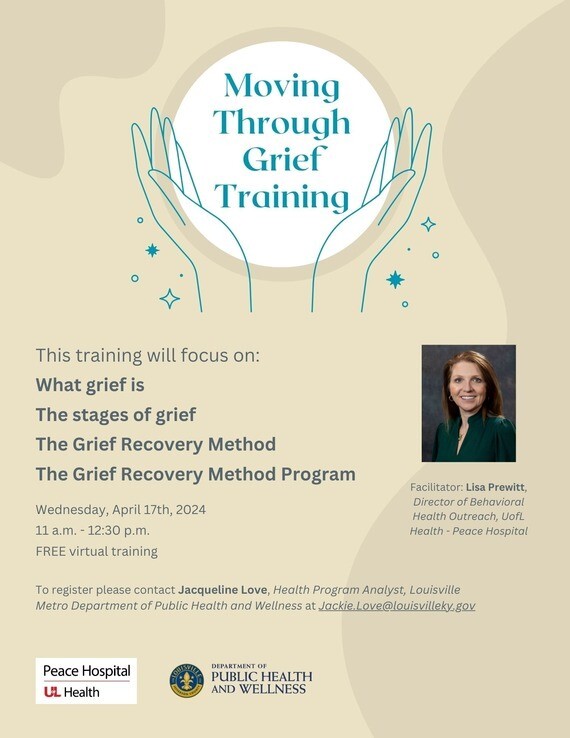 Louisville Metro Department of Public Health and Wellness (LMPHW) is teaming up with UofL Health - Peace Hospital to host a free virtual training seminar, Moving Through Grief, at 11 a.m. on Wednesday, April 17.
Lisa Prewitt, director of Behavioral Health Outreach at the hospital, will lead the event, featuring topics that will define the meaning of grief, the stages of grief, the Grief Recovery Method and the Grief Recovery Method Program.
To register, please email LMPHW's Health Program Analyst Jacqueline Love at Jackie.Love@louisvilleky.gov.
|