 Friday, September 22, 2023

Narcan vending machine is up and running at LMDC
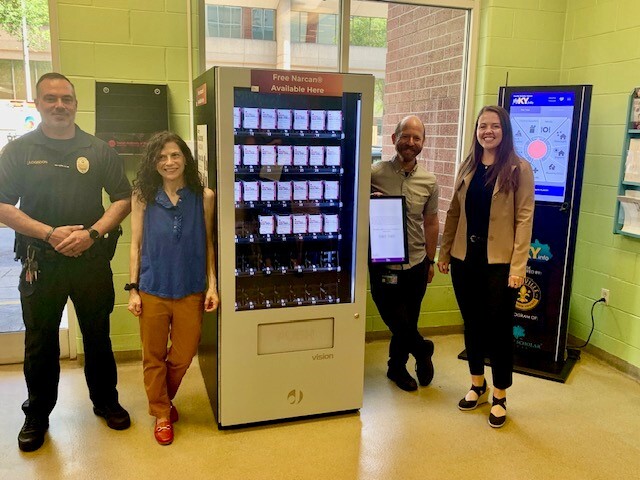 From left, Louisville Metro Department of Corrections (LMDC) Captain Jason Logsdon, LMDC Substance Abuse Program Coordinator Kathy Salomon, Ph.D, Louisville Metro Department of Public Health and Wellness (LMPHW) Community Health Administrator Ben Goldman and LMDC Executive Administrator and Chief Psychologist Dr. Mariya Leyderman recently announced the new vending machine filled with free naloxone at LMDC's exit lobby.
The Louisville Metro Department of Corrections (LMDC) has added another harm reduction measure to prevent fatal overdoses. A vending machine filled with free naloxone, more commonly known as Narcan, is now in the jail's exit lobby. People leaving LMDC can access the overdose reversal medication that has already saved lives within the correctional facility.
“Jails have a disproportionate number of people with substance use, mental health and co-occurring disorders. Research has shown that approximately 65% of the United States’ carceral population has an active substance-use disorder,” said Dr. Mariya Leyderman, executive administrator and chief psychologist at LMDC. “A harm reduction approach creates an effective mechanism to provide treatment and services to individuals while in custody and upon reentry into the community. De-stigmatizing and recognizing the underlying root causes of criminal involvement allows for correctional agencies to both reduce drug use and crime after people return to the community. Ultimately, jails must be innovative and re-imagine the services provided, particularly considering the public health crisis surrounding substance use.”
The vending machine was purchased by the University of Kentucky’s HEALing Communities Study (HCS) and stocked with the initial 300 units of Narcan.
MORE program helping incarcerated individuals with opioid use disorder
LMDC is not only working to prevent overdoses, but is also providing a continuum of care for its residents, with a focus on treatment and mental health. The Louisville Metro Department of Public Health and Wellness’ Medication Oriented Recovery and Enhancement (MORE) program helps people with opioid-use disorder housed at the jail and in the home incarceration program by providing medication treatment and counseling. The services are not only provided while they are serving time, but also once they are released to help them continue a path to recovery.
To learn more about harm reduction efforts in Louisville Metro visit our Harm Reduction Outreach Services page on louisvilleky.gov.
Free Narcan kits are available for pick up at Public Health and Wellness headquarters, 400 E. Gray St., Monday through Friday, 8 a.m. to 5 p.m. as well as at any of our Harm Reduction Services community outreach locations.
Health Department donates medical supplies to JCPS
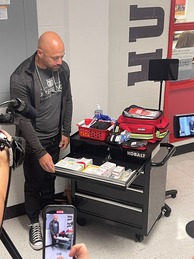
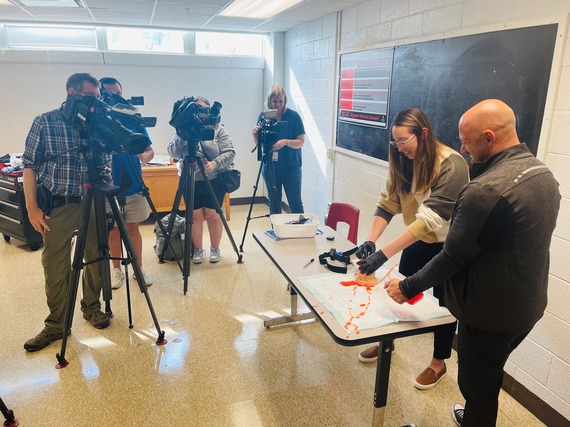 LMPHW Community Health Manager Molly Parsch, left, and Waggener High School Nurse Eric Schweinhart (also pictured below) demonstrate how to use the Stop the Bleed kits and displayed other medical supplies donated by the health department to Jefferson County Public Schools (JCPS).
Jefferson County Public Schools (JCPS) continues to ensure it is fully equipped to take care of its students while also addressing community issues that spill into the school.
Thanks to a grant from the Kentucky Cabinet for Health and Family Services, the Louisville Metro Department of Public Health and Wellness (LMPHW) is providing critical medical supplies to the district. The supplies include rolling carts, Stop the Bleed kits and high-quality medical bags.
“JCPS is one of the largest healthcare providers in our community. With more than 96,000 students, our school nurses provide care for everything from vaccinations to medical emergencies,” said Eva Stone, manager of JCPS Health Services. “We are grateful for this generous support, which will go a long way in helping us continue to meet the growing health and safety needs of our students.”
The rolling carts will be used to securely transport and store essential supplies including EpiPens, medications, and other medical items, making them easily accessible throughout the school day. iPads will be used to facilitate communication and translation services at vaccine clinics, ensuring all members of the community have access to the health care they deserve. Stop the Bleed kits allow all schools to be prepared in the case of a medical emergency where someone is experiencing blood loss.
“We know preparation is key when it comes to saving lives and reducing harm,” said Dr. Inder Singal, interim medical director at LMPHW. “We need to do all we can to ensure children’s safety and overall well-being. This is a small example of the great partnership we have with JCPS where the goal is to enhance emergency preparedness, disease control and prevention efforts, and emergency response and recovery capabilities.”
In total, LMPHW is providing JCPS with:
- 28 rolling carts
- 175 Stop the Bleed kits
- 28 first responder bags
- 8 iPads
- 8 iPad stands
- 155 medical tackle boxes
These tools will help JCPS expand its care. JCPS is also providing each school nurse with Albuterol and Narcan.
|
Mayor Greenberg appoints advisory board
to oversee distribution of opioid settlement funds
Mayor Craig Greenberg recently announced the formation of a dedicated advisory board tasked with overseeing the distribution of funds from the landmark opioid settlement. The board represents a significant step to ensuring the funds are allocated wisely and effectively to address the opioid crisis that has affected countless lives in Jefferson County.
“The opioid epidemic has ravaged communities, families and individuals, causing widespread devastation and loss,” said Mayor Greenberg. “The settlement funds represent an opportunity to provide much-needed resources to immediately save lives, support prevention, treatment, recovery, and other critical initiatives aimed at alleviating the opioid crisis.”
To ensure the transparent, equitable and impactful distribution of these funds, Mayor Greenberg has appointed individuals with both lived experience and professional expertise in serving the community to form the Opioid Settlement Distribution Advisory Board.
Individuals appointed to the board are:
- Connie Mendel, the city’s Interim Chief Health Strategist, who shall act as chair;
- Dr. Inder Singal, the city’s Interim Medical Director, who shall act as co-chair;
- Nicole George, the Deputy Mayor of Public Health and Services;
- Philip Baker, Metro Council District 6, representing Louisville Metro Council;
- Dr. Maryia Leyderman, licensed clinical forensic psychologist and executive administrator-chief psychologist at the Louisville Metro Department of Corrections, representing the behavioral health community;
- Lee Zimmerman, CEO of KidzClub, uniquely focused on the needs of children, youth, and families;
- Adria Johnson, president and CEO of Metro United Way, uniquely focused on building community resilience and addressing the root causes of substance use;
- Mariana Barzun, executive director, Mayor’s Office of Philanthropy;
- Barry Allen, president and treasurer of the Gheens Foundation, representing the philanthropy community.
The mission of the advisory board is to increase opportunities for everyone to live their healthiest life and reach their full human potential by investing in evidence-based solutions for substance use prevention and addressing the needs of people who experience the greatest barriers to accessing harm reduction, treatment, and recovery services.
For more information about Louisville’s opioid settlement and the Opioid Settlement Distribution Advisory Board and its work, https://louisvilleky.gov/government/health-wellness/louisville-opioid-settlement.
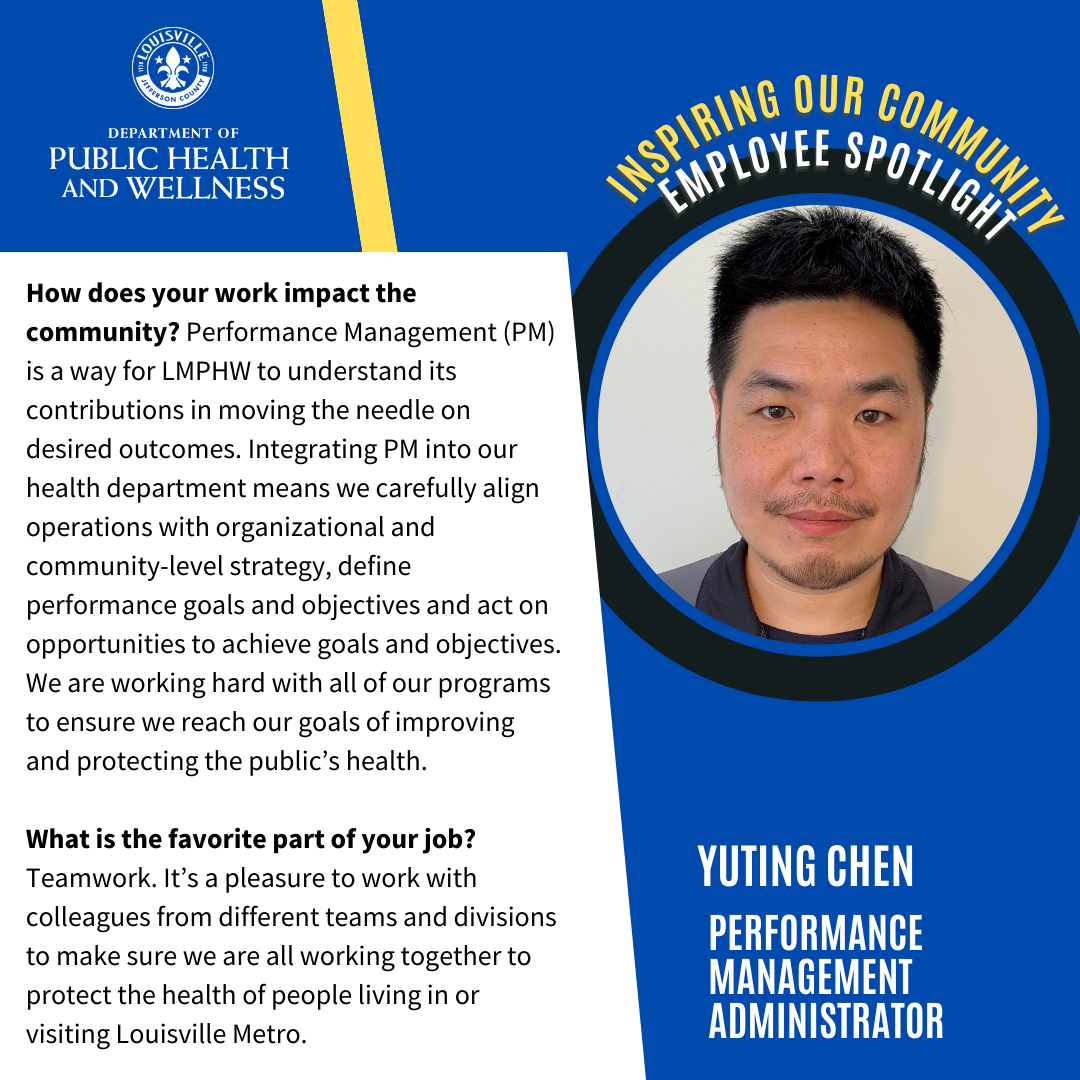
Learn more about who we are and what we do
Free COVID-19 at-home tests available at centers
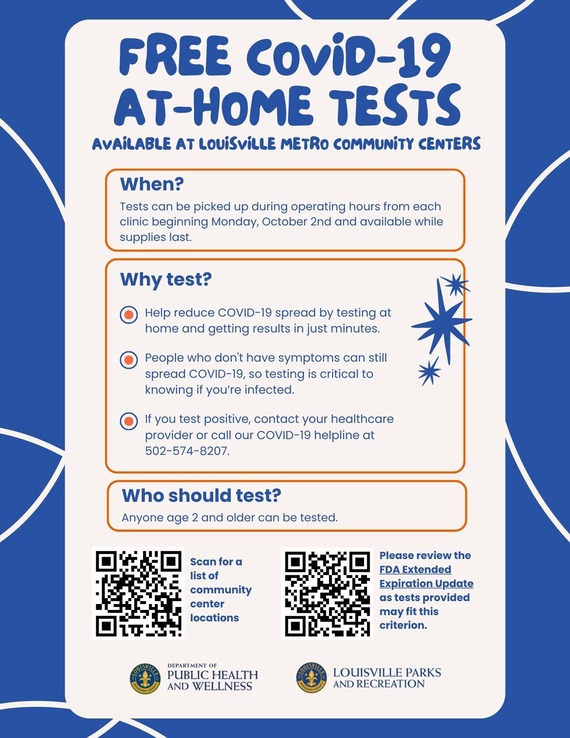 Do you need any COVID-19 at-home tests? If so, the tests can be picked up during the operating hours from each clinic beginning Monday, Oct. 2 and available while supplies last. Anyone 2 years old and older can be tested.
Why test?
- Help reduce COVID-19 spread by testing at home and getting results in just minutes.
- People who don't have symptoms can still spread COVID-19, so testing is critical to knowing if you’re infected.
- If you test positive, contact your health care provider or call our COVID-19 helpline at 502-574-8207.
For a list of community center locations, you can scan the QR codes above or view a list of community center locations. You can also scan the QR code above or visit FDA Extended Expiration Update to learn more about at-home tests.
And beginning Monday, Sept. 25, you can order four free at-home tests sent directly to your home. Please visit covid.gov/tests to learn more information.
|