Air Pollution Control District Releases Report on
Air Toxics Monitoring Program
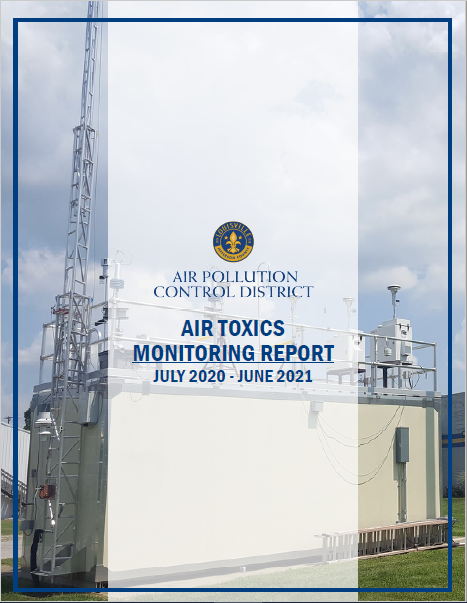
The APCD is utilizing new equipment to collect data on Louisville’s air quality and has published a report summarizing the progress of the project, including an overview of the first year of quality-assured data that was collected.
This new technology, called an automated Gas-Chromatograph (auto-GC), can collect large quantities of data on Louisville’s air in near-real time while operating in the field. The APCD is using the equipment to monitor for a group of “target compounds” notable to Louisville, selected because there are known sources or previous studies measured them at unhealthy concentrations.
The data featured in the report show significant reductions in ambient concentrations and estimated health-based risk produced by many of the target compounds in the past few decades. These reductions are corroborated by known reductions in emissions from industrial facilities, vehicles, and other sources of air pollution.
“Our air monitoring section is a nationwide leader, not only because they work with diligence and precision, but because they are willing to utilize new equipment, methods, and practices to collect more data on Louisville's air than ever before.” said Rachael Hamilton, Director, APCD “The new data shared in this report allows us all to understand Louisville's progress and informs our work as we continue to implement the laws and programs that improve Louisville's air quality.”
Toxic air emissions are regulated by the APCD in Louisville through the Strategic Toxic Air Reduction (STAR) program. STAR was implemented in 2005 in response to community feedback and several studies showing that Louisville had unacceptably high levels of toxic chemicals in the air, particularly in the neighborhoods around a cluster of industrial facilities commonly known as Rubbertown. Since STAR’s inception, emissions of all toxic air pollution have dropped almost 80%. Emissions of Category 1 Toxics Air Contaminants (TACs), those that previously produced the greatest estimated cancer and noncancer risk, have decreased by about 96%.
The APCD was among the first agencies to use auto-GC equipment for this purpose, and as an early adopter has offered their knowledge of the system to other agencies and performed field testing that resulted in upgrades by the vendor to auto-GCs nationwide.
This new equipment adds to the APCD’s already robust air monitoring network, which has sites in five separate locations throughout the city and annually collects tens of millions of data points on Louisville’s air quality. The data contained in the report come from the APCD’s Algonquin Parkway air monitoring site, which is located to measure the maximum impact from industrial sources in Rubbertown.
As of February 2023, another auto-GC at the APCD’s Cannons Lane site will now collect data that can be used for comparison to the auto-GC data at the Algonquin Parkway site. This will allow for greater understanding of the disparate impacts of toxic air pollution throughout Louisville, a known environmental justice issue.
Find the full report here.
|