|
GSK has identified a labeling issue affecting three lots of the 2026-2027 FluLaval vaccine distributed through CDC’s vaccine programs. The issue involves the linear barcode on the syringe labels of the FluLaval TIV 0.5 mL prefilled syringes listed below. No other lot numbers or products are affected.
The lot numbers involved are:
CDC states, “GSK’s investigation has confirmed that the product itself remains fully compliant with approved quality specifications. The issue is limited to the incorrect NDC in the syringe linear barcode and does not affect the quality, potency, safety, efficacy, sterility or performance of the vaccine.”
Questions should be directed to GSK at 1-888-825-5249.
Each year, the influenza significantly impacts the health and well-being of children and their families. Annual flu vaccination is the most effective way to protect children from the flu and its potentially serious complications.
To ensure optimal protection, children should receive the flu vaccine every flu season.
Some children aged 6 months to 8 years may need two doses of the flu vaccine this season:
- Those being vaccinated for the first time,
- Those who have previously received only one dose of flu vaccine, or
- Those with an unknown flu vaccination history.
For these children, it’s important to administer the first dose as soon as the vaccine is available, as the second dose should be given at least 4 weeks after the first.
Immunize.org has put together a Guide for Determining the Number of Doses of Influenza Vaccine to Give to Children Age 6 Months Through 8 Years. This easy-to-follow chart will help vaccine providers determine if a child needs a second flu vaccine. You will want to save this valuable resource!
How can we help policymakers and the public understand the silent consequences of not vaccinating?
Join the Midwest Immunization Consortium for the 4th Annual Vaccinate the Heartland. Learn how to turn vaccine data into action, engage policymakers, support evidence-based policies, and communicate the value of vaccination in your community.
Vaccinate the Heartland
Celebrating the Value of Vaccination, From the Classroom to the Community
Wednesday, September 30, 2026
12:00 P.M. CT
Register today and join the conversation about strengthening vaccination efforts – from the classroom to the community.
The 2025-2026 academic year data, the most recent year surveyed, has been added to the KDHE Kindergarten Immunization Coverage Dashboard. This dashboard provides statewide, county level, and school district level data on up-to-date vaccination coverage for school entry vaccines for kindergarteners in Kansas. The dashboard also provides data on exemption rates for religious and medical exemptions. Data for the dashboard come from the Kindergarten Vaccination Assessment Survey that is conducted annually. To learn more about the survey methodology, please see the Methodology and Technical Notes. Please see Kindergarten Vaccination Coverage Dashboard to view the full dashboard.
In recognition of Hispanic Heritage Month, Immunize Kansas Coalition (IKC) is highlighting its growing collection of Spanish-language resources to ensure accessible and evidence-based vaccine information for all Kansas communities.
Key Spanish-language resources include the following:
-
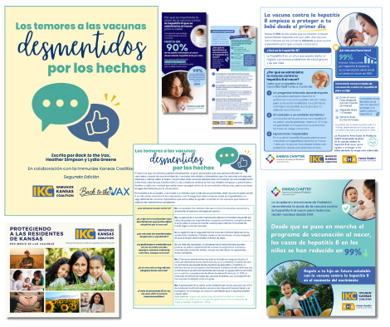
Vaccine Fears Overturned by Facts booklet and Key Facts handout- The newly released Spanish edition of the booklet and its accompanying Key Facts handout help providers answer parents’ questions about vaccines, vaccine ingredients, and the science behind them, sharing perspectives from two mothers who went from opposing vaccines to advocating for them.
-
Protecting Kansans with Immunizations Education Module – This module explores the importance of immunizations, the risk of vaccine-preventable diseases, and why maintaining state childhood vaccination policies is crucial to the health of children, pregnant women, and adults.
-
HepB Birth Dose Campaign - Designed to share with parents and caregivers, the campaign includes a HepB birth dose social media toolkit, a parent handout, and a parent-friendly informative rack card, all available in Spanish, that emphasize the importance of the HepB birth dose.
Healthcare providers and public health professionals can share these resources during Hispanic Heritage Month and throughout the year with Spanish-speaking parents and families to support informed conversations about vaccination.
There are new TB Disease Investigation Guidelines (DIG)
The New target date for the updated TB DIG is Oct. 1, 2026.
- Update will also come with enhancements to the TB form in EpiTrax.
- There will be a training opportunity on Sept. 23, during the Monthly Field Epi Office Hours for anyone that enters TB Data into Epitrax.
In the meantime you can find all of KDHE’s current TB DIGs at this page. https://www.kdhe.ks.gov/1446/Disease-Investigation-Guidelines
The Intersection of HIV and Other STIs Sept. 29, 2026 at 11:00 A.M. CST.
Alzheimer's Disease and Other Neurocognitive Disorders in People With HIV Sept. 29, 2026 at noon CST.
TB Nurse Case Management Level 1 Sept. 29, 2026 at 11:15 A.M. CST
Check out our full training list.
|