September 2026 Newsletter
Letter from the Health Officer
Dear Community Member,
Earlier this month, I had the bittersweet experience of attending the retirement celebration for Kent County’s long time Medical Examiner, Dr. Stephen Cohle. Over his many decades of public service, Kent County has had the blessing of one of the nation’s finest forensic pathologists. The importance of extraordinary performance by Medical Examiners cannot be overstated as law enforcement, medical, and public health officials all rely on their determinations.

From our department's perspective, his work has helped us better understand challenges such as infant mortality, substance use disorder and overdose, accidents, and disease mortality. Many injuries and premature deaths have been prevented due to interventions that were informed by Dr. Cohle's work. Congratulations on a well-earned retirement!
|

My team and I would occasionally sit in on case reviews with Dr. Cohle as he and his investigators would summarize recent deaths caused by unexpected or questionable causes. Among the most heartbreaking of these cases were those who died by suicide. In recent years, Kent County’s suicide rate has been near 15 deaths per 100,000 — about 100 Kent County lives lost each year. September is Suicide Prevention Month and our Healthy Kent Suicide Prevention Coalition is working hard to drive those numbers down. Please take the time to notice and be aware of the wellbeing of the people in your circle (including yourself). Seek to understand how they are feeling and if they are thinking of hurting themself. Please don’t hesitate to call or text 988 for help.
Adam London, PhD, RS, DAAS
Administrative Health Officer
|
 The Suicide & Crisis Lifeline is there for anyone who is struggling, not only for people in a full crisis. Feeling overwhelmed or in emotional pain is reason enough to reach out.
A real person answers every call, text, and chat to 988. The support is free, confidential, and available any time of day or night — in more than 150 languages, for Veterans, and for deaf and hard of hearing callers via ASL Videophone and chat. Help is for everyone.
Medicaid Changes: What You Should Know and Do to Prepare
Health insurance is an important part of getting the medical care you need, but recent changes to Medicaid could affect your coverage. We want to help you understand what’s happening and, most importantly, what you can do now to help keep your coverage running smoothly.

Two important changes:
October 1, 2026: Medicaid eligibility rules will change for some people who are not U.S. citizens. These changes do not affect everyone. Most pregnant people and children under 21 will continue to receive full Medicaid coverage.
January 1, 2027: Some adults with Healthy Michigan Plan (HMP) coverage will need to work, go to school, or complete other approved activities to keep their coverage. Many people may already meet these requirements and only need to provide proof. Medicaid renewals will also happen every six months instead of once a year.
|
Steps you can take now:
-
Log in to MI Bridges account to make sure your contact information is up to date and make the appropriate changes if needed.
-
Upload current immigration documents to your MI Bridges account so MDHHS has the information it needs to accurately determine your eligibility.
-
Report pregnancy information if you are curently pregnant or have been pregnant within the last 12 months.
-
Watch your mail closely and respond quickly to Medicaid renewal packets, letters from your health plan, or local county Medicaid office.
Need help? Call the Michigan Beneficiary Help Line at 1-800-642-3195, contact a local community navigator for assistance, or connect with the West Michigan Medicaid Task Force for trusted information and resources.
Childhood Vaccinations: Staying On-Time and Healthy

Back-to-school season means more opportunities for germs to spread, especially among people who aren't fully vaccinated. Vaccines help the immune system recognize and fight infections before they become worse and can reduce the spread of serious illnesses like measles, polio, and whooping cough throughout the community.
|
Following the recommended vaccination schedules below helps ensure kids receive protection at all the right ages.
If your child missed a recommended vaccine, talk with their healthcare provider about getting caught up. To schedule an appointment with us, please call 616-632-7200.
Under the Microscope: Respiratory Syncytial Virus (RSV)
As summer fades and fall finds its footing, we want to remind readers about the respiratory illnesses that become more common when the weather turns colder and people spend more time indoors, gathering closely together.
Respiratory syncytial virus (RSV) is a contagious respiratory virus that spreads easily from person to person through coughs and sneezes, close contact with someone who has the virus, and touching surfaces where the virus is present. It can cause decreased activity and apnea, or paused breathing for more than 10 seconds, in infants, and contributes to the hospitalization of 80,000 babies and 160,000 older adults in the U.S. every year.

Since symptoms can turn severe in certain high-risk groups, vaccination is recommended as a one-time dose for some, including:
- Adults 75 and older
- Adults ages 50-74 with certain medical conditions
- Pregnant people at 32-36 weeks who are likely to deliver during RSV season.
Babies younger than 6 months are too young to receive the RSV vaccine. However, a preventive treatment called a monoclonal antibody can help protect them. Talk with your doctor to determine the risk and if protection is recommended for you or your child.
|
Food Safety for Thought: Packing Safe School Lunches
Did you know that about 60% of foodborne illnesses originate in the home? That makes packing lunches a pretty important part of the school-day routine. Good thing there are simple guidelines to keep your all-star student safe and healthy:
-
Wash your hands. Always wash hands with soap and water for at least 20 seconds before handling food.
-
Keep it cold. Keep perishable foods chilled by storing lunches in a classroom or cafeteria refrigerator when possible. If refrigeration isn’t available, use an insulated lunchbox or cooler bag with ice packs on the top and bottom.
-
Pack it right. Put hot foods in an insulated container to keep them at a safe temperature without reheating. If reheating is necessary, make sure your child knows how long the food should be in the microwave and that it’s heated thoroughly.
-
Toss the leftovers. Not everything from the lunchbox is safe to save. Most raw fruits and veggies can be saved, but throw out cut melon, cut tomatoes, and cut leafy greens. Hard cheeses and dry, cured meats like pepperoni are safe to save.
-
Clean regularly. Wipe up spills and crumbs from lunchboxes and follow the manufacturer’s instructions for cleaning to help keep germs from hanging around.

Want to learn more?
We're partnering with the Grand Rapids Public Library to offer free presentations about food safety at home. Join us from 1-2 p.m. at the following locations:
Every household that attends one of our trainings will take home a kit full of food safety tools like thermometers and a cutting board.
|
Bat in the House: What Steps to Take Now and Later
Lions and tigers and.......bats? Oh my! It's that time of year again, when young bats are learning how to be independent and fly, sometimes, right into our homes. Since bats can carry rabies, knowing what to do when one gets inside is important. We recently shared some tips with a local news station, and we're passing them along to you!

Capture the Bat Safely
-
Keep people and pets away from the bat and close doors to other rooms.
-
Do not try to catch or swat at a flying bat. The brain tissue must remain intact for an accurate rabies test to be performed.
-
Once the bat lands, and while wearing thick leather or work gloves, place a container over the bat and slide a stiff piece of cardboard between the wall or floor to trap the bat inside.
-
Secure the container with a lid and do not release the bat.
-
If the bat is dead, keep it cool (such as in a cooler with ice or in a refrigerator).
-
If you are uncomfortable capturing the bat, contact a professional pest or wildlife control company to assist.
-
Do not bring a bat in for testing until speaking with a member of our team.
Our team is here to help. During normal business hours, Monday–Friday, 8 a.m.–5 p.m., call 616-632-7228 and select Option 2 for a rabies risk assessment, information about bat testing, and guidance on any necessary medical follow-up.
|
Fall into Prevention: Mosquitoes and Ticks Remain Active
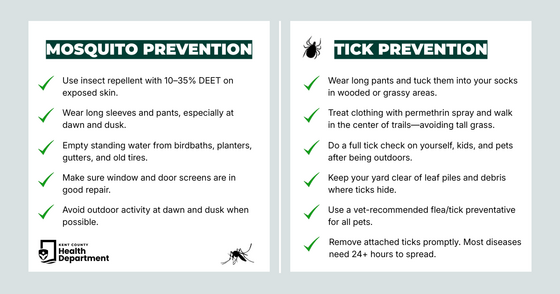
Summer may be winding down, but mosquitoes and ticks are still out and about, and recent cases of Eastern equine encephalitis (EEE) and West Nile virus (WNV) remind us that bites from these bugs can become serious.
With after-school activities back in full swing, keep taking simple steps to protect yourself and your family. Remember to use insect repellent, wear long sleeves and pants when possible, and check for ticks after spending time outdoors.
Pop-Up Public Health: Where to Find Our Mobile Unit
Summer may be winding down, but our mobile unit team is still on the move, making stops at community events throughout Kent County.

By meeting residents where they are, the team helps remove barriers and connects people directly with health information, services, and resources available.
Here is a look at where we'll be rolling to next:
Whether you're headed to a festival, fair, or food distribution event, we hope you’ll stop by and say hello if you see us! For more information about the services we provide through our mobile unit, please email Melissa Bisel or call 616-632-7096.
|
People’s Champion Award: Recognizing Teamwork and Community Impact
Each month, the previous recipient of the People’s Champion Award selects the next honoree — a tradition that allows us to recognize staff who consistently go above and beyond their everyday responsibilities.

This month, we’re proud to recognize our Registered Dietitians Sam Samuels and Jenn Sowle from our South Clinic for their expertise, teamwork, and passion for supporting both their coworkers and the community.
Sam and Jenn support many of the interns who come through the Women, Infants, and Children (WIC) program, contribute their time and expertise to committees working to strengthen WIC across the state, and regularly step outside their roles to help families — including discussing the importance of vaccines with parents.
Please join us in congratulating Sam and Jenn on this well-deserved recognition as our People’s Champions!
|
Opportunities with Impact: Start a Career in Public Health
Are you passionate about helping others and having a meaningful impact in your community? Consider applying to join our team!

We’re currently hiring for the following full-time position:
Working at your local health department means serving your neighbors, strengthening community partnerships, and being part of a team dedicated to caring for those who need it most.
|
Make a Difference: Apply to Serve Your Community
Want to help shape programs and services that affect residents across Kent County? The Kent County Board of Commissioners is seeking residents to serve on County boards, commissions, and committees.

Current openings include positions on the Kent County Family & Children’s Coordinating Council and Lakeshore Regional Entity Substance Use Oversight Policy Board, along with several other opportunities.
Qualified Kent County residents are encouraged to review current vacancies and apply online. Applications are due Wednesday, Sept. 30 with resumes and cover letters encouraged.
For more information, call the Board of Commissioners’ Office at 616-632-7580.
|
|