Ribbon Cutting Held for Completed Skokie River Revitalization Project
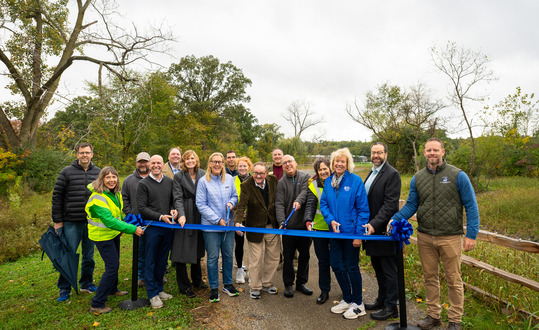
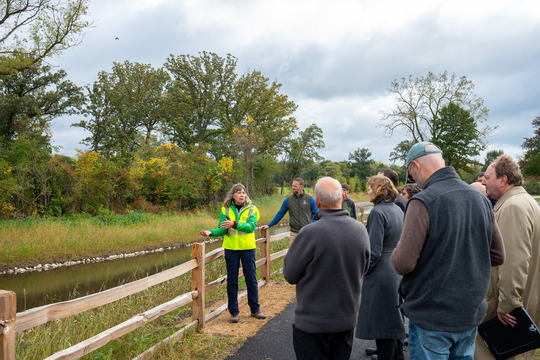
The Lake County Stormwater Management Commission (SMC) and the Skokie Consolidated Drainage District celebrated the completion of the Skokie River Channel Improvement Project in Highland Park on October 16 with speeches, a ribbon cutting and a short tour of the project area. This project stabilized severely degraded streambanks along the Skokie River in Danny Cunniff Park.
The river in this area had experienced excessive erosion, contributing to poor water quality and degraded aquatic habitats. Erosion also raised significant safety concerns by undermining structures along the river, including perimeter fences, pedestrian bridges and the walking path. The damage threatened nearby property and increased the risk of trees falling into the river.
To address these issues, the project included stream channel grading and streambank stabilization using stone and wire baskets to reinforce areas where the riverbanks had severely slumped. These improvements will help reduce erosion and protect nearby infrastructure.
Learn to Calibrate Winter Trucks
When winter arrives it inevitably brings snow and ice. Road salt and other deicing materials are necessary to keep our area roads, parking lots and sidewalks safe, but they can have a negative impact on our water and other infrastructure.
An important part of SMC’s mission is to help improve our area's water quality. We’ve partnered with the Lake County Health Department and Division of Transportation to educate our local partners about calibrating their winter trucks with the "How to Calibrate a Winter Truck" video. It features guidance on dry salt material and pre-wet (liquid) material calibrations.
This educational video will assist winter maintenance professionals in the public and private sectors in calibrating their own trucks before the winter season and after any relevant repairs. Applying the right amount of materials by calibrating vehicles, helps keep us safe during the winter season without excessive salt use and limits the environmental impacts to our local waterways.
Interested in educating your peers or sharing more about a recent work project? Apply to be a presenter at the upcoming 2027 DECI Workshop on Tuesday, February 9, 2027.
Each year, SMC strives to provide attendees with helpful, practical and real-world DECI related information. If you or someone you know would be a great presenter on a relevant and interesting topic, please apply. Presentations should be between 30 to 45 minutes.
The following topics were requested by previous attendees, but any related subjects will be considered:
- DECI Responsibilities: on a weekly basis, overcoming problems in the field
- New and Innovative SESC Technologies and Solutions
- Projects in Lake Michigan
- Regulation Updates from IEPA, SMC, USACE
- Contractor's Perspective
- Case Studies: successes and challenges
- Streambank Restoration
As always, any topic relating to soil erosion and sediment control will be considered. The deadline to apply to present is December 31.
There are great benefits to presenting at the DECI workshop!
- Highlight YOUR projects
- Celebrate your accomplishments and share your project challenges
- Connect and share your work knowledge with your peers
- Present innovative ideas, technology and solutions to a large audience
- Showcase your public speaking skills
Click on the link below to email your presentation topic to Mea Blauer or call (847) 377-7701.

Select Winter Best Practice Webinars Still Available
There's still time to register for the last of this year’s Winter Best Practice Workshops! A mix of virtual workshops for Public Roads and Parking Lots & Sidewalks are still being offered through November.
Public Roads
- Thursday, November 12 - Virtual
Parking Lots & Sidewalks
- Tuesday, November 17 - Virtual
Register for these workshops at: saltsmart.org/workshops
The online webinar fee is $90. Members may use the code CHLORIDE for a $10 discount. The webinar links are shareable within your organization so you only need one registration for each date. Login information for the webinars is provided at the time of registration; and the link to join the webinar will be emailed to you after you complete your registration.
Please note, attending these workshops counts toward meeting MS4 permit requirements. We ask that you encourage others to attend and distribute this registration information to your contacts at parks, schools, colleges/universities, hospitals, shopping mall and other snow removal contractors. By helping advertise this event, you are also meeting the education & outreach requirements of your MS4 permit.
Stormwater Awards Presentation
The nominations have been received and now the winners will be chosen! Join us at the Stormwater Board of Commissioners Meeting on December 3 if you'd like to see the winners of the 2026 Stormwater Awards recognized for their work.
Thursday, December 3 at 6 p.m.
Second Floor Conference Room
500 W. Winchester Road, Libertyville

SMC Working to Protect Wildlife
To help protect local wildlife and keep drivers safe at Lake County's Libertyville campus, the Stormwater Management Commission (SMC) coordinated and funded the installation of five new "Watch for Wildlife" signs. The signs were placed near water detention basins at the campus entrances and near the Central Permit Facility, home of SMC's offices, to remind drivers to watch for wildlife crossing the road.
This initiative began with a handful of concerned staff members who regularly helped turtles safely cross the road as they traveled between water sources. They wanted to encourage drivers to slow down to help reduce wildlife fatalities. SMC partnered with the Lake County Division of Transportation and Facilities to determine the best locations for the signs to help employees and visitors be aware of the wildlife activity on campus. Be sure to do your part by slowing down and look out for wildlife!

Friendly Reminder for Fall Leaves
 Now that the autumn leaves are falling, be sure to help do your part to keep leaves clear of storm drains. Storm sewers are designed to drain rainwater to prevent flooding. Leaves and grass clippings can clog storm drains, resulting in slow drainage, pooling water and in some cases, flooding. When large amounts of leaves are transported into waterways and watersheds it can also negatively impact the ecosystem.
Leaves transported through storm drains to rivers, lakes, and streams decompose in the water, releasing phosphorous. Phosphorus is an essential nutrient in plant development but can be harmful in excessive amounts in water. High levels of phosphorous stimulate the growth of algae, increasing the potential for algae blooms and depleting water oxygen levels, which can be harmful to fish and other aquatic species.
Remember these tips:
-
Sweep grass clippings, leaves and other debris off the street and away from storm drains
-
Leave the leaves to decompose, compost them, or dispose of all yard waste properly with paper yard bags
-
Never dump leaves or branches in streams or lakes
-
When it snows, try to shovel ice and snow away from storm drains to maintain a clear opening
|