County Board Members Advance Local Priorities at National NACo Conference
Lake County Board members recently joined county leaders from across the nation at the National Association of Counties (NACo) Annual Conference in New Orleans, where they advocated for federal policies that address local challenges, shared best practices with peers and strengthened partnerships between counties and the federal government.
They participated in discussions with elected officials and county leaders representing communities nationwide, sharing local perspectives and helping shape NACo’s federal advocacy priorities for the coming year.
Founded in 1935, NACo represents the nation’s more than 3,000 counties and serves as a collective voice for county governments in federal policy discussions. Through its annual conference, county leaders collaborate on solutions, share best practices and establish policy priorities that guide advocacy efforts with Congress and federal agencies.
During the conference, Lake County introduced and advanced several policy resolutions that were adopted by NACo and will now become part of the organization’s advocacy efforts at the federal level.
Lake County’s resolutions focused on issues where federal support and collaboration can help local governments better serve residents, supporting:
Programs to Reduce Gun Violence
Advocating for federal support of community-based violence intervention programs that address the root causes of violence and complement public safety efforts.
“Gun violence has no borders, and communities across the country are working together to implement solutions that make a difference,” said Gina Roberts, Lake County Board Member for District 4. “Community-based violence intervention programs give counties another tool to address the root causes of violence, strengthen partnerships and support safer communities. Continued federal support for these proven approaches can help communities expand this important work.”
Low-Carbon Fuel Standards for Hard-to-Electrify Fleets
Supporting policies that help local governments reduce emissions from hard-to-electrify fleets by expanding the use of low-carbon fuels, including renewable diesel and biodiesel, in long-haul trucks, heavy-duty equipment and emergency response vehicles.
“While we support the continued transition toward electric vehicles, we also recognize that some fleet vehicles and equipment are not easily electrified with today’s technology,” said Marah Altenberg, Lake County Board Member for District 19. “Low-carbon fuels, such as renewable diesel, provide an immediate opportunity to reduce emissions from these vehicles while maintaining the reliability of essential county services. By using a range of solutions, counties can continue making progress toward a more sustainable future.”
Protecting Local Authority in Artificial Intelligence Policy Making
Preserving local decision-making authority as communities develop responsible approaches to artificial intelligence, including protecting residents' personal data and managing local infrastructure impacts.
Strengthening Election Security and Administration
Supporting continued federal investment in election systems, including funding through the Help America Vote Act (HAVA) and the Elections Infrastructure Information Sharing and Analysis Center (EI-ISAC) to help counties maintain secure and accessible elections.
Improving Railway Safety and Protecting Communities
Federal action on rail safety issues, including blocked crossings, freight train impacts, hazardous materials transportation and infrastructure improvements.
Expanding Digital Access and Opportunity
Continued investment in broadband affordability, digital literacy programs and technology access initiatives that help residents connect to education, jobs, healthcare and government services.
Improving Access to Local News and Civic Information
Federal legislation that strengthens the availability of local journalism and civic information.
“Many of the challenges facing counties today require collaboration across all levels of government,” said Jennifer Clark, Lake County Board Member for District 15. “From election security and artificial intelligence to rail safety and digital access, these issues directly impact our communities. Through NACo, counties have an opportunity to share best practices and advocate for policies that strengthen the services residents rely on every day.”
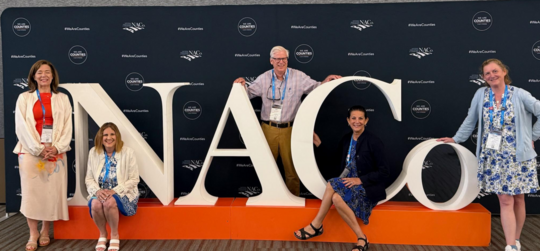 Lake County Board Members Sara Knizhnik (District 18), Marah Altenberg (District 19), John Wasik (District 6), Gina Roberts (District 4) and Jennifer Clark (District 15), at the 2026 NACo Annual Conference.
|