|

Please join us in welcoming Christopher Hoff, MPH, as the new Lake County Health Department and Community Health Center Executive Director effective March 10, 2025. Hoff is currently the Deputy Director, Public Health for the DuPage County Health Department where he has made significant contributions for over 10 years.
“I am honored to be joining the Lake County Health Department and Community Health Center as its next Executive Director. I’m excited to be leading a dedicated team of public health professionals in Lake County as we work to improve the health and quality of life for the Health Department’s clients, staff, and all residents of Lake County,” said Hoff.
Read the full press release for more information.
|

The Lake County Health Department is hosting a blood drive in cooperation with Vitalant and would like to invite members of the public to participate on:
Thursday, February 13
9 a.m. — 3 p.m.
Board Room (3rd Floor)
3010 Grand Ave., Waukegan, IL
Interested individuals can schedule an appointment by visiting donors.vitalant.org and using code ORD00475 or by calling 877-258-4825.
Appointments are recommended, but walk-ins are welcome. Prepare properly by eating well, hydrating, and bringing your ID.
Are you interested in donating blood but cannot make it on February 13? There are a number of Vitalant locations around Lake County where you can schedule an appointment to donate blood. Anyone who uses this link to schedule an appointment will give credit to the Lake County Health Department! Feel free to share the link with family and friends to increase LCHD/CHC’s giving totals. It is not required to sign up for an appointment, however it is recommended to ensure a smooth donor experience, plus not all centers are open 7 days a week. Find a Vitalant location near you!
|

Although avian flu (H5N1) is affecting poultry and dairy cows in the United States, there are currently no human cases of bird flu in Lake County, Illinois. Avian flu viruses mainly infect and spread among wild migratory water birds and domestic poultry, some bird flu viruses can infect and spread to other animals as well. Follow these steps to keep your pets safe and healthy:
- Feed your pet only fully cooked food—H5N1 virus can survive in raw pet foods.
- Never feed your cat raw milk—H5N1 virus can be found in raw milk.
- Keep pets away from birds and wildlife.
- Keep pets away from livestock and poultry.
- If you work with livestock or poultry, wash your hands and change your clothes before being around pets.
Talk with a veterinarian if you have concerns about your pet's health. Visit the CDC to learn more about bird flu and pets.
|
 |

Every day, about 37 people in the United States die in drunk-driving crashes — that's one person every 39 minutes. Alcohol reduces the function of the brain, impairs thinking, reasoning and muscle coordination. All these abilities are essential to operate a vehicle safely.
Being a responsible driver is simple: if you are drinking, do not drive.
- Plan your safe ride home before you start the party, choose a non-drinking friend as a designated driver.
- If someone you know has been drinking, do not let that person get behind the wheel. Take their keys and help them arrange a sober ride home.
- If you drink, do not drive for any reason. Call a taxi, a ride-share service, or a sober friend.
- If you’re hosting a party where alcohol will be served, make sure all guests leave with a sober driver.
- Always wear your seat belt — it’s your best defense against impaired drivers.
If you see an impaired driver on the road, contact local law enforcement. Your actions could help save someone’s life.
For more information and statistics, visit the National Highway Traffic Safety Administration.
|
|
American Heart Month
Heart disease is the leading cause of death in the United States – 1 in 5 people die from it each year, even though it is largely preventable. Research shows that many Americans will likely develop some form of heart disease, but you don’t have to be one of them. Devoting a little time every day to care for yourself can go a long way toward protecting the health of your heart. Simple self-care, such as taking a moment to de-stress, giving yourself time to move more, preparing healthier meals, and not cheating on sleep can all benefit your heart.
Knowing your own risk factors for heart disease can help guide your lifestyle choices. Talk to your healthcare provider if you have any questions or concerns.
Visit the National Heart, Lung, and Blood Institute to learn more about living a heart-healthy lifestyle.
|
|
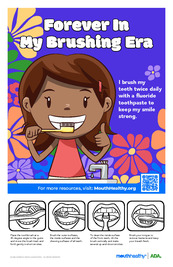
National Children’s Dental Health Month
National Children's Dental Health Month is a great time to promote the benefits of good oral hygiene. Did you know that cavities are the most common chronic disease of childhood? Developing good dental health habits can help children get a jump start on a lifetime of healthy teeth and gums.
Parents and caregivers can help their child develop healthy dental habits by:
- Brushing teeth two times a day with fluoride toothpaste
- Floss daily
- Eat healthy foods and limit sugary beverages
- See a dentist twice a year.
A child should see a dentist within six months of their first tooth appearance or by the age of one. Schedule an appointment with your dentist today to make sure your teeth are healthy and clean. If you don’t have a dentist, you can learn more about Dental Care at the Lake County Health Department.
Visit the CDC for more information and resources about children’s oral health.
|
|
Teen Dating Violence Awareness Month
Dating violence is more common than people think, especially among teens & young adults with 1 in 10 high school students face dating violence.
Healthy relationships all depend on a few key elements: healthy communication, healthy boundaries, mutual respect, and support for one another. It is a good idea to regularly check in with each other about each person needs while also ensuring both of you have space and privacy, and be sure to keep an eye out for the warning signs of dating abuse.
Be aware that relationships exist on a spectrum, and it can sometimes be hard to tell when a behavior goes from healthy to unhealthy or even when it becomes abusive. Know the typical warning signs of abuse.
Visit Love is Respect to learn more about what a healthy relationship looks like, personal safety, and how you can support others.
|
|
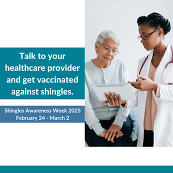
Shingles Awareness Week
Shingles Awareness Week is from February 24-March 2, 2025. Shingles is a painful, blistering skin condition that people develop when the virus that causes chickenpox reactivates in their bodies after they have already had chickenpox. Over 90% of adults over the age of 50 already carry the virus that causes shingles, and over 30% of adults will develop shingles in their lifetime. Shingles can sometimes lead to serious complications like long-term nerve pain and vision loss.
Shingles is avoidable. Getting the shingles vaccine is the best chance to reduce your likeliness of developing shingles. If you do get shingles, getting vaccinated can reduce your chances of long-lasting pain. Talk to your healthcare provider about your vaccination options.
Visit the CDC’s Shingles page for more information.
|
Where do I find information about...
Who can I contact to ask a question about...
-
Lake County Health Department Services: Call (847) 377-8000
-
COVID-19 in Illinois: Contact the Illinois Department of Public Health at 1-800-889-3931 or DPH.SICK@ILLINOIS.GOV
|
|
|
|
|