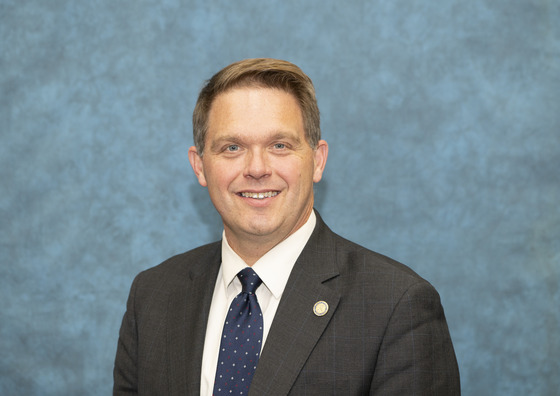
(Lake County, IL) Today, Eric Rinehart was officially sworn in, marking the start of his second term as Lake County State’s Attorney.
Along with him, all Lake County Assistant State's Attorneys and Investigators also took their oaths.
After the ceremony, State’s Attorney Rinehart expressed gratitude to his family for their support and presence and delivered the following statement:
"Thank you Judge Manak for your work in Lake County and the legal community. You are an amazing person who leads by example and who has never backed down from the challenge of helping others.
Next, I want to thank each and every person who has ever worked in the Lake County State’s Attorney’s office. By serving others and by making our communities safer, you have answered the highest calling. And to each of you, I want to thank you for your public service in advancing our office’s mission.
This mission is to make our community safer within a justice system that must be dedicated to truth, fairness, and compassion as it breathes life into democratically-passed laws and secures the constitutional rights that generations have fought to protect.
We serve: the Lake County residents who we strive to make safer today, and decades into the future; the survivors whose voices we lift up in the courtrooms as we join them in seeking justice in individual cases; and the civilians whose rights we protect by always making sure that we seek true justice – not “victories” – but fair and constitutional results.
While performing this solemn duty of bringing equal justice to every community, we must also strive to answer the question of why the most-resourced country in the world struggles with a crime problem?
Locally, we know that many types of violent crimes are down in Lake County – at a rate much faster than the national or state averages. But we cannot be complacent.
We will continue to hold offenders accountable through modern and effective investigations with our dedicated police partners. Because of new technology inside and outside the office, crime clearance rates have risen steadily – particularly in underserved communities. After an arrest, and without cash bail, we can now hold violent offenders and hopefully give some peace to survivors and protection to the community.
We will also keep investing in the amazing prosecutors, administrative staff, investigators, and victim specialists who take over after the police have solved the case. I will keep urging the county board and state legislature to prioritize safety and to invest in this office. We need more victim specialists to support domestic violence survivors, more prosecutors to decrease caseloads, and more tools to counteract the opioid crisis.
These steps will help us respond to the crime that happens right now.
But Bishop Desmond Tutu once said, 'There comes a point where we need to stop just pulling people out of the river. We need to look upstream to find out why they are falling in.'
Prevention is key to the long-term health of the community, and we are the ones who are best situated to identify what can prevent crime. In other words, we are the ones standing on the river.
In other words, the best way to be hard on crime is to prevent it in the first place – to find those root causes and to treat them so that violent crimes do not take lives. By saving lives and reducing crime we reduce generational and community trauma.
Investing in trauma reduction not only serves our moral mission, but also protects communities in the future. The same can be said of the need to invest in mental health and substance abuse treatment. We should expand our specialty courts so that more of those in-need can be part of such a successful treatment program. At the same time, we will expand diversion and deflection for simple, non-violent crimes to treat people closer in time to the offense, and to save time and resources in our courthouse for those cases with victims and/or that are complicated.
But our work cannot succeed without data, transparency, and trust from the community.
We must work much harder to create a data culture in Lake County. Not because we think data itself drives down crime, not because we believe data dashboards should replace compassion or counseling, but because we know that data will explain our successes, teach us about our mistakes, and allow us to compassionately and urgently direct people and money to those in the highest need.
Data will also help us strengthen the trust between the courthouse and the community. The community needs to see whether our office is diverse, whether our dispositions create racial disparities, and whether we are securing justice for all victims – regardless of what they look like, what language they speak, or where they are from. It may be uncomfortable, but I must lay down this challenge: we must work harder to end the racial disparities that we see in our crime victimization data, our coroner statistics, and our incarceration rates.
In conclusion, I want to end by thanking the community. Lake County is beautiful and diverse, with amazing resources and large challenges. Our local resources include our amazing non-profit organizations, our local governments, our churches, our schools, our civic organizations, our businesses, and our survivor-support providers. We know that using your connections and experiences will make this office stronger and our community healthier.
Our job must be to use our resources in this county to solve our crime problems so that we can lift everyone up and so that everyone is safe. We truly can achieve safety, justice, and equality for all. But it is hard work. And I know we are up to it as an office and as a community."