Lake County Public Works
Summer Newsletter
Welcome to the summer edition of the Lake County Public Works (LCPW) newsletter. Read below to learn more about summer water restrictions and projects we are working on throughout Lake County.
Summer Water Restrictions
From May 15 to September 15 each year, County ordinance prohibits the use of water for outside and landscaping purposes between 10 a.m. and 6 p.m. Outside water use is also restricted to certain days of the week. Even-numbered addresses can use outside water on even-numbered days, and odd-numbered addresses can use outside water on odd-numbered days. As we move into the later parts of summer, hotter and drier conditions can be present, which may lead to additional water-use restrictions.
Lake Michigan Water Interconnection Project
Lake Michigan water is on its way to the Pekara, Horatio Gardens and Inverrary neighborhoods in south central Lake County. The Lake County Board recently approved a contract that gave us the green light to begin construction on an interconnection project.
Construction is starting this month and will be completed this winter. Some residents in the area may experience short-term water service disruptions during construction. Affected customers will receive notice prior to water shutoffs.
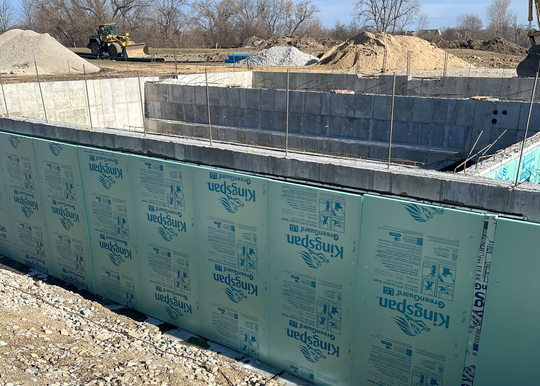
New Reservoir Under Construction
Construction on the White Deer Run Reservoir in Vernon Hills is progressing nicely! The new two-million-gallon reservoir will provide additional storage capacity in the event of increased water demand or emergency circumstances. This reservoir will be incredibly important to ensuring that the Vernon Hills Water System is resilient.
What You Flush. Where does it Go?
You often hear about the water coming to your home, but you don't hear much about what you flush and goes down your drain. Well, that water doesn't just end up in your backyard or sit underground (unless of course, you have have a septic tank!). Instead, it goes to a local water reclamation facility.
LCPW operates three water reclamation facilities (WRFs) serving about 125,000 people. These facilities are incredibly important, which is why we're investing in them through our Capital Improvement Program. Each WRF has a name:
- Des Plaines River WRF near Buffalo Grove
- Mill Creek WRF in Old Mill Creek
- Vernon Hills (NCT) WRF in Vernon Hills
Millions of gallons of wastewater can be treated every day at a WRF. During treatment, they remove biological nutrients like nitrogen and phosphorus, and greatly reduce the weight and volume of biosolids (yuck!). After treatment, this water is then sent back into the environment, flowing into the Des Plaines River, a tributary of the Mississippi River, and eventually traveling into the Gulf of Mexico. Our treatment facilities are operated in strict compliance with federal, state and local regulations to protect our waterways from hazardous discharge.
The treatment process is essential for public health and our environment. WRFs serve as the barrier between our wastewater and the environment. Needless to say, it would NOT BE GOOD if wastewater ended up in our lakes, rivers and streams before it was treated.
So now you know where the water goes after you use it. We thank you for reading this edition of the Public Works newsletter!
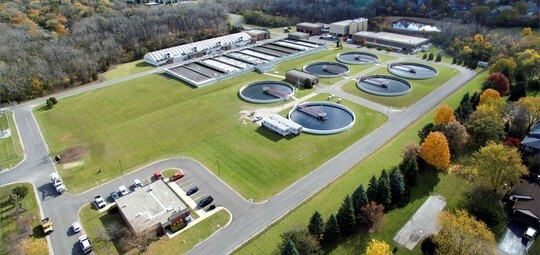 Des Plaines River Water Reclamation Facility
Contact Us
The Lake County Public Works Building located at 650 W. Winchester Road, Libertyville is open to the public. Customers may also contact us virtually with any questions or concerns at:
|