On Friday, March 1, the CDC released updated recommendations for how people can protect themselves and their community from respiratory viruses like flu, COVID-19, and RSV. The CDC made these updates because the U.S. is seeing far fewer hospitalizations and deaths with COVID-19 and because of the increase in tools and resources to combat respiratory viruses.
The simplified and unified recommendations include:
-
Staying up to date with vaccinations to protect people against serious illness, hospitalization, and death.
-
Practicing good hygiene by covering coughs and sneezes, washing or sanitizing hands often, and cleaning frequently touched surfaces.
-
Taking steps for cleaner air, such as bringing in more fresh outside air, purifying indoor air, or gathering outdoors.
-
Staying home and away from others when sick. People may resume normal activities when symptoms have been improving for 24 hours, and if a fever was present, it has been gone without use of fever-reducing medication.
The updated guidance also includes additional considerations for people who are at higher risk of severe illness from respiratory viruses. Learn more at the CDC’s Preventing Respiratory Viruses page.
|
 |
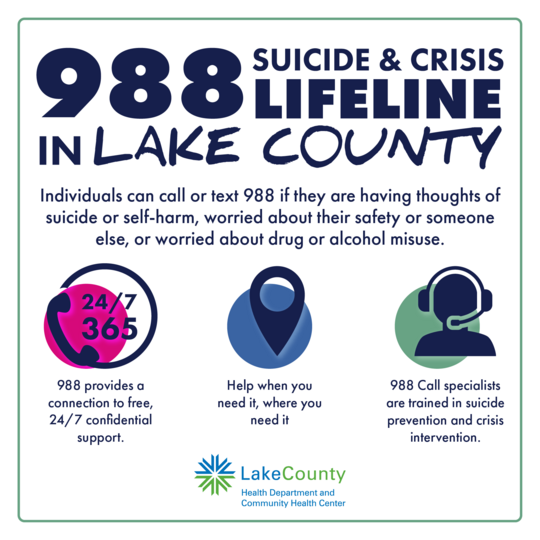 Life can be overwhelming, and it is okay not to feel okay. No matter what age you are, there is support for you. Get the support you need through the 988 Suicide & Crisis Lifeline. You can call or text 988 or visit 988lifeline.org/chat to talk to someone 24 hours a day, seven days a week.
Visit the 988 Suicide & Crisis Lifeline website and this Myth Busters sheet for more information about the hotline.
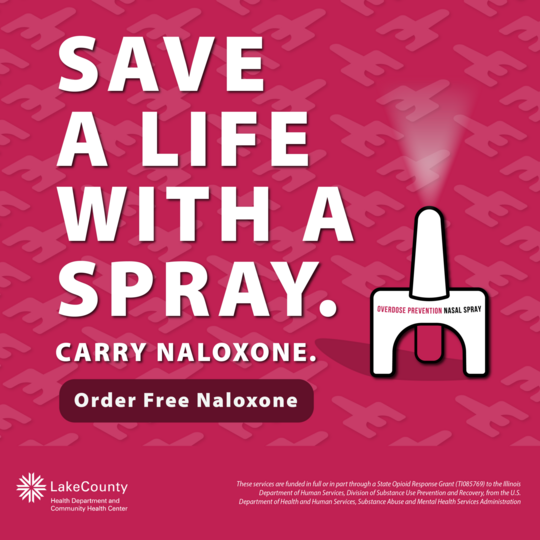 Minutes matter in the event of an overdose. If you or someone you care for uses opioids, carry naloxone. Naloxone is a lifesaving, non-addictive medication that can reverse the effects of an opioid overdose when used in time. Naloxone is safe and easy to use. If you or someone you care for uses opioids, it is especially important to carry naloxone and know how to use it. Tell your family and friends what it is, where it is, and how to use it. It may save a life.
Lake County residents can visit the Health Department's Naloxone Saves Lives page to learn more about naloxone, and place an order today!

We are excited to announce the release of the Health Department's 2023 Annual Report! This year's annual report's theme is "Connecting the Dots," highlighting stories of collaboration and coordination between our agency and, in some cases, community partners. Additionally, the report includes the achievements of our programs.
Watch this video to view some highlights from the report, or view the report in its entirety on our website.
|
|
February 29 was Rare Disease Day, occurring annually on the last day of February, which this year is the rarest day of the year! This is an internationally recognized day to raise awareness, generate support, and advocate for those with a rare disease. Most rare diseases are caused by genes, though some can be from environmental factors. Rare diseases impact an estimated 25 to 30 million Americans—that is 1 in 10 people! Although each disease is individually rare, collectively, many are affected.
For more information about rare diseases, visit the National Human Genome Research Institute, and the NIH Genetic and Rare Diseases (GARD) Information Center for a comprehensive list of rare diseases.
|
|
Shingles Awareness Week is from February 26–March 3, 2024. Over 90% of adults over the age of 50 already carry the virus that causes shingles, and over 30% of adults will develop shingles in their lifetime. People develop shingles when the virus that causes chickenpox reactivates in their bodies after they have already had chickenpox.
Shingles is avoidable. Getting the shingles vaccine is the best chance to reduce your likeliness of developing shingles. If you do get shingles, getting vaccinated can reduce your chances of long-lasting pain. Talk to your healthcare provider about your vaccination options.
Visit the CDC’s Shingles page for more information.
|
|

March is National Nutrition Month created by the Academy of Nutrition and Dietetics. National Nutrition Month encourages making informed food choices and developing healthy eating and physical activity habits. This year’s theme, “Beyond the Table," addresses the farm-to-fork aspect of nutrition, from food production and distribution to navigating grocery stores and farmers markets. It also describes the various ways we eat and includes sustainability. National Nutrition Month weekly themes will focus on:
-
Staying nourished on any budget:
- Learn cooking, food preparation and meal planning skills
- Use a grocery list and shop sales when purchasing food
-
Seeing a Registered Dietitian Nutritionist (RDN):
- Ask your doctor for a referral to an RDN
- Find an RDN who specializes in your unique needs
-
Eating a variety of foods from all food groups:
- Eat foods in various forms including fresh, frozen, canned, and dried
- Try new foods or global cuisines
-
Eating with the environment in mind:
- Get creative with leftovers and ways to reduce food waste
- Grow food at home or in a community garden
View this handout for more tips surrounding food, nutrition and health.
|
|
Colorectal cancer is the second leading cause of cancer death in the United States, affecting both men and women, but it can be prevented with routine screening. Regular screening, beginning at age 45, is the key to preventing colorectal cancer (cancer of the colon or rectum). If you're younger than 45 and think you may be at high risk of getting colorectal cancer, or if you're older than 75, talk to your doctor about screening.
Visit the CDC to learn more about colorectal cancer.
|
Groundwater Awareness Week, March 10-16, 2024, is observed as a reminder of how important groundwater is to our health and environment while encouraging yearly water well testing and well maintenance. An estimated 145 million Americans get their tap water from a groundwater source.
Mark your calendars because between March 10 and March 22, 2023, the Health Department will be offering a reduced well water testing fee for homeowners who use well water as their primary source of drinking water. The normal $18.00 fee for testing for bacteria and nitrates will be reduced to $15.00.
Sterile test bottles and sampling instructions are available at the Lake County Central Permit Facility at 500 W. Winchester Road, Libertyville, the Health Department's headquarters at 3010 Grand Avenue, Waukegan, and 19 township or municipal offices located throughout Lake County. To find a location nearest you, call (847) 377-8020 or visit lakecountyil.gov/726/water-wells. Water sampling kits can also be mailed to residents for an additional postage fee.
Visit the Health Department’s Water Wells page for more information.
|
World Tuberculosis (TB) Day is recognized annually on March 24. TB is one of the world’s leading infectious disease killers.
There are two types of TB conditions: TB disease and latent TB infection. People with TB disease are sick from active TB germs. They usually have symptoms and may spread TB germs to others. People with latent TB infection do not feel sick, do not have symptoms, and cannot spread TB germs to others. But, if their TB germs become active, they can develop TB disease. If left untreated, 1 in 10 people with latent TB will get sick with active TB, which can spread to others and be deadly.
The Health Department’s Tuberculosis Clinic provides screening, testing, consultation, education, treatment, and home visits for anyone living, attending school, or working in Lake County. Visit our TB Clinic page for more information.
To learn more about Tuberculosis, visit the CDC.
|
Where do I find information about...
Who can I contact to ask a question about...
-
Lake County Health Department Services: Call (847) 377-8000
-
COVID-19 in Illinois: Contact the Illinois Department of Public Health at 1-800-889-3931 or DPH.SICK@ILLINOIS.GOV
|