|
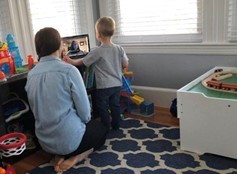
Live video visits (i.e., telehealth or teletherapy) enable you to receive EI services during COVID-19. Live video visits are new to Illinois’ EI system and are being offered during the pandemic. Here are some questions you may have about live video visits.
What Are Live Video Visits?
Live video visits are EI services provided through the Internet. You and your EI provider will be present in real time. Over an Internet platform, you will see and hear your EI provider. Internet platforms vary; platforms may include Skype and Zoom.
Who Provides Live Video Visits?
Your service coordinator and EI provider may provide live video visits. Just like during in-person EI visits, the live video visit will include coaching. Specifically, your EI provider will coach you in using EI strategies with your child. The coaching may include joint planning between you and the EI provider, reflection on your own practices with your child, feedback from the EI provider about ways to support your child, observations the EI provider uses to learn about your family interactions, and suggestions for actions/activities (e.g., strategies, modeling) to help you meet your goals.
Where and When Can Live Video Visits Be Provided?
Your service coordinator will contact you to explain live video visits. You and your EI provider decide how you will receive your EI services. If live video visits are selected, you will schedule the live video visit at a convenient time/date. To ensure privacy, we encourage you to conduct the live video visit in a quiet area of your home, to the extent possible.
Why Provide Live Video Visits?
During COVID-19, live video visits are one of the safest ways to receive EI services. Illinois has continued to implement live video visits so you and your family can continue to receive EI services and supports during the pandemic. In addition to keeping families safe and healthy, Illinois Early Intervention and DHS (Illinois Department of Human Services) recognize live video visits are equally effective as in-person therapy sessions.
Do Live Video Visits Require My Child to Sit in Front of a Screen for an Hour?
Your child does not need to be present for the entire visit. Just like in-person visits, your EI service provides an opportunity for you to receive coaching from your EI provider. It may be helpful for the interventionist to see your interactions with your child or how your child is accomplishing certain tasks, but your child will not need to be in front of the screen for an hour. Your EI visit may also include the provider giving you feedback about strategies to use with your child. Also, if needed, you can split up your EI session into two 30-minute sessions.
For a short (four minute) video about what to expect during the live video visit, see:
A Family Perspective (infanthearing.org)
Raising a child with Special Needs does not take a special family. It makes a family special.

What Is Family Engagement?
By Chelsea Guillen
Family engagement is an essential component of early intervention services and is driven by the use of family-centered practices. When your team uses family-centered practices, you can expect to be treated in particular ways, be involved in informed decision-making, and be an active participant in identifying outcomes and developing strategies for your child and family.
These practices also can help you advocate for your child, understand your choices, and grow your leadership skills. They support the development of critical family-professional partnerships, too. Ultimately, the practices help professionals tailor their approaches to each unique family.
Out of all the members on your child’s EI team, you have the most knowledge about your child, your family, and what you want to happen as your child learns and grows. Team members will look to you to share information during your child’s evaluations and for ideas about what you’d like to work on.
It is important to share information about your child’s likes and interests with your team. Only you know what is best for your family and the things you already do to help your child. Your knowledge and experience are unique.
Your conversations with team members help them learn about your family. As they understand more about your concerns and priorities, they become better prepared to offer helpful information. To aid understanding, they need to provide opportunities to really listen to you. You should feel comfortable asking questions about anything you don’t understand and should expect the information they share to be complete and unbiased.
Information about your family’s concerns and priorities should be included in your child’s Individualized Family Service Plan. Team members will use this plan to guide their interactions with your family. Intervention visits provide opportunities for expanding what your team knows.
Interacting with your team members during visits provides opportunities for trying out strategies, sharing ideas about what to address next, and providing feedback on what is or is not working.
Because family engagement is so critical to successful early intervention services, the Division for Early Childhood (DEC), an organization for families who have children with delays and disabilities and the professionals who support them, has developed a subset of its recommended practices that focuses on families.
Although these recommended practices were developed to guide practitioners’ behavior, understanding the practices can help you know what to expect from your team and how to work together successfully. You can see the full set of DEC Recommended Practices on the DEC website.
The Early Childhood Technical Assistance Center has developed several family practice guides to help families understand the practices and know when they are working. They can be found on the ECTA website. Four particular guides of interest include:
|

Parenting Concerns in a COVID World
As parents, it’s a joy to see kids getting back to social gatherings, but there is still that tinge of anxiety about what the summer will bring. So, what can parents do? Be kind to yourselves and when you are feeling unsure, seek support and care from your family, friends, clergy, and anyone else who you feel comfortable with.
Full Article - Parenting Concerns in a Covid World | JCFS
Pandemic babies are behind after years of stress, isolation affected brain development
Full Article - Pandemic babies are behind after years of stress, isolation affected brain development (msn.com)
Baby talk isn’t just cute—it’s critical for kids’ vocabularies
You know how your voice automatically jumps an octave when you’re around a baby? There’s a reason for that.
Full Article: Baby talk plays a big role in language development | Popular Science (popsci.com)
How to Help Late Talkers: Activities for Parents and Caregivers
Full Article: How to Help Late Talkers: Activities for Parents and Caregivers | Speech Pathology Masters Programs
Positive Solutions for Families: Family Routine Guide
This Family Routine Guide can assist parents and caregivers in developing a plan to support young children who are using challenging behavior. Children engage in challenging behavior for a variety of reasons, but all children use challenging behavior to communicate messages. Challenging behavior, typically, communicates a need to escape or avoid a person or activity or communicates a desire to obtain someone or something. Once caregivers understand the purpose or meaning of the behavior, they can begin to select strategies to change the behavior. They can do this by selecting prevention strategies, teaching new skills, and changing the way they respond to eliminate or minimize the challenging behavior.
Full Resource: Positive Solutions for Families: Family Routine Guide (usf.edu)
|
 |
Join us for a FREE and FUN nutrition and activity lessons that bring together art, stories, and music for the entire family!
These virtual meetings will be held monthly on the FIRST WEDNESDAY of the month at 4pm for all Early Intervention Families!
Virtual Team Meeting: Email Kayla Olson; Early Intervention Parent Liaison and a meeting link and program details will be provided!
Email address: Kolson@lakecountyil.gov
|