CMAP has asked us to share this recently released guidebook with our members. If your community is considering taking any of these actions, please send Mike Klemens an e-mail with what actions your community is considering. CMAP is collecting information about how regional recovery efforts are being implemented.
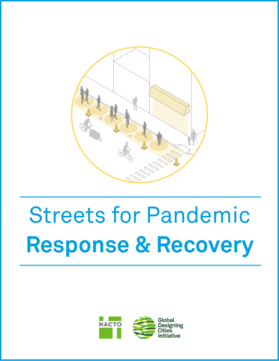 The COVID-19 global pandemic altered every aspect of urban life in recent months. In response, city transportation officials around the world have quickly implemented new street design and management tools to keep essential workers and goods moving, provide safe access to grocery stores and other essential businesses, and ensure that people have safe space for social/physical distancing while getting outside. These evolving practices will shape our cities as we respond to the COVID-19 pandemic and are key to our long-term recovery.
Streets for Pandemic Response and Recovery compiles emerging practices from around the world and includes implementation resources for cities and their partners. Recognizing the rapidly changing nature of this pandemic, Streets for Pandemic Response and Recovery will be revised and expanded to include new strategies, address changing conditions, and provide the best possible information on each design practice.
As of May 21, 2020, Streets for Pandemic Response and Recovery includes an introduction to using streets for recovery and response (pdf) and detailed implementation information about the following street strategies:
- Lanes for Biking & Rolling (pdf)
- Sidewalk Extensions (pdf)
- Transit Lanes (pdf)
- Slow Streets (pdf)
- Pick-Up & Delivery Zones (pdf)
- Outdoor Dining (pdf)
- Markets (pdf)
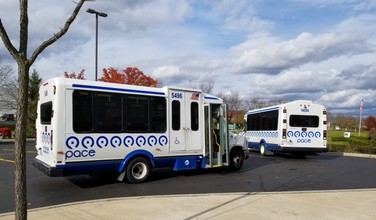 Do you or someone you know face transportation challenges? The Regional Transportation Authority (RTA) wants to hear from you about transportation issues and gaps that may exist in the RTA region.
Please fill out a survey to help the RTA improve transit options for older adults and people with disabilities in the greater Chicago region.
The RTA is updating the 2013 Human Services Transportation Plan (HSTP). The plan’s goal is to build on the existing network of transportation services provided by public, private, and human service organizations. The agency also uses the HSTP to connect projects to funding through the Section 5310 Enhanced Mobility for Seniors and Individuals with Disabilities Program.
The planning process involves extensive stakeholder involvement, public outreach, evaluation of existing services, and identification of transportation barriers, gaps, and challenges. This work will provide a foundation for new, coordinated transportation goals and strategies to guide planning over the next five years. Please help us by forwarding this e-mail or the separate survey links to the appropriate groups of people.
Three different surveys are now available. Please take the appropriate survey by Monday, June 8 to give your feedback on this important issue.
- Are you a rider who takes Pace, CTA, Metra, Dial-A-Ride, or other public transit or transportation service? “Human service transportation” can include rides provided by your employer, senior service program, or disability service agency. “Private transit” might include a taxi, shared rides on Uber, Lyft, or other micro-transit service, or a vehicle owned by an assisted living community. Take this survey.
- Do you work in health, economic development, or human services? If so, you provide your customers an essential service every day and have a unique perspective on their transportation needs. Take this survey.
- Do you work in transit or transportation services in the six-county RTA region, which includes Cook, DuPage, Kane, Lake, McHenry, and Will counties, as well as portions of Kendall, DeKalb, or Grundy counties? Take this survey.
 The State of Illinois through the Department of Commerce and Economic Opportunity(DCEO) has allocated $25,000,000 in Rebuild Illinois funds to the Fast-Track Public Infrastructure (FTPI) component. Applicants may apply for multiple projects, and a grant ceiling of $5,000,000 per applicant has been established. Grants for less than $500,000 will not be awarded. This grant opportunity does not require a cost sharing or match option. The objective of this program is to stimulate the economy in the wake of the COVID-19 health crisis by quickly getting Illinoisans back to work on public infrastructure projects that are valuable to their communities.
Applications will be accepted on a rolling basis. Projects will be funded on a first come, first qualified, first serve basis. Applications will be accepted until Monday, June 15, 2020 or until funds have been exhausted.
All uses must comply with the Bondability Guidelines attached to the Notice of Funding Opportunity. Only projects that can demonstrate the ability to break ground within 90 days of receiving a Notice of State Award Finalist (NOSAF) will be eligible for grants.
Eligible projects: Eligible projects include a wide range of public infrastructure improvement
projects, including projects that entail new construction and/or significant renovation or
improvements of:
• Publicly owned buildings, facilities, and parks
• Publicly owned industrial and commercial sites
• Waste disposal systems
• Water and sewer line extensions
• Water distribution and purification facilities
• Gas and electric utility extensions
• Dredging of waterways
• Rail, air, or water port improvements
• ADA-compliant sidewalks, curb and gutters
• Previously unimproved WPA streets
• Other public infrastructure capital improvement
Click here for the Notice of Funding Opportunity
Click Here for the Fast Track Public Infrastructure Guidebook
|