|
December 2018/January 2019
Dear Community Leaders,
Welcome to another edition of “For the People.” In addition to information regarding some new changes to our laws, this edition highlights some of our efforts to engage our youth and our community. Rather than wait to prosecute crime after it has occurred, our office works every day with our many community partners to prevent crime in the first place. One part of our job in the Lake County State’s Attorney’s Office is—and will always be—the prosecution of crimes. However, I firmly believe that crime prevention is the best way to keep those that live and work in our county safe.
One of our efforts is a Youth Advisory Board. We have worked over the past few years to increase our outreach to young people. Our Youth Advisory Board consists of students from across Lake County who volunteer their time to help us fulfill our mission. Their insight and feedback have been invaluable. These young leaders have helped us create programs and improve existing ones, and they have also facilitated presentations to their peers on issues like teen-dating violence, drug and alcohol abuse, bullying, social media, and internet safety.
Continuing our efforts to engage the community, we are pleased to partner with Nicasa Behavioral Health Services, the Zacharias Center, A Safe Place, and YWCA Lake County to sponsor this year’s “Lake County Rising” event, which urges our entire community to come together and take a stand against the abuse and oppression of women globally. While these types of crime have traditionally been under-reported, we have witnessed a significant increase in the number of survivors that have taken the courageous step of coming forward. Public demonstrations of support for survivors, like Lake County Rising, serve to empower those who have been victimized.
We continue to face many challenges, but as community partners, we face them together. I remain proud to work alongside the dedicated men and women of the Lake County State’s Attorney’s Office, and to encourage us all to continue to work together to ensure that Lake County is a happy, healthy, and safe community.
Yours,
 Michael G. Nerheim, Lake County State's Attorney
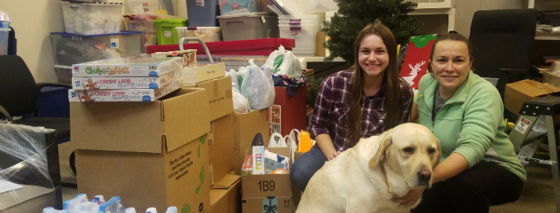 Left to Right: Cheyenne Biedron, Teresa Pieczykowski, and Mitchell the Facility Dog
In December 2018, ZionSolutions, EnergySolutions and Manafort Brothers Inc. collaborated with Cheyenne Biedron, a Young Ambassadors Board member of the Lake County Children's Advocacy Center (LCCAC) to bring holiday donations to the children at the LCCAC in Gurnee. In addition to the collaboration, Cheyenne and her mother Teresa Pieczykowski made an enormous contribution for families to enjoy the holidays. Monetary donations were also received.
One family expressed that they had never had a Christmas tree for the holidays. Cheyenne heard this, and donated a Christmas tree and ornaments to the family.
Cheyenne is currently a senior at Zion-Benton High School.
ZionSolutions, EnergySolutions and Manafort Brothers Inc. are currently working on the clean-up, decommissioning, and deconstruction of the old nuclear plant in Zion.
On December 12, 2018, Lake County State's Attorney Michael G. Nerheim was elected by his colleagues in the Second Judicial District to serve on the Board of Governors for the Illinois Office of the State's Attorneys Appellate Prosecutor (ILSAAP).
ILSAAP is a judicial agency of state government that provides support services for the 102 State’s Attorneys throughout Illinois. The agency is responsible for handling intermediate appeals, providing advice on novel and complex legal issues, conducting conflict-of-interest prosecutions, training prosecutors and coordinating legislative policy recommendations. The Board of Governors is responsible for overseeing and providing guidance to the Director of the agency, who handles all administrative and managerial functions for the 70 plus employees statewide. Together, they help prosecutors pursue justice, not merely convictions.
Membership of the ILSAAP encompasses all 102 State’s Attorneys, but the Board of Governors is comprised of ten elected State's Attorneys who direct the Agency's functions. Eight State's Attorneys are elected to serve on the Board, with two from each judicial district, plus the Cook County State's Attorney, who serves by statute, and one additional State's Attorney, who is appointed as a member-at-large by the other nine members. The Board members elect officers to preside during their one-year term.
The counties in the Second Judicial District include:
- Boone
- Carroll
- DeKalb
- DuPage
- Jo Daviess
- Kane
- Kendall
- Lake
- Lee
- McHenry
- Ogle
- Stephenson
- Winnebago
In addition, at its meeting on December 12, 2018, statewide members of the Illinois State's Attorney's Association elected State's Attorney Nerheim to serve on the Executive Committee of that Association.
"I am honored to have been selected by my fellow State’s Attorneys to help represent the interests of justice across Northern Illinois. While the Second District is comprised of counties that range from urban to rural, we share many of the same issues," said Nerheim. "By working together, we can ensure that we are all most effectively serving our respective communities," he added.
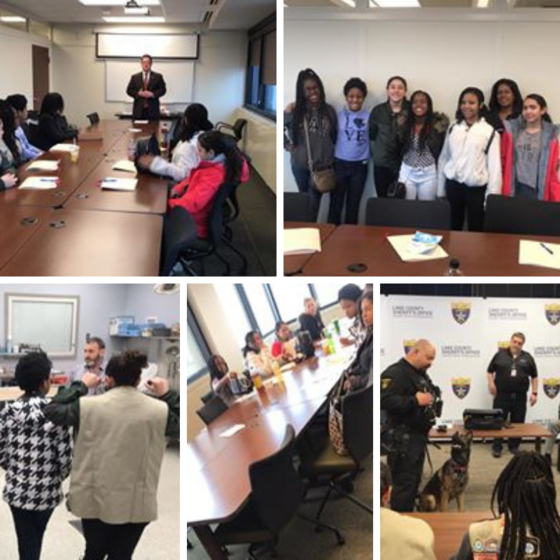 The Girl Scouts Troop of Beach Park completed a ‘Knowledge is Power’ workshop on January 14, 2019! The girls visited the different government offices throughout the day. Thank you the County, the Sheriff's Office the Coroner's Office, the Public Defender's Office, the staff with Lake County T.V., and the 19th Judicial Circuit Court for helping us host the girls! They learned so much about careers within the justice system.
The Lake County State's Attorney's Office's Knowledge is Power program invites high school students to learn about the various careers in Lake County Government through internships. This semester, the LCSAO is happy to have Mundelein High School seniors Jennifer Lopez, Madison Parola and Abby Gomez on board!
The Knowledge is Power program is intended to provide an opportunity for young people in our community to experience the criminal justice system in a positive way.
The goal is to educate youths regarding all aspects of the criminal justice system and to inspire them to consider potential career paths in the field.
The Lake County State’s Attorney’s Office works in collaboration with high schools and middle schools across Lake County, along with other Lake County justice partners, to make the program a wonderful experience for the participants.
“We want our future leaders to see who we are and what we do, so they can see first-hand how their criminal justice system works, and in doing so, hopefully inspire the next generation of public servants,” said State's Attorney Michael G. Nerheim
The program is made possible through the collaboration of our justice partners, including, the 19th Judicial Circuit, the Lake County Coroner’s Office, the Lake County Sheriff’s Office, the Lake County Public Defender's Office and Lake County Television.
For more information, contact Cynthia Vargas at cvargas@lakecountyil.gov.
The Illinois legislature passed many new laws, which become effective in 2019. A complete list, with a summary of the law, is available from the Illinois State Police website, http://www.isp.state.il.us/docs/1-176.pdf. All of the new laws take effect on January 1, 2019 unless otherwise noted.
Public Act 100-607/House Bill 2354
One of the new state laws is the Firearms Restraining Order Act, which was created by Public Act 100-607/House Bill 2354. This law provides that a person can petition a court for a firearm restraining order. There are two types of firearm restraining orders. The first type is an emergency restraining order, and the second type is a six-month restraining order. A petitioner may request an emergency firearm restraining order by filing an affidavit or verified pleading that alleges that the respondent poses an immediate and present danger of causing personal injury to himself/herself or another by having a firearm in their custody or control, or by having the ability to obtain a firearm for causing injury. The ex-parte hearing shall be held the same day the petition is filed, or the next day. The petition should describe all of the firearms that a respondent has access to, and their locations.
A law enforcement officer may seek an emergency firearm restraining order if the officer believes that someone’s “intimate partner” (defined as a “spouse, former spouse, or a person with whom the respondent has or allegedly has a child in common”) is the target of the immediate and present danger. The officer must make a good faith effort to notify the intimate partner of the danger, and if the officer cannot notify the partner, the officer must, in an affidavit, describe the efforts taken to notify the intimate partner of the danger. The notice to the intimate partner must include that the petitioner intends to petition a court for an emergency firearm restraining order, and include a referral to relevant domestic violence or stalking advocacy or counseling resources.
If an emergency hearing is held, the judge must find probable cause that the respondent poses an immediate and present danger of causing personal injury to himself/herself or another by having a firearm in his custody or control. Once the judge finds probable cause, the judge will issue a search warrant directing a law enforcement agency to seize the respondent’s firearms and Firearms Owners Identification Card and Concealed Carry License, if applicable. The law enforcement agency must retain the items seized.
If a petitioner does not ask for an emergency hearing, then the petitioner may request a six-month firearm restraining order. A different standard then applies, because the petitioner need not allege an “immediate and present” danger, but rather a “significant danger” of personal injury to himself/herself or others. Once the petition is filed, the court must order a hearing within 30 days. At a hearing for the six-month firearms restraining order, the court must find by clear and convincing evidence that a respondent poses a significant danger of causing personal injury to himself/herself or others by having a firearm in his or her possession.
Some of the factors the court may consider in granting a petition include the respondent’s: reckless display or brandishing of a firearm; history of attempted or threatened physical force against another; prior arrests; drug or alcohol abuse; recent threats or acts of violence toward himself/herself or others; violations of orders of protection; and pattern of violent acts. Courts may also consider other relevant evidence.
The Act also provides that “any act of omission or commission by any law enforcement officer acting in good faith in rendering emergency assistance or otherwise enforcing this Act shall not impose civil liability upon the law enforcement officer of his or her supervisor or employer, unless the act is a result of willful or wanton misconduct.” 430 ILCS 67/75.
Public Act 100-060/Senate Bill 3256
A different law, Public Act 100-060/Senate Bill 3256, provides that a person commits the offense of unlawful sale or delivery of firearms when he or she knowingly delivers any firearm, incidental to a sale, without withholding delivery of the firearm for at least 72 hours after application for its purchase has been made. Current law permits delivery of a rifle, shotgun or other long gun after 24 hours. The law remains 24 hours for tasers and stun guns.
Public Act 100-0911/House Bill 5231
Public Act 100-0911/House Bill 5231 provides that an employer of an law enforcement officer shall not make possession of a Firearm’s Owner’s Identification Card a condition of continued employment if the officer’s Firearm Owner’s Identification Card is revoked or seized because the officer has been a patient of a mental health facility and the officer has not been determined to pose a clear and present danger to himself,/herself or others as determined by a physician, clinical psychologist, or qualified examiner. 50 ILCS 725/6 and 7.2.
Public Act 100-927/Senate Bill 2560
Public Act 100-927/Senate Bill 2560 amends the freedom of Information Act to limit the publishing of booking photographs with respect to civil offenses and offenses that are classified as less than Class A misdemeanor. It also amends the Consumer Fraud and Deceptive Business Practices Act to provide for the correction of errors by entities that publish criminal-record information for profit. It provides remedies for persons injured by a violation. It does not apply to the Illinois State Police, a news medium or reporter, or a consumer reporting agency. 5 ILCS 140/2.5, 160/4a, and 815 ILCS 505/2000.
Public Act 100-1004/House Bill 3920
Public Act 100-1004/House Bill 3920 provides that a person who drives or is in actual physical control of a motor vehicle while his or her driver’s license or privilege to drive is suspended due to a violation of 625 ILCS 5/6-306.5 or 625 ILCS 5/7-702 shall receive a Uniform Traffic Citation from the law enforcement officer. The ticket is a petty offense. However, if the offender receives three or more Uniform Traffic Citations without paying any associated fees, he or she shall be guilty of a Class A misdemeanor. 625 ILCS 5/6-303. Note: 625 ILCS 6-306.5 is a suspension for failure to pay tickets issued by automated enforcement systems. 626 ILCS 5/7-702 involves a suspension for violations of child support or visitation orders.
Public Act 100-1010/ Senate Bill 271
Public Act 100-1010/ Senate Bill 271 provides that a prosecution for any offense involving sexual conduct or sexual penetration, in which the victim was 18 years of age or older at the time of the offense, may be commenced within one year after the discovery of the offense by the victim when corroborating physical evidence is available. It also provides that the charging document shall state that the statute of limitations is extended under this provision and shall state the circumstances justifying the extension. It also provides that nothing in the new provision shall be construed to shorten the period within which a prosecution must be commenced under any other provision of the extended limitations or general limitations statutes. 720 ILCS 5/3-6.
Public Act 100-789/Senate Bill 2341
Public Act 100-789/Senate Bill 2341 expands the existing list of specified synthetic cathinones that are Schedule 1 controlled substances to include any synthetic cathinones that are not approved by the United States Food and Drug Administration or, if approved, are not dispensed or possessed in accordance with State or federal law. It also provides that synthetic cannabinoids and piperazines are schedule 1 controlled substances when they are not approved by the United States Food and Drug Administration, or, if approved, are not dispensed or possessed in accordance with State or federal law. 720 ILCS 570/102 and 204.
Public Act 100-690/House Bill 5267
Public Act 100-690/House Bill 5267 provides that a “crime of violence” in the Crime Victims Compensation Act includes: (i) posting identifying or graphic information on a pornographic Internet site or possessing graphic information with pornographic material; and (ii) non-consensual dissemination of private sexual images. The law specifies that “pecuniary loss” means appropriate expenses (instead of expenses) for psychiatric care or counseling. It provides that a law enforcement agency within this State shall, with 15 days of receipt of a written request, provide the Attorney General’s office with the law enforcement agency’s full written report of the investigation of the crime for which an application for compensation has been filed. It provides that the law enforcement agency may redact the following from the report: names of confidential sources and informants; locations from which law enforcement conduct surveillance; and information related to issues of national security the law enforcement agency provided to or received from the United States Department of Homeland Security or another federal law enforcement agency. It also provides that the Attorney General’s office and a law enforcement agency may agree to the redaction of other information in the report or to the provision of necessary information in another format. The records that are obtained by the Attorney General’s office shall not be disclosed to the public, including the applicant, by the Attorney General’s office, and are exempt from disclosure under the Freedom of Information Act. 5 ILCS 140/7.5, 740 ILCS 45/2 and 45/4.2.
Public Act 100-740/Senate Bill 2270
Public Act 100-740/Senate Bill 2270 provides in the Humane Care of Animals Act that nothing shall prohibit a law enforcement officer from taking temporary custody of a dog or cat that is a companion animal that is exposed in a manner that palaces the dog or cat in a life threatening situation for a prolonged period of time in extreme heat or cold conditions that may result in injury or death of the animal or may result in hypothermia, hyperthermia, frostbite, or similar condition. Upon taking temporary custody of the dog or cat, the law enforcement officer shall attempt to contact the owner and shall seek emergency veterinary care as soon as possible. 510 ILCS 70/3.01.
Public Act 100-703/Senate Bill 2295
Public Act 100-703/Senate Bill 2295 amends the Fish and Aquatic Life Code to define “fishing license” as an electronic or physical license authorizing the person to take a certain type of fish during a specified period.
Public Act 100-1001/ Senate Bill 3509
Public Act 100-1001/ Senate Bill 3509 provides within the Municipal Code that municipalities are prohibited from requiring police officers to issue a specific number of citations within a designated period. It removes an exclusion for municipalities with their own independent inspector general and law enforcement review authority. 65 ILCS 5/11-1-12
Public Act 100-0996/Senate Bill 2350
Public Act 100-0996/Senate Bill 2350 amends the School Safety Drill Act in that it provides that within the first 90 days of a new school year, schools must conduct at least one law enforcement drill that addresses an active threat or active shooter within the school building. 105 ILCS 128/20
Public Act 100-828/House Bill 4472
Public Act 100-828/House Bill 4472 amends the Illinois Vehicle code in that now it requires all vehicles licensed in another State but being driven upon the highways of the State of Illinois to have proof of a liability insurance policy. 625 ILCS 7/7-601(d)
The Faith Committee of the Lake County Domestic Violence Council will be hosting a lunch and learn on Thursday, February 28, 2019 from 11:30 am until 1 pm at the Waukegan Public Library's Bradbury Room.
Recognizing that people facing difficulties in life often turn to their institution of faith for support and guidance, the Faith Committee’s mission is to empower faith communities to intervene and act when family violence is encountered. Institutions of faith are equipped with the tools needed to appropriately refer families to community resources and to create safe environments in their communities, homes and places of worship. Areas of focus are child abuse, teen dating violence, domestic violence, elder abuse and sexual abuse/sexual assault. The mission of the committee is achieved through monthly meetings that involve networking and resource sharing, along with presentations on the committee’s focus issues. The efforts complement the Domestic Violence Council, which is chaired by State’s Attorney Michael G. Nerheim. Established in 1994, the Domestic Violence Council is comprised of community stakeholders whose work connects to domestic violence. The Council is committed to raising awareness, promoting prevention and intervention, and facilitating a consistent response to domestic violence in Lake County.
This program is for anyone involved in an institution of faith. Leaders and lay members are all welcome and encouraged to attend. Come enjoy a light lunch, engage with people from various walks of life who are committed to their institution of faith, and learn about programs and services which can enhance the way your institution of faith addresses problems faced by its members.
The event is free of charge and open to the public. Please register at faithcommitteelunchandlearn.eventbrite.com. For questions, please contact Sandra Bankston at (847) 377-3184.
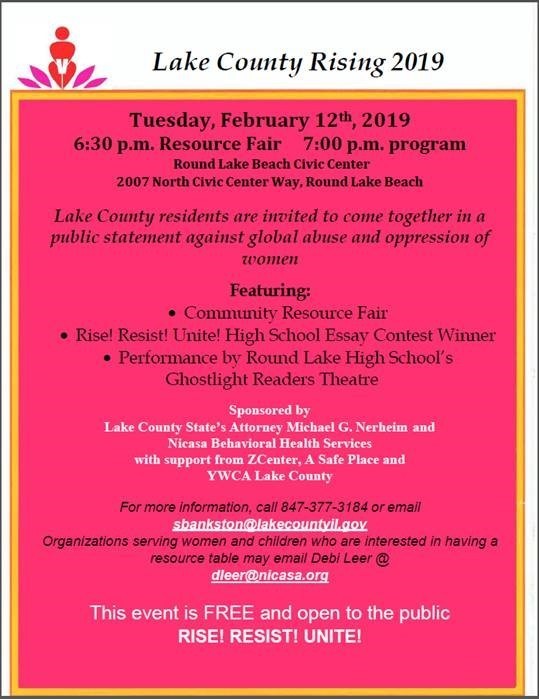 Lake County Rising 2019 will be held on Tuesday, February 12, 2019 at the Round Lake Beach Civic Center, 2007 North Civic Center Way in Round Lake Beach. The doors open at 6:30 for a resource fair. The program begins at 7 p.m.
Lake County Rising is an awareness event, a public demand to end violence against and oppression of women. It is Lake County’s version of One Billion Rising, a global movement to end rape and sexual violence against women. Recognizing that it takes everyone to make societal changes, the 2019 Lake County Rising committee strongly urges men and youth to lend their support by attending this event. “I can’t underscore the importance of these community awareness events,” stated Lake County State’s Attorney Michael G. Nerheim. “Crimes of violence often leave victims feeling alone and isolated. Public demonstrations such as Lake County Rising can let victims know that they are not alone, and can be an important step towards empowerment and healing,” Nerheim said.
Students from Round Lake High School’s Ghostlight Readers Theatre will perform vignettes from Seven, depicting various forms of oppression experienced by women. The winner of Lake County Rising’s essay contest will be announced and he or she will share the winning essay.
The event is free and open to the public. It is hosted by Lake County State’s Attorney Michael G. Nerheim in partnership with Nicasa Behavioral Health Services and support from Z Center, A Safe Place, and YWCA Lake County. Round Lake Beach community activist Judy Armstrong brought the Rising events to Lake County in 2012 and has had an integral role since its inception.
For more information, please contact Sandra Bankston at sbankston@lakecountyil.gov. Nonprofit organizations serving women and children who are interested in having a resource table may contact Debi Leer at dleer@nicasa.org.
|