Friday June 19, 2020 | View in browser
Weekly Deployment Meeting Highlights
Every week, Linda Hansen attends the Evanston Police Department’s Deployment Meetings, takes notes on the topics discussed and writes about other police-related matters of interest to the people who work and live in Evanston.
SPECIAL NOTICE: Please read the City of Evanston's Police Policies and Training FAQ addressing questions and concerns from the community, as well as Evanston Police Chief Releases Statement on George Floyd. While In the Squad Room features are not considered an official media/press release, ITSR wants its readers to know their questions and concerns are respected.
Community Outreach: Building Bridges
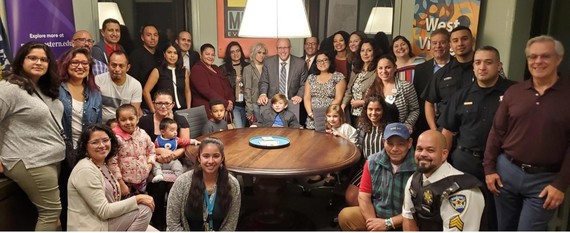 The concept of community policing (or more formally, community-oriented policing) has been around since the 1980s. The idea behind it: to build positive ties between cops and citizens on a neighborhood level to forge partnerships, build trust and then work together to identify and solve problems.
One of the earliest pillars of community policing was the return of foot patrols. More recently, it has evolved to include social media and community engagement systems to share relevant local information with residents. In that respect, even In The Squad Room is a tactic.
Here’s how most police departments (Evanston included) implement the policy:
- More reliance on community-based crime prevention through civilian education, neighborhood watch, social media and a variety of other techniques (as opposed to relying solely on police patrols).
- The re-structuring of patrol from an emergency response-based system to emphasize proactive techniques such as foot patrol.
- Increase officer accountability to the civilians they serve.
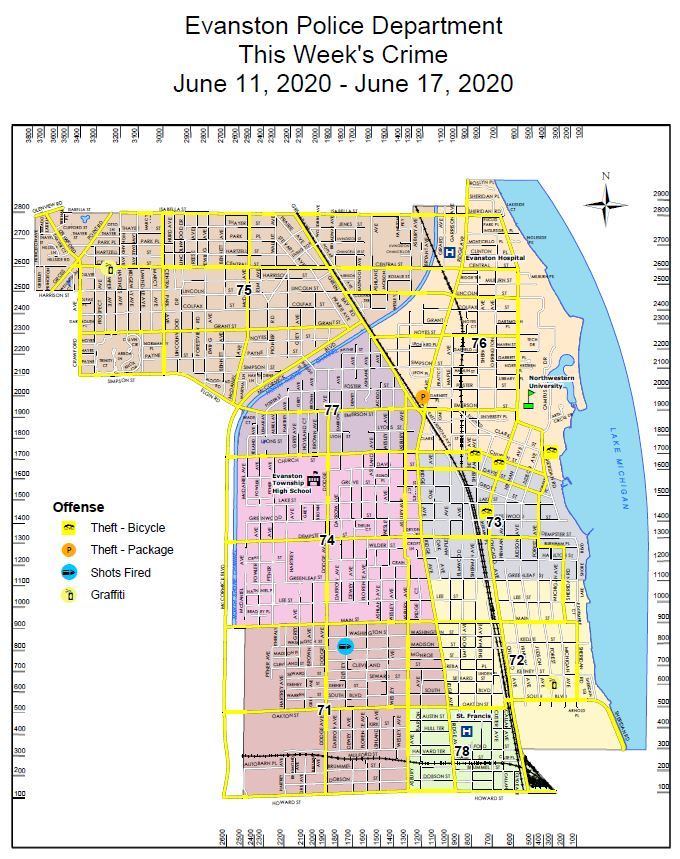 Click to Enlarge
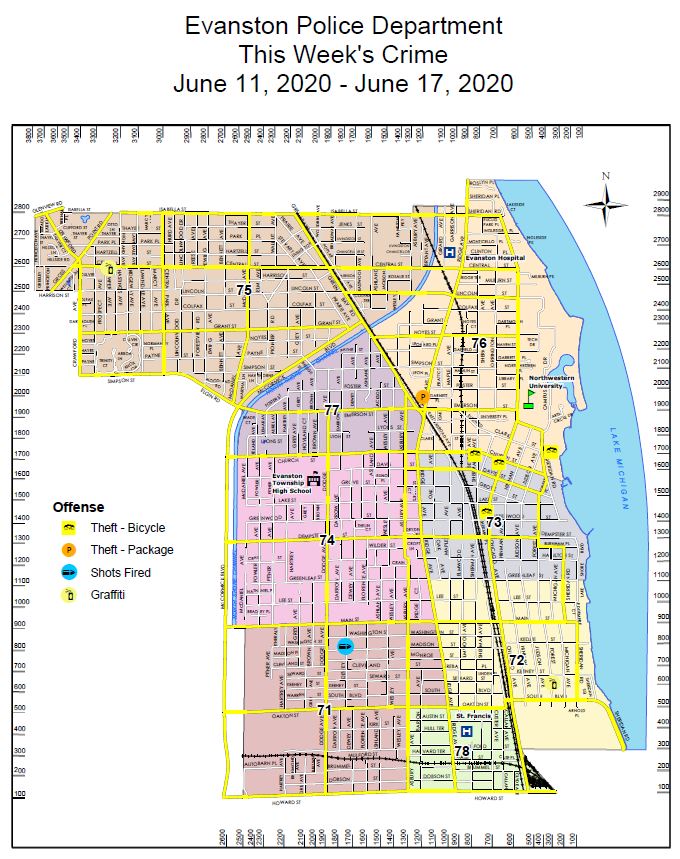
We will continue to publish This Week’s Crime map, but without commentary. If there are topics of interest to you, please send them our way.
Back in the Old Days, those days before the Stay-at-Home Order, when I still attended actual in-person meetings, one fixture of the Deployment Meetings was a recounting and forecasting of meetings attended by members of various bureaus, including Patrol Operations. To be perfectly candid, I was kind of exhausted just listening. (This is partly because they attend so many meetings in a week and also because I can barely make it through a one-hour meeting without getting squirmy.)
Eventually, I understood that police officers’ participation in these meetings, sessions and services are some of the essential ingredients of Evanston’s community policing initiative. And while listing them all would make for another unusually lengthy ITSR, now seems like a good time to highlight a few that address the needs of our community:
Citizen Police Academy (CPA)
Hecho en Evanston (Latinx Organization)
Officer and Gentleman Academy (OGA)
Police Explorer Program
Project Bridge
Skills to Achieve Results (STAR)
Citizen Police Academy
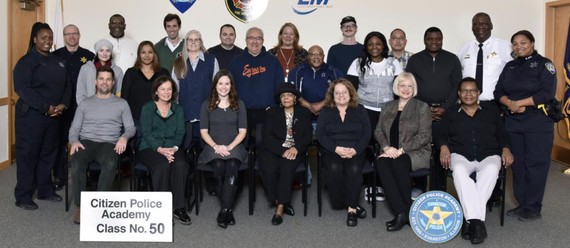 About: The Citizen Police Academy (CPA) was established in 1995 and is a 13-week program designed to give participants a working knowledge of the Evanston Police Department. Class #51, already full, is scheduled for this fall (assuming Illinois moves and remains at Phase 4 or 5). So far, the CPA, a community favorite, has produced over 800 enthusiastic graduates.
The program consists of classes, discussions and hands-on activities that include a mock trial, a tour of the Communications Center, CSI exercises, an opportunity to meet the EPD K-9 and his handler (a high point) and of course, a ride along (another high point). The Academy culminates with a graduation ceremony on the NU campus. Graduates can go on to join an Alumni program that includes periodic free-of-charge trainings and volunteer opportunities.
The Academy’s goal, through education, is to create a better understanding between citizens and the police. The hope is that the graduates become partners with the EPD in identifying problems and solutions to criminal issues affecting the community.
For the past five years, Officer Enjoli Daley has been the CPA’s Facilitator. When I asked her what one thing most participants discover through the classes, she said, “It’s almost like they’re surprised to find out that we’re human. People have this idea of the police that’s based on the institution of law enforcement. They rarely look at us as individuals with the same hopes, dreams and challenges they have. The CPA gives them the opportunity to meet different officers and spend time with the facilitators…joking, talking and sharing personal stories.” And that’s a solid foundation on which to build trust.
(Note: I was a member of Class #39 and can heartily recommend it. Among its many benefits was the opportunity to get to know not just the police, but Evanston residents from every corner of the city.)
More information on CPA is here.
Hechos en Evanston
(With thanks to Acting Commander Anthony Correa, who provided the commentary.)
About: Evanston's Latino population is not centralized to any particular neighborhood. In the past, we faced challenges trying to organize, and then determine the needs of the community. As time passed, the Latino population increased both in numbers and activism. The lines of communication were beginning to open and their concerns were clearer to us.
That group eventually formed the current Latinx advocating resident-driven organization called Hechos en Evanston. My role was to attend meetings and functions, make presentations and respond to any other needs of the community. But as a supervisor, it was challenging to find the time to fully participate.
It was evident that we needed a consistent commitment to the Latino community. On October 3, 2019, I introduced other members of EPD to serve, under my supervision, as Latinx Liaisons and take over my routine responsibilities with the Hechos en Evanston group.
Hechos en Evanston has become a formidable group offering services, translating media and initiating dialogue, all in the interest of supporting an underserved community. Having a law enforcement officer serve as a non-traditional police resource with the needs of the community informing police interaction is what true community policing is about. The progress we’ve made is clear in the relationships we’ve established.
Hechos en Evanston has sponsored several convivencias (Note: convivencia translates to ‘coexistence’ in English). These are gatherings where we can discuss community issues or share our cultural contributions with the community through food and entertainment. The next step after the eventual return to post-pandemic normalcy is the kind of full community access that will let us celebrate at our next convivencia.”
Ask to join their Facebook page here.
Officer and Gentleman Academy (OGA)
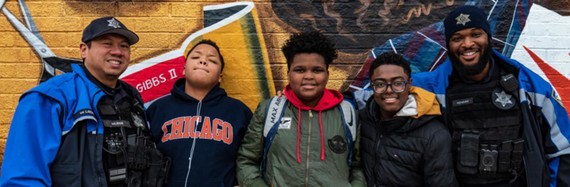 About: In 2017, EPD Officer Adam Howard partnered with Evanston/Skokie School District 65, co-founding the Officer and Gentlemen Academy. Its goal was to remove the barriers between police officers and young men of color. Now in its fourth year, OGA has expanded to include middle and high school students.
Howard says, "The current climate and historical discord between the police and black communities creates a negative perception of law enforcement. OGA," he said, "allows them to develop their own perception of law enforcement through experiences and enrichment.
“When you have a mentoring program in the community for black and brown boys, there's great responsibility because they want to hear your perspective on the most recent police-related incidents involving young black men,” Howard said. “Our program is committed to serving young men and surrounding them with a village, yielding success.” Now, more than ever, police need to build trust and transparency in order to create change.
EPD Officer Mario Miller, a former CPS teacher, has been with the EPD for 19 years and the OGA since 2017. Families, he told me, must be as engaged as the Gentlemen who enter the program; “In order for this program to be beneficial for the child, we need parental participation and engagement. This is a team effort – the more involved the family, the greater the success.”
He knows what he’s talking about. As a youth, Miller was involved in a mentoring program that he says helped to shape him into the man he’s become. “I want to give back by bringing what I experienced into the program. It takes patience and persistence. But if just one kid benefits from something that I said or something that I did, I’ve succeeded.”
The 12-session program runs from January through the end of the school year, kicking off with an Open House in December and culminating in May. Currently, there are 12 gentlemen in the program.
The group meets at the Evanston Township High School Transition House on Lemar Avenue. Lessons, in four three-session segments, cover a wide spectrum of life skills topics, from conflict resolution, financial literacy, and accountability to the mastery of tying a Windsor knot. Mentors and Academy students also take time out for weekend sporting events and field trips. This year, COVID-19 squelched those plans, consequently utilizing Zoom for the remainder of the sessions. Their annual breakfast and awards ceremony was subsequently postponed amid the pandemic.
Find out more about OGA here.
Police Explorers
 About: In January 2018, Sergeant Scott Sophier, then a 15-year veteran of the Evanston Police Department, spearheaded the relaunch of the Police Explorer Program after a 30-year pause. As a teenager, he had first-hand experience with the Explorer program in Skokie. “Exploring,” he says, “was a great opportunity to learn about leadership, community service, teamwork and responsibility.” Those characteristics, according to him, gave him the foundation he needed to succeed in college, and later on, as a police officer.
The year-round program offers Evanston high schoolers who are interested in Law Enforcement an opportunity to learn directly from officers through a close-up look at police work. The program consists of a classroom-style curriculum, coupled with hands-on activities such as traffic stops, mock crime scene investigations and ride alongs. There’s also a community service component to the program. Classes are held twice a month with a modified summer schedule. (This summer’s schedule is hampered by COVID-19; however, plans are underway for safe, socially-distant volunteer activities.)
According to Sergeant Sophier, the goal “is to provide a solid foundation of basic police principles. We also work to create a better understanding, dialogue, and partnership between our Explorers and the EPD through education. Giving local youth an opportunity to gain real hands-on knowledge of law enforcement is a benefit to them, the police department and the community.”
He says he wouldn’t be surprised to see them join the ranks of the EPD someday. “That,” he told me, “makes the program an important investment in their futures and ours.”
Learn more about the Police Explorer Program here.
Project Bridge
About: In 2016, Commanders Brian Henry and Tommy Moore (now retired) worked with Moran Center Deputy Director Kirsten Kennard and Restorative Justice Coordinator Pam Cytrynbaum to develop and launch a weekly program designed to strengthen relationships between police officers and high school-age youth. Four years later, Commander Henry is still involved in the program, along with 6 or 7 additional EPD officers who volunteer their time.
He pointed out that Project Bridge, which meets for about two hours every other week during the school year, is not a mentoring program. Instead, its nearly equal mix of officers and kids builds friendships and trust between these two groups through restorative practices like peace circles (in a classroom setting), but more importantly, fun activities like field trips, bowling events and escape rooms.
Presently on pause due to the pandemic, the program remains an innovative collaboration engineered to repair, rebuild, and strengthen communication and relationships between officers and youth of color. Commander Henry predicts that Project Bridge will be back for the 2020-2021 school year, but like everything else, with some possible adaptations relating to COVID-19.
Want to know more about the James B. Moran Center for Youth Advocacy? It’s here.
Skills To Achieve Results (S.T.A.R.) Academy
 In 2019, Officers Tosha Wilson, Enjoli Daley, Nina Griffith, Tanya Jordan and Amanda Wright developed a curriculum and model for a mentoring program designed for 6th – 8th grade girls. The Skills to Achieve Results Academy (S.T.A.R.) debuted at Chute Middle School later on that year.
The group defined its missions as: providing young girls with the opportunities and the skills needed to succeed in their community and society, while promoting self-awareness and empowerment. Candidates for the Academy were referred by teachers, school administrators and social workers. There were 12 girls the first year.
The five pillars, on which the curriculum is based, are:
Respect
Responsibility
Self-Awareness
Leadership
Education.
Meetings covered a wide swath of related topics – first impressions, building healthy relationships - situations, according to its planning team, that are challenging in the coming-of-age years and even into adulthood for most females. The girls participated in peace circles, interacted with guest speakers and went on field trips. Keeping it real, I was told, was Job #1. Here’s Officer Wilson: “Sometimes kids don’t feel comfortable talking to their parents about certain things, so one of our goals is to provide just one more space or one more person that they can talk to. We try to connect with them female-to-female, more than anything.”
At the end of the first year, a decision was made to move the sessions out of Chute and into a community facility. Discussions were underway with several organizations to secure a new home for the Academy when (you guessed it), COVID-19 happened. Discussions and a relaunch plan will resume when most of the current restrictions are lifted.
According to Officer Daley (who is also Community Engagement and Programs Facilitator for all of EPD’s outreach initiatives), “It’s important to partner with an organization already involved in community programming. We’re ready, we have the materials and the officers – all we need to find is a host.”
Many thanks to Commander Henry, Sergeants Correa and Sophier, and Officers Daley, Howard, Miller and Wilson for their contributions to this week’s post.
Coming Next Week:
We’re not quite back to in-person Deployment Meetings as we head toward Phase Four of Governor Pritzker’s RESTORE ILLINOIS plan, but we will resume coverage of the (reportable) week’s incidents. Inquiring Minds for next week: Inside the Property Room.
Gun Buyback Program
The Ongoing Gun Buyback Program allows Evanston residents to turn in an operational firearm to police at any time in exchange for $100. Residents can utilize this service by calling 311 or the Evanston Police Department non-emergency line at 847-866-5000. A police officer will pick up the unwanted firearm at the resident's address and present the resident with a voucher that can be exchanged for $100 at the City Collector’s Office located in the Morton Civic Center, 2100 Ridge Ave.
Firearms should not be brought to the police department, unless prior approval has been granted from a supervisor at the police department. An officer will call the resident after a request is made for the officer to come to a person's residence and retrieve the firearm.
 What would you like to know about what the Evanston Police Department is doing to fight crime? Let us know if you have specific questions or concerns about issues in your neighborhood. Submissions are always welcome at police@cityofevanston.org or by calling the community strategies bureau at 847-866-5019.
Subscribe to Evanston’s Daily Crime Report by email or view the Monthly Crime Statistics that are reported on a yearly basis to the FBI.
 If you would like to learn more about the Evanston Police Department, take an active role in community-oriented policing, and join the ranks of over 900 graduates since 1995, please visit the Citizen Police Academy webpage.
There is no cost to anyone who lives or works in Evanston. Getting to know your police force is essential in reducing crime, building trust in the community and serving the needs of the community.
The weekly deployment report is an informational bulletin prepared by a community member that keeps citizens informed about what police do on a weekly basis. Information contained in this report is not to be considered as a media/press release. Any information considered by a media source from this bulletin needs to be verified by an official from the department. This can be done by contacting the media line at 847-866-5026.
|