Friday June 12, 2020 | View in browser
Weekly Deployment Meeting Highlights
Every week, Linda Hansen attends the Evanston Police Department’s Deployment Meetings, takes notes on the topics discussed and writes about other police-related matters of interest to the people who work and live in Evanston.
SPECIAL NOTICE: Please read the City of Evanston's Police Policies and Training FAQ addressing questions and concerns from the community, as well as Evanston Police Chief Releases Statement on George Floyd. While In the Squad Room features are not considered an official media/press release, ITSR wants its readers to know their questions and concerns are respected.
The Forensics File
 I met Mike Wasowicz in the basement of EPD headquarters where his office is located several years ago, when, after exposure to decades of cop shows, I wanted to separate fact from fiction. Was the real world of criminal investigations different from what I’d seen on television? One thing I knew for sure – crimes were not, and are not, solved in 22 or 44 minutes.
 Click to Enlarge
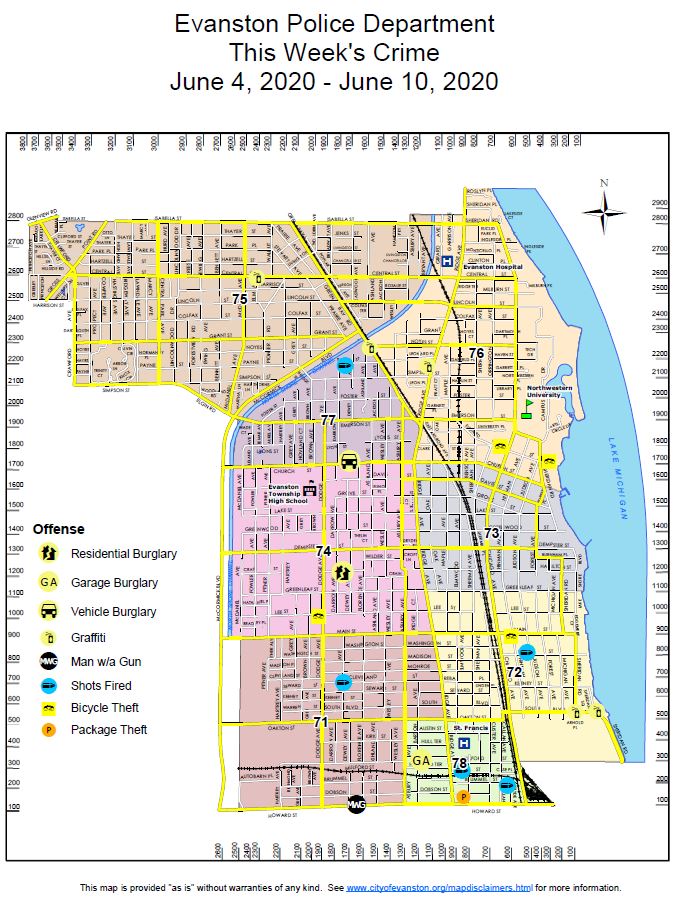
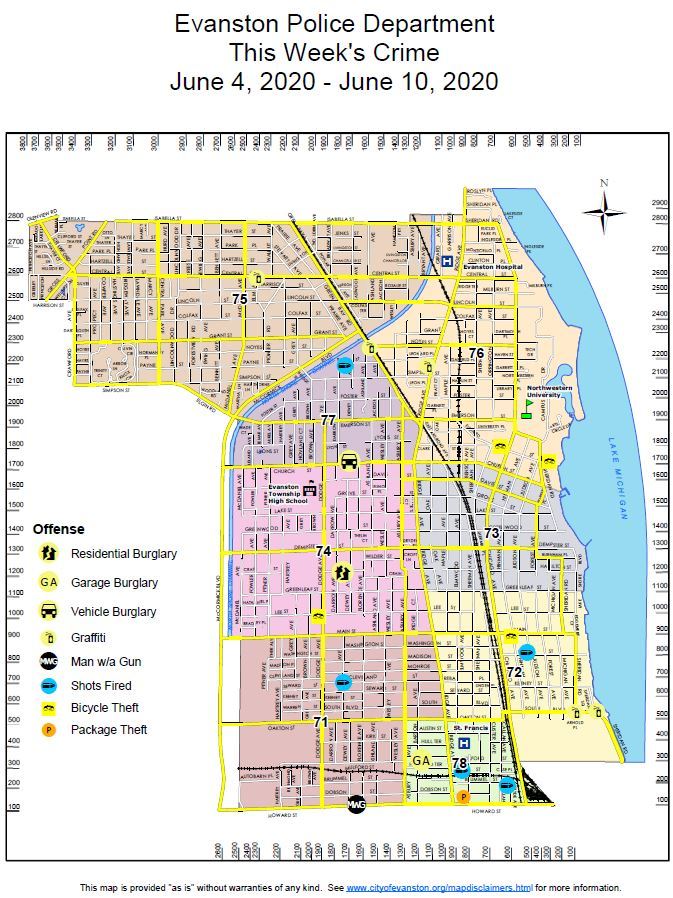
We will continue to publish This Week’s Crime map, but without commentary. If there are topics of interest to you, please send them our way.
Mike, as Management Analyst for Forensic Services, is the man in charge. He has been with the EPD for 9 years; before that he spent 27 ½ years at the Skokie PD, almost all of it in evidence processing. He was the Forensics Supervisor for NORTAF (Northern Regional Major Crimes Task Force), the multi-jurisdictional entity that assists member police departments with the investigation of homicides and kidnappings, where three members of the EPD Forensic Team serve today.
This time around, we were not able to meet face-to-face, so we defaulted to an update by email and telephone. Here’s how our exchange went:
What evidence processing is done right here at police headquarters?
“We have some in-house capabilities, including a trained Latent Prints Examiner, so we do a lot of fingerprint processing (collecting fingerprints from evidence) here. Our Examiner has the ability to do fingerprint analysis.”
How about DNA?
“We collect blood from a scene and swab objects to collect DNA that might be present, but those items are sent to a third-party crime lab. We don’t process them here. Collecting fingerprints and DNA is the bulk of what we do.”
There was a change several years go from the state crime lab to Northeastern Illinois Regional Crime Laboratory, the third-party lab you just mentioned. What was behind that move?
“The state lab was taking an extraordinarily long time to turn specimens around, making it hard to prosecute and follow up on cases. If it takes two years to get a fingerprint result from a burglary or a DNA match or something like that, it means there’s a suspect on the street maybe committing more crimes. The move has been beneficial all the way around. Today, the typical turnaround time for DNA is generally less than 60 days. Some cases, sex assaults, for example, usually come back sooner.”
How large is the staff?
“We have 19 active Evidence Technicians. They’re spread out across the department because some of them, for example, may be assigned to investigations where they can use their evidence expertise if those services are required. At the street level, we need to have the staff to cover all three shifts.”
Which shifts are the busiest for the Forensic Investigators?
“We have tracked activity since 2012 and it remains fairly consistent. Third Detail (afternoon shift; 3 PM – 11PM) averages about 40% of the workload, followed by Second Detail (day shift; 7 AM – 3PM) at 35% and First Detail (Midnights; 11 PM – 7 AM) at 25%."
Can you give us an example of a typical call for service?
“There really isn’t a typical call for service. Our Evidence Technicians respond to a wide range of incidents including criminal damage, domestic battery, fire scenes, crash scenes, burglaries, death investigations, robberies, sex assaults, etc.
I would say that their most frequent response is to burglary and criminal damage scenes. Not all responses are to criminal incidents either. Crash scenes involving damage to city property or incidents where someone gets injured on city property are two good examples.”
How many investigations do you handle in a year?
“Last year, Evidence Technicians responded to 1,305 calls for service that produced over 1,700 hours of evidence work.”
What kind of training is required?
“Evidence Technicians go through an 80-hour basic evidence program. We try to do two one-day in-service trainings a year and they also participate in a one-day semi-annual in-service training program with their counterparts in Skokie and Lincolnwood.
We will also send officers to other types of multi-day training in specific areas related to crime scene and evidence investigations. Examples include advanced photography, fingerprint and biological evidence training.”
Is there cooperation among jurisdictions? Do you ever get calls for help from other police departments?
“We’re a part of NORTAF, so in that regard, we partner with the 11 other agencies in that group for major crimes. Periodically, different agencies - Wilmette or Skokie, for instance - will provide support if we need it. And we, of course, reciprocate.”
What's the most common misconception about the work that you and the team do?
"Unfortunately, crime scene shows, especially the fictional ones, have created the illusion that all crimes can be solved by forensic evidence. That is just not the case. There are many times when, despite all best efforts, physical evidence that identifies or implicates an offender is just not located.”
Any memorable case that comes to mind?
“My most memorable case is a 1998 murder that happened in Skokie. It was a NORTAF investigation that spanned 5 or 6 months. The victim was originally reported as missing from Evanston.
As it turned out, he was killed in Skokie and then buried in the Upper Peninsula of Michigan. To say the least, it was a complex investigation. The offender was convicted and is still in custody. It was an early successful case for NORTAF that highlights the effectiveness of a multi-jurisdictional task force. In my opinion, if it were not for NORTAF the victim would still be an unsolved missing person from Evanston.”
Our work lives have been turned upside down here in the midst of the COVID-19 pandemic. This has to have changed procedures for your team. What modifications have you made?
“Procedures have not changed that much. Evidence technicians are quite frequently involved in scene investigations and evidence collection where hazards, such as blood-borne pathogens, are present. Our personnel have always been equipped with appropriate protective gear such as gloves, N95 masks, respirators, protective suits, etc. Dealing with biological hazards is part of their training.
We have modified some death scene responses where COVID-19 is known to be involved. In those instances, the evidence technician is not required to respond to the scene so long as the initial investigating officer finds nothing unusual. That process is designed to help minimize possible exposure of personnel. With other scenes, standard precautions such as maintaining social distance and mask wearing are employed just as in any other contact with the public.”
You’ve been an evidence guy for over 30 years. What keeps you going?
“The fact that it’s an indisputable way to put offenders in jail and keep them off the street. It’s science.”
Every job, no matter how much you love it, has a downside. What’s the downside here?
“Probably the long hours involved with an investigation, the long hours away from home.”
Many thanks to Management Analyst (for Forensic Services) Mike Wasowicz for his numerous contributions to this week’s post.
Coming Next Week:
Walking the Talk: Building Bridges.
Gun Buyback Program
The Ongoing Gun Buyback Program allows Evanston residents to turn in an operational firearm to police at any time in exchange for $100. Residents can utilize this service by calling 311 or the Evanston Police Department non-emergency line at 847-866-5000. A police officer will pick up the unwanted firearm at the resident's address and present the resident with a voucher that can be exchanged for $100 at the City Collector’s Office located in the Morton Civic Center, 2100 Ridge Ave.
Firearms should not be brought to the police department, unless prior approval has been granted from a supervisor at the police department. An officer will call the resident after a request is made for the officer to come to a person's residence and retrieve the firearm.
 What would you like to know about what the Evanston Police Department is doing to fight crime? Let us know if you have specific questions or concerns about issues in your neighborhood. Submissions are always welcome at police@cityofevanston.org or by calling the community strategies bureau at 847-866-5019.
Subscribe to Evanston’s Daily Crime Report by email or view the Monthly Crime Statistics that are reported on a yearly basis to the FBI.
 If you would like to learn more about the Evanston Police Department, take an active role in community-oriented policing, and join the ranks of over 900 graduates since 1995, please visit the Citizen Police Academy webpage.
There is no cost to anyone who lives or works in Evanston. Getting to know your police force is essential in reducing crime, building trust in the community and serving the needs of the community.
The weekly deployment report is an informational bulletin prepared by a community member that keeps citizens informed about what police do on a weekly basis. Information contained in this report is not to be considered as a media/press release. Any information considered by a media source from this bulletin needs to be verified by an official from the department. This can be done by contacting the media line at 847-866-5026.
|