Friday Apr. 10, 2020 | View in browser
Weekly Deployment Meeting Highlights
Alternatives to Incarceration: Restorative Justice
Every week, Linda Hansen attends the Evanston Police Department’s deployment meetings, takes notes on various topics, and writes about other police-related matters of interest to ordinary citizens like her.
This week's highlights
 We've come a long, long way.
Click to Enlarge
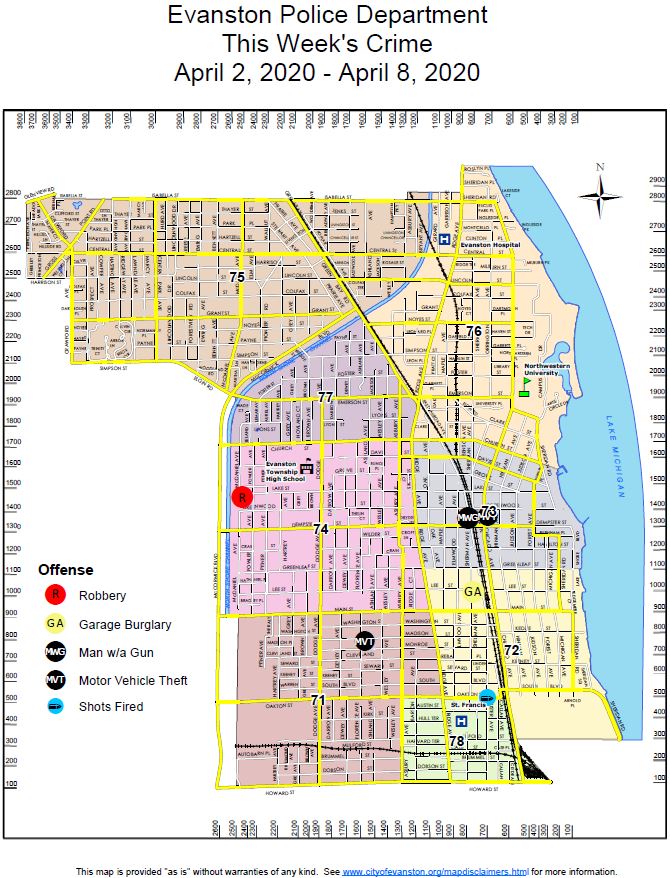
We will continue to publish This Week’s Crime map, but without commentary. If there are topics of interest to you, please send them our way.
I grew up in the 1960s in the then-wilds of Kane County. St. Charles was a small town, not really a suburb, and our house was west of town nestled in between the cornfields and ravines, less than a half-mile from what was then called the “Illinois State Training School for Boys”. It was a sprawling 125-acre reform school. The lofty mission that the social justice reformers of 1904 had in mind when the school was founded had probably become an impossible dream by then.
Fast forward to the present day and restorative justice, a practice that originated in the 1970s as mediation between victims and offenders. Legend has it that Mark Yantzi, a young probation officer in Elmira, Ontario, arranged for two teenagers to meet directly with their victims following a vandalism spree and agree to restitution. Before long, similar programs based on accountability, healing and reconciliation were adopted by law enforcement in the US, Canada and Europe.
Alternatives to Arrest in Evanston
Here in Evanston, restorative justice practices have been in place for many years but were codified last May when the City Council passed Resolution 68-R-18 in support of it, citing its value in both reducing recidivism and encouraging accountability by providing, when appropriate, an alternative to the juvenile justice system.
To understand how it works, I leaned heavily on Sgt. Charlotte Hart who works in the Investigative Services Bureau and is the liaison with the City’s Youth Services group where social worker Heather Perkins, who I also interviewed, is the Youth Advocate.
How it Works
From the EPD’s perspective, the process begins with an incident involving a juvenile. It could be “hooliganism” – damage to personal property, shoplifting, bicycle thefts or criminal trespass – just about anything that doesn’t rise to the level of serious criminal activity or harm to a person. For these kinds of incidents, police officers, at their discretion, can issue a c-ticket (a compliance citation – basically a civil ticket heard locally) or streamline the process by directly referring the youthful offender to Youth Services.
The Youth Services group has daily access to the EPD’s incident reports and will automatically follow up by phone to determine how the juvenile and his/her family wishes to proceed. They also contact the victim – if there is a victim – to ask how they want the incident to resolve. “In many cases”, Sgt. Hart told me, “all they want is their stuff back. Or maybe they’re only looking for an explanation or apology from the teen.”
The restorative justice practices we have in Evanston for youths under the age of 18 are directed toward holistic versus punitive measures. Teens with a c-ticket attend hearings, with a Youth Services social worker, at the Civic Center – not at the 2nd District Courthouse in Skokie. Hearings are held after school so that parents and students can attend. Outcomes include a wide range of solutions - counseling sessions, community service volunteer opportunities, mediation services, participation in peace circles and a myriad of other creative options.
Police Chief Cook has stated, on numerous occasions when we were actually in the squad room, that the police station is “no place for children.” RJ (Restorative Justice) services, along with programs sponsored by the EPD (Project Bridge, Officer & Gentlemen Academy, Strive to Achieve Results) address the growing need for mentoring and character-shaping approaches.
Once a teen has been referred to Youth Services, police involvement ends. That’s important. Minor incidents referred by the EPD are not reported to the State of Illinois and can save a young person from having a police record that will follow him or her for life. However, there are limits. A repeat offender who has exhausted restorative justice options – for example, restitution, then a peace circle and finally, community service – for multiple incidents will, subsequent to more incidents, no longer be a candidate.
Youth Services, now back at EPD headquarters after a few years at the Civic Center, receives referrals from law enforcement, as well as both Evanston school districts, community groups, the Moran Center and even the Adjudication Court at the Civic Center. Heather Perkins says that 100% of her job involves restorative justice. “It’s a way of thinking. It’s a mindset. It’s not just a protocol.”
Last month, Youth Services reviewed and followed up on 72 incident reports. Of those, about half resulted in RJ (Restorative Justice), a heavy case load for the group’s team of one full-time and one part-time intern. But no one’s complaining.
How well is RJ working? According to both Sgt. Hart and Heather Perkins, extremely well. The City is tracking data, which needs to be viewed over a period of several years, but Perkins says that one measure is how many familiar faces she sees in Court, which according to her are “not many”. She also mentioned that parents are appreciative of the options it offers.
Post script
As for St. Charles, I only learned, when I moved to Chicago after college, that the town’s name was a threat used by exasperated parents throughout most of the last century: “You better be good or they’ll send you to St. Charles.” Today, the Illinois Youth Center-St. Charles functions as a Level 2 medium-security facility that has a capacity of 318 inmates. Yes, they call them “inmates”.
To stay up to date on local, regional, national and global updates on the Coronavirus Pandemic, please visit:
City of Evanston
https://www.cityofevanston.org/government/departments/health-human-services/coronavirus-disease
Illinois Department of Public Health
https://www.dph.illinois.gov/topics-services/diseases-and-conditions/diseases-a-z-list/coronavirus
Centers for Disease Control and Prevention
https://www.cdc.gov/coronavirus/2019-ncov/index.html
World Health Organization
https://www.who.int/emergencies/diseases/novel-coronavirus-2019
Gun Buyback Program
The Ongoing Gun Buyback Program allows Evanston residents to turn in an operational firearm to police at any time in exchange for $100. Residents can utilize this service by calling 311 or the Evanston Police Department non-emergency line at 847-866-5000. A police officer will pick up the unwanted firearm at the resident's address and present the resident with a voucher that can be exchanged for $100 at the City Collector’s Office located in the Morton Civic Center, 2100 Ridge Ave.
Firearms should not be brought to the police department, unless prior approval has been granted from a supervisor at the police department. An officer will call the resident after a request is made for the officer to come to a person's residence and retrieve the firearm.
 What would you like to know about what the Evanston Police Department is doing to fight crime? Let us know if you have specific questions or concerns about issues in your neighborhood. Submissions are always welcome at police@cityofevanston.org or by calling the community strategies bureau at 847-866-5019.
Subscribe to Evanston’s Daily Crime Report by email or view the Monthly Crime Statistics that are reported on a yearly basis to the FBI.
 If you would like to learn more about the Evanston Police Department, take an active role in community-oriented policing, and join the ranks of over 900 graduates since 1995, please visit the Citizen Police Academy webpage.
There is no cost to anyone who lives or works in Evanston. Getting to know your police force is essential in reducing crime, building trust in the community and serving the needs of the community.
The weekly deployment report is an informational bulletin prepared by a community member that keeps citizens informed about what police do on a weekly basis. Information contained in this report is not to be considered as a media/press release. Any information considered by a media source from this bulletin needs to be verified by an official from the department. This can be done by contacting the media line at 847-866-5026.
|