 One of the many reasons Evanston is such a great community in which to live and work is its volunteer spirit. Neighbors helping neighbors is an Evanston tradition, and I would like to share with you a great EFD-sponsored program that will put you in position to help your neighbors when they need you the most.
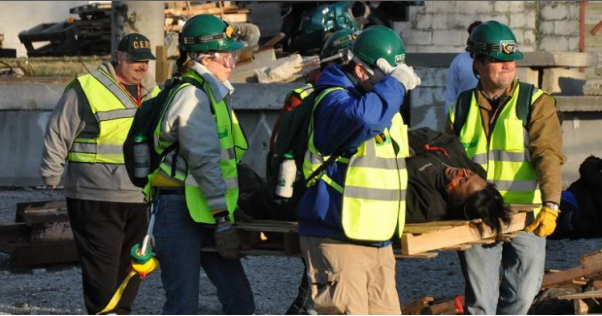
The program is called Community Emergency Response Team or CERT. The CERT program educates volunteers about disaster preparedness that may impact Evanston and trains them in basic disaster response skills, such as fire safety, light search and rescue, team organization, and disaster medical operations.
Our national experience has shown that community participants play a significant role in post-disaster response and support. It is everyday people – neighbors and co-workers – that can become vital first responders in a disaster or extreme weather event when fire and police may be overtaxed by an extreme situation. Simply put, CERT members can make a positive difference and will certainly help save lives.
I hope you will consider joining this great group of volunteers in service to our community. We are sponsoring a free CERT class beginning Wednesday, September 4, from 7 p.m. to 9 p.m.
If you would like more information about the program or the upcoming class please email: cert.evanston.il@gmail.com. You can also download a class application download a class application..
Please have a wonderful and safe rest of the summer and enjoy this month’s Roll Call!
Stay Safe!
Brian R. Scott
Fire Chief
Below is a breakdown of recent emergency responses.
587 EMS Incidents
|

353 Fire Incidents
|

EFD average response times for July:
3 min 29 sec from dispatch to emergency
NFPA average: 4 min or less
|
Operations
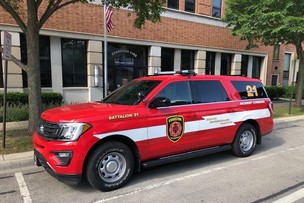
In early July of this year, the Evanston Fire Department took delivery of a 2019 Ford Expedition as its new fire command vehicle, replacing a 2012 Chevy Tahoe. This will give our battalion chiefs a larger more visible vehicle with improved capabilities, such as better communications and mission critical computer hardware and software. Battalion 21 is equipped with five mobile radios, two mobile laptops, iPads and hands-free Bluetooth capabilities. All of these assets will assist our battalion chiefs with managing emergency incidents more efficiently and effectively.
|
Training
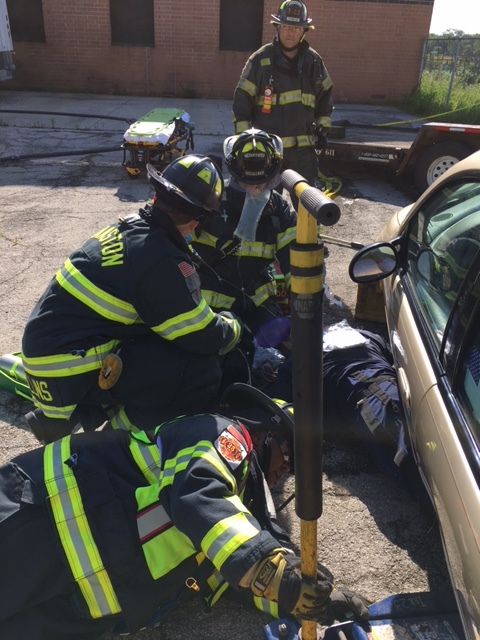
Evanston Firefighters lifting a vehicle during extrication operations.
In July, members of the Evanston Fire Department practiced lifting a vehicle off a victim (mannequin dressed in blue) trapped underneath. In this photo from the training exercise, you can see firefighter/paramedics providing medical care while others are preparing to stabilize and lift the vehicle.
Evanston Fire Department crews were able to extricate the victim and provide all field medical care in less than 10 minutes on average from arriving on the accident scene until the patient was en-route to the emergency room. This statistic is important within the context of what’s known as “The Golden Hour”; which essentially states a positive patient outcome becomes more likely the faster a seriously injured person receives definitive care in a trauma center. While the literal 60 minutes from injury time to definitive care of “The Golden Hour” is debatable; the concept of rapid extrication, appropriate field EMS care, and transportation to a trauma center (St. Francis or Evanston Hospital) as quickly as possible remains vital to patient survivability.
Fire Prevention Bureau
Fire Safety At Your Home Away From Home
Peer-to-peer hospitality services, such as Airbnb, Vacation Rentals by Owner and other types of vacation rentals are not regulated in the same way as hotels. Requirements vary widely across jurisdictions. Act as your own safety advocate and know before you go. Be sure the following safety measures are addressed.
SAFETY TIPS
- Working smoke alarms are in every sleeping room. They are outside each separate sleeping area. They are on every level of the home.
- Working smoke alarms are interconnected, if possible. When one alarm sounds, they all sound.
- Portable fire extinguishers are in the home and are easy to reach.
- Working carbon monoxide alarms are outside each separate sleeping area. They are on every level of the home and in other locations as required by laws, codes, or standards.
- The owner has posted a floor plan. It notes all escape routes and exits and provides emergency contact information.
- Everyone knows the address of the home.
- Everyone staying in the home has identified two ways out of every room and how to escape in an emergency.
- All doors and windows that lead outside are able to be opened.
- An outside meeting place has been chosen. It is a safe distance away from the home.
- Everyone knows how to call 9-1-1 or the local emergency number from a cell phone from outside.
- If smoking is allowed, a smoking area has been designated and is well away from the structure. Deep, sturdy ashtrays have been provided.
- All pathways are free and clear of tripping hazards.
- Electrical outlets are free from multiple cords and adaptors.
- The stovetop is clear. Anything that can catch fire is not near the stovetop, such as curtains and towels.
|