 A fire department deals with a large amount of statistics and metrics, which can include everything from the budget and water flow calculations to staffing levels and calls for service. One of the most important and mission critical numbers we deal with is response times – the time it takes our firefighter/paramedics to respond to you in an emergency.
From efficiently taking the call by the dispatcher to the response from the fire station, the EFD takes every measure possible to keep our response times low in order to deliver assistance to you as quickly as possible. The combination of state-of-the-art technology, proper staffing and strategic fire station locations allow us to maintain response times well below the NFPA national standard of 4 minutes. In fact, our average emergency response time in 2018 was an enviable 3 minutes and 12 seconds.
With over 10,000 calls for service each year, that outstanding response time average translates to us being better able to save lives, reduce injuries and minimize property damage. It is the primary reason why we save over 98 percent of all property involved in fire as well as deliver advanced life support emergency medical care in a way that provides the very best chances for survival, especially relative to cardiac care.
You can play an important part in helping us with response times as well:
- Make sure your building address is easily visible, both day and night, from the street.
- If at home, turn on your porch light and unlock the front door.
- If you have a dog, please secure your pet in a separate room.
- If a patient for a medical emergency is located deep inside a building or in a hard to find location, have someone meet the paramedics at the curb to guide them directly to the patient.
- If you come across an emergency away from your home or business, please give as specific a location as possible to the 911 dispatcher and if safe, wait for the fire department to arrive to direct them further.
Please enjoy this month’s Roll Call. If you have questions, please feel free to contact me at 847-866 5924 or bscott@cityofevanston.org.
Stay Safe!
Brian R. Scott
Fire Chief
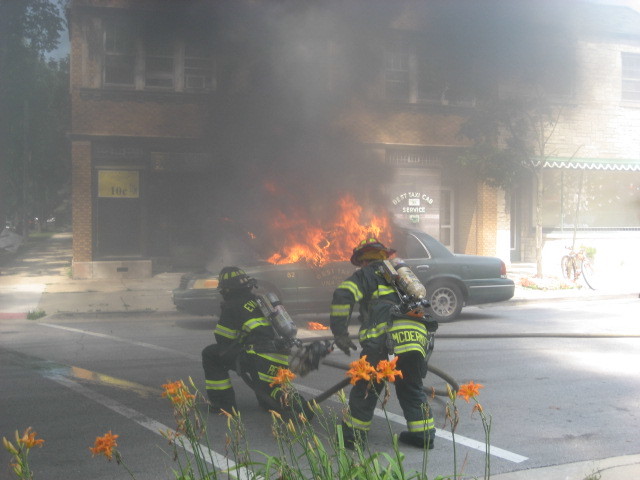 Firefighter Joe Peters and Captain Mike McDermott extinguish a fully involved car fire on Greenleaf.
Below is a breakdown of recent emergency responses.
499 EMS Incidents
|

281 Fire Incidents
|
 |
|
6 Cardiac Arrests
|

EFD average response times for April:
3 min 31 sec from dispatch to emergency
NFPA average: 4 min or less
|
Training
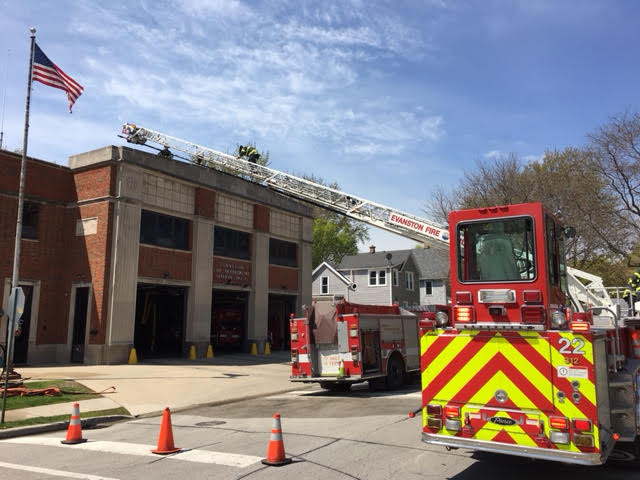
Evanston Firefighters training utilizing Truck 22 and Fire Station 22.
The members of the Evanston Fire Department spend thousands of hours training every year when they are not handling emergency responses. Here is a prime example of Engine 22 and Truck 22 training on skills for fighting roof fires.
The training allowed fire companies to practice alternate tactics to establish effective fire extinguishment on a roof. EFD trucks have the capability to connect a fire hose to the tip of their 100-foot aerial ladders in order to deploy a fire attack hose in an elevated position, such as a roof or parking structure. Using this tactic has pros and cons, but is a critical skill that must be practiced in case it's needed on an emergency scene. Great job, Captain Bazan and newly promoted Captain Fochs, for leading this training based on a recent multi-unit residential roof fire.
Fire Prevention Bureau
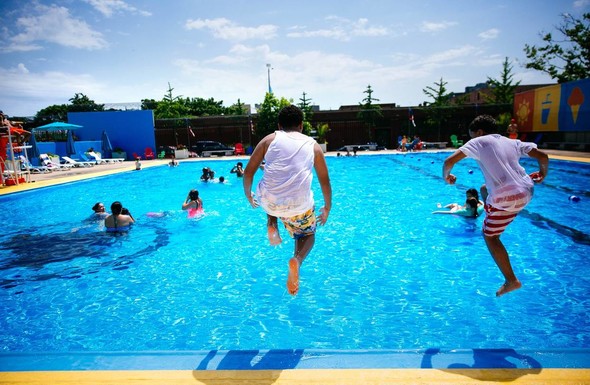
Water Safety Tips courtesy of the “Simple Steps Save Lives” Program
Stay close, be alert and watch children in and around the pool
- Never leave a child unattended in a pool or spa and always watch your child when he or she is in or near water
- Teach children basic water safety tips
- Keep children away from pool drains, pipes and other openings to avoid entrapments
- Have a telephone close by when you or your family is using a pool or spa
- If a child is missing, look for him or her in the pool or spa first
- Share safety instructions with family, friends and neighbors
Learn and practice water safety skills
- Learn how to swim and teach your child how to swim
- Learn to perform CPR on children and adults and update those skills regularly
- Understand the basics of life-saving so that you can assist in a pool emergency
Have appropriate equipment for your pool or spa
- Install a four-foot or taller fence around the pool and spa and use self-closing and self-latching gates; ask your neighbors to do the same at their pools
- Install and use a lockable safety cover on your spa.
- If your house serves as a fourth side of a fence around a pool, install door alarms and always use them. For additional protection, install window guards on windows facing pools or spas.
- Install pool and gate alarms to alert you when children go near the water.
- Ensure any pool and spa you use has compliant drain covers and ask your pool service provider if you don’t know.
- Maintain pool and spa covers in good working order.
- Consider using a surface wave or underwater alarm.
For more tips for pool and spa owners, visit PoolSafely.gov
|