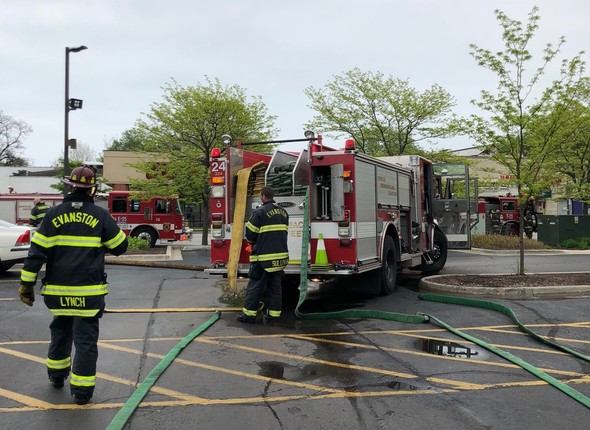
 Captain Dan Lynch and Firefighter Brendan Sullivan re-bedding hose after a structure fire at the Subway restaurant.
A fire department
deals with a large number of statistics and metrics, which can include
everything from the budget to water flow calculations and staffing levels to calls
for service. One of the most important and mission-critical numbers we deal
with is response times – the time it
takes our firefighter/paramedics to respond to you in an emergency.
From the dispatcher taking the call to the response from the fire station, the EFD makes every effort to keep our response times low in order to deliver assistance to
you as quickly as possible. The combination of state-of-the-art technology,
proper staffing and strategically-located fire stations allow us to maintain
response times well below the NFPA national standard of 4 minutes. In fact, our average emergency response time
in 2017 was an enviable 3 minutes and 15 seconds.
With over 10,000 calls
for service each year, that outstanding average response time translates to us
being better able to save lives, reduce injuries and minimize property damage. It
is the primary reason why we save over 98% of all property involved in a fire, as
well as deliver advanced life support emergency medical care in a way that
provides the very best chance for survival, especially as it relates to cardiac
care.
You can play an important part in in keeping response times low. Here are steps you can take:
- Make sure your
building address is easily visible, both day and night, from the street. Detached garages should also have an address that is easily visible.
- If you have called for emergency assistance from home, turn on
your porch light and unlock the front door.
- If you have a dog,
please secure your pet in a separate room.
- If a patient involved in a
medical emergency is located deep inside a building or in a hard-to-find
location, have someone meet the paramedics at the curb to guide them directly
to the patient.
- If you come across an
emergency away from your home or business, please give as specific a location
as possible to the 911 dispatcher and, if it is safe to do so, wait for the fire department to
arrive to direct them further.
Please enjoy this
month’s Roll Call. If you have
questions, please feel free to contact me at 847-866 5924 or
bscott@cityofevanston.org.
Stay Safe!
Brian R. Scott
Fire Chief
 Our thanks to The Merion and Total Child Preschool for hosting Firefighter Appreciation Day
Below is a breakdown of recent emergency
responses.
EMS Calls
552 Incidents
|
Fire Calls

284 Incidents
|
Response Times
 EFD average response times
3 min., 12 sec. from dispatch to emergency.
NFPA average: 4 min. or less.
|
Operations
 Summer Awareness
As summertime quickly approaches, the City of Evanston gears up for many family activities, festivals, street fairs and block parties. The Fire Department is doing the same. Thanks to continuous fire and EMS training, as well as preparing ourselves and the equipment, the EFD will be ready for any type of emergency. As residents, here are a few things you could do to prepare your family and yourself for summertime fun.
Beat The Heat
The best way to avoid a heat-related illness is to limit exposure outdoors on hot days. Air conditioning is the best way to cool off, according to the Center for Disease Control and Prevention (CDC). Also:
- Drink more liquid than you think you need and avoid alcohol
- Wear loose, lightweight clothing and a hat
- Replace salt lost from sweating by drinking fruit juice or sports drinks
- Avoid spending time outdoors during the hottest part of the day, from 11 a.m. to 3 p.m.
- Wear sunscreen; sunburn affects the body's ability to cool itself
- Pace yourself when you run or otherwise exert your body
Bug Safety
Everyone can protect themselves and their family from the threat of Zika and other mosquito-borne illnesses, such as Dengue Fever and West Nile virus. Follow simple preventative measures:
- To prevent mosquito bites, use Environmental Protection Agency-registered insect repellant with DEET and wear long-sleeved shirts and long pants.
- Read product labels when using insect repellant and apply as directed.
- Do not leave doors or windows propped open.
- Once a week, scrub or empty planters, birdbaths, vases and flowerpot saucers; mosquitoes lay their eggs in standing water.
- Use EPA-approved indoor and outdoor flying insect spray or foggers.
- Turn on air conditioning; mosquitoes prefer warm, damp and dark spaces.
Water Safety
When we think of water safety, we often think of the potential for young children to drown. But drowning is also a concern for teens and young adults.
Swimmers should keep a few safety precautions in mind:
- Don't go in the water unless you know how to swim; swim lessons are available for all ages.
- Never swim alone
- Learn CPR and rescue techniques so you can assist others.
- Make sure the body of water matches your skill level; swimming in a pool is much different than swimming in a lake or river, where more strength is needed to handle currents.
- If you do get caught in a current, don't try to fight it. Stay calm and float with it, or swim parallel to the shore until you can swim freely.
- Swim in areas supervised by a lifeguard.
Please be mindful and stay prepared.
Training and Special Operations
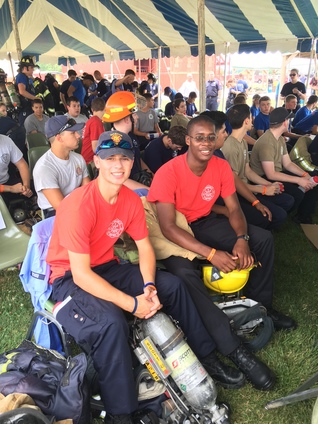 Fire Explorers
The Fire Explorer Program has over 25 students who are exposed
to the career of firefighting/paramedic career. The program
is a resource that will benefit them once they begin the fire service testing
process. The participants gather twice a month with our firefighters, who lead both classroom and practical exercises,such as how to tap a fire
hydrant or advance advance a hose line. Topics covered also include fire behavior, and use of ladders,
performing ventilation, and conducting search and rescue evolutions.
In addition, the Explorers volunteer and
participate in various public education events, such as our annual open house and festivals. They also participate in training events
with the fire department by role-playing as victims, which makes the
training more realistic.
During the program, the Explorers are exposed to the unique experience of riding along with the firefighters for a shift and participating as a member of
the crew as an observer during actual emergency responses.
Finally, participants and their leaders participate in an annual Explorer Cadet Fire School designed specifically to train Explorers. The next session will be held at the Illinois Fire Service Institute in Champaign from July 12-15. During this experience the
explorers will receive hands-on training that includes vehicle extrication,
forcible entry, rope rescue, search and rescue, and live fire evolutions which match their skill level.
To help offset the $525 Fire School tuition expense, as
well as to purchase new equipment for EFD, participants will be hold a car wash
on Saturday, May 26, 10 a.m. to 2 p.m., at Fire Station 25, 2830 Central
St. We hope to see you there!
|
Fire Prevention Bureau
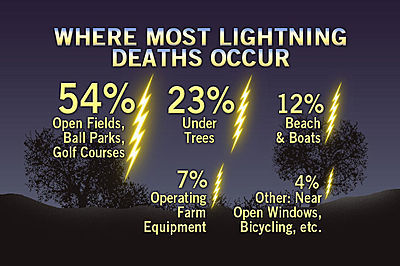
LIGHTNING
SAFETY
INDOOR
SAFETY
- Stay off corded phones, computers, and other electronic
equipment that put you in direct contact with electricity.
- Avoid washing your hands, showering, bathing, doing
laundry, or washing dishes.
- Stay away from windows and doors.
OUTDOOR
SAFETY
Seek shelter immediately in a building or a hard-topped
vehicle.
If you are in or on open water, go to land and seek
shelter immediately.
If you cannot get to shelter and you feel your hair stand
on end, indicating that lightning is about to strike, squat low to the ground
on the balls of your feet. Place your hands over your ears and put your head
between your knees. Make yourself the smallest target possible and minimize
your contact with the ground. This is a last resort when a building or
hard-topped vehicle is not available.
If a person is struck by lightning, call 9-1-1 and get
medical care immediately. Victims of lightning strikes carry no electrical
charge, so attend to them immediately. Administer CPR if you know how and it is
needed.
|