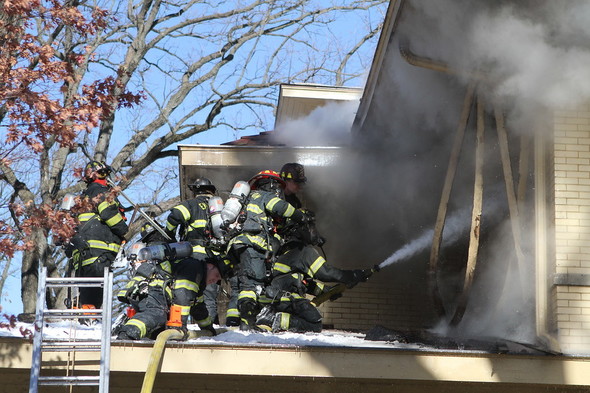
 Evanston firefighters extinguishing a working fire in the 2800 block of Sheridan Pl.
Did you know that Illinois
has the fourth highest residential fire death rate in the country? The biggest single factor in that alarming
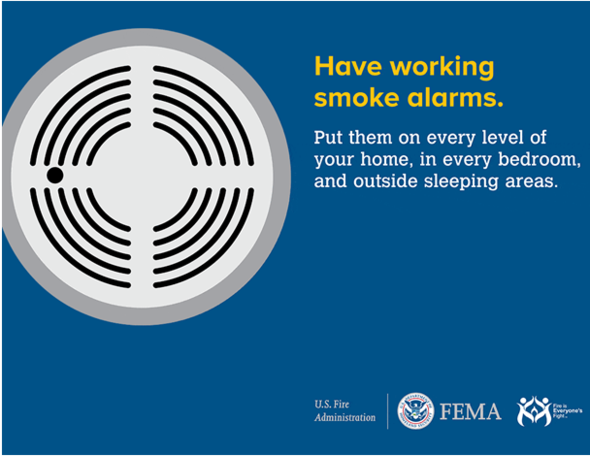
statistic is the lack of a working smoke detector in the home. Statistics show
that if you do not have a working smoke alarm in your home, the odds of you
getting out and escaping unharmed go down significantly.
That's why the Evanston
Fire Department is teaming up with the Illinois Fire Safety Alliance and the
Office of the State Fire Marshall to make sure as many homes as possible in
Evanston have working smoke alarms through the “Be Alarmed!” program.
This program will help
provide FREE smoke detectors to all
those in need. Please feel free to contact us through 311 to receive your free smoke detectors for your
residence along with free fire safety educational materials and installation.
Additionally, please remember that your Fire
Prevention Bureau will always be happy to assist you and your family to be as
safe as possible in your home. These services are also provided at no cost and
include:
- Home fire safety
surveys and escape plan design.
- Assistance with carbon
monoxide detectors.
- Residential high rise
and apartment building fire safety and evacuation presentations
- Fire extinguisher
training
Enjoy this month’s Roll Call.
If I can be of assistance in any way, please feel free to contact me at
847-866 5924 or bscott@cityofevanston.org
Stay Safe!
Brian R. Scott
Fire Chief
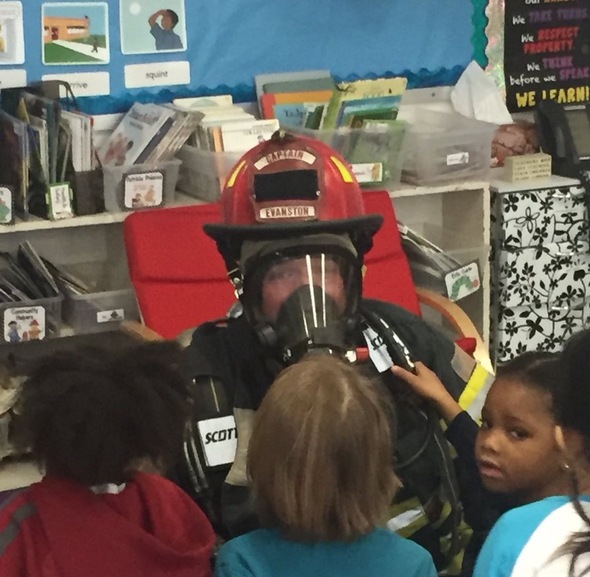 Evanston Fire Captain John Roche teaches fire safety at Lincoln School.
Below is a breakdown of emergency responses the Evanston Fire Department responded to in January.
EMS Calls

556 Incidents in January
|
Fire Calls

350 Incidents in January
|
Response Times
 EFD average response times for December:
3 min 29 sec from dispatch to emergency
NFPA average: 4 min or less
|
Operations and EMS
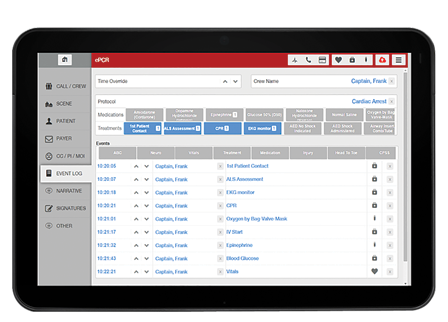 |
The Evanston Fire Department is excited to announce Physio
EMS Mobil Touch as our new Electronic Patient Care Reporting platform by the
middle of April. The Evanston Fire Department converted from paper reporting to
Electronic Patient Care Reporting back in 2010 using Zoll. Even though patient
care reporting has not changed in decades, technology on the other hand has.
This new ePcr platform by Physio will allow the Evanston Fire Department to
take advantage of a cloud-based platform available on tablets, which will feed
information into the report right from our Computer Aided Dispatch (CAD) for
reporting. This platform will also allow receiving hospitals the ability to see
the report live, as it is being completed by the paramedics on scene. Not to
mention the ability to access protocols at the tip of your finger. These are
just a few of the features Mobil Touch will provide. Ultimately, with the use
of this program, paramedics will have better data capture, more flexibility,
and be able to get back in service quicker.
Training and Special Operations
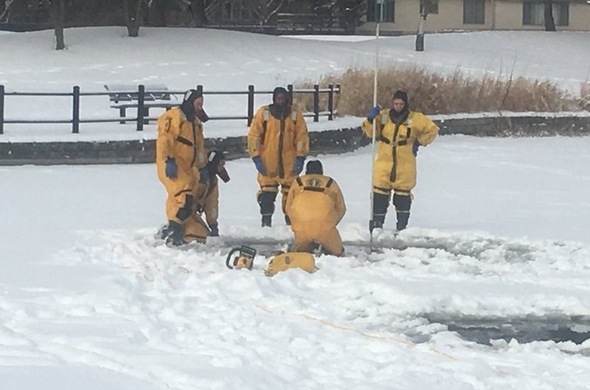 The Evanston Fire
Department took advantage of the recent cold weather to conduct its Surface Ice
Rescue training. Over three days, 78 of our firefighters participated in various drills
utilizing the pond at Lovelace Park in Evanston. Our goal is to prevent an
accident from becoming a catastrophe. This training allows us to provide a safe
and effective rescue by developing both the knowledge and skills required to execute an efficient rescue plan. This
plan includes: “Reaching” for a victim
with a pike pole or ladder if possible, “Throwing” a rope to a victim that is
farther out, and “Going” out on to the ice to rescue the victim in our Mustang
Cold Water Survival Suits. Every
situation will dictate a specific response. Each firefighter was put through multiple
scenarios practicing both single and multiple victim rescues. We also practiced
cutting holes in the ice to gain access for our ice divers.
Our members were
trained in nationally recognized and proven methods for rapid, effective and
safe rescue of victims who had fallen through the ice. A guiding principle in the training provided
is that there is not one sure method that will work for all incidents. Using a
few proven techniques to maintain safety, being able to adapt, and working as a
team are the keys to a successful rescue effort.
When
is ice safe?
There really is no sure answer, and no such thing as 100 percent
safe ice. You cannot judge the strength of ice by one factor like its
appearance, age, thickness, temperature or whether the ice is covered with
snow. Ice strength is based on a combination of several factors, and they can
vary from water body to water body. Ice strength can also vary in different
areas of the same body of water.
Safety tips:
- Never go out on the ice alone.
- If you fall through the ice, don’t panic. Try to get your feet up and float
onto the edge to get out.
- If you get out, don’t stand up but roll away from the hole to stronger ice.
- If you can’t get out, get to the edge and try to rest your arms on the ice.
- One of the leading causes of people falling through the ice is trying to
rescue animals.
Fire Prevention Bureau
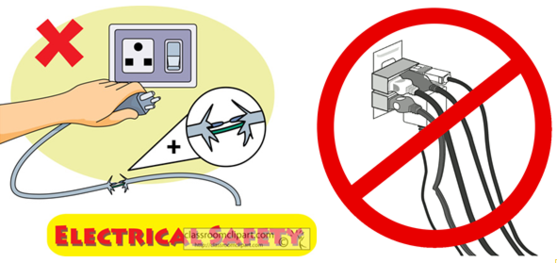 Follow
these electrical safety tips to help keep your home fire-safe.
Appliances
- Always plug major appliances, like refrigerators, stoves, washers and dryers, directly into a wall outlet.
- Never use an extension cord with a major appliance, it can easily overheat and start a fire.
- Always plug small appliances directly into a wall outlet.
- Unplug small appliances when you are not using them.
- Keep lamps, light fixtures and light bulbs away from anything that can burn.
- Use light bulbs that match the recommended wattage on the lamp or fixture.
- Check electrical cords on appliances often. Replace cracked, damaged and loose electrical cords. Do not
try to repair them.
Outlets
- Do not overload wall outlets.
- Insert plugs fully into sockets.
- Never force a three-prong cord into a two-slot outlet.
- Install tamper-resistant electrical outlets if you have young children.
Extension
Cords, Power Strips and Surge Protectors
-
Replace worn, old or damaged extension cords right away.
- Use extension cords for temporary purposes only.
- Avoid putting cords where they can be damaged or pinched, like under a carpet or rug.
- Do not overload power strips.
- Use power strips
that have internal overload protection
|