How Assessments Work in Cook County

View as a webpage / Share

Assessor Logo


News from the Assessor's Office

August 2, 2022

HOW ASSESSMENTS WORK

IN COOK COUNTY

New Trier and Schaumburg Townships Reassessed

Reassessment Notice

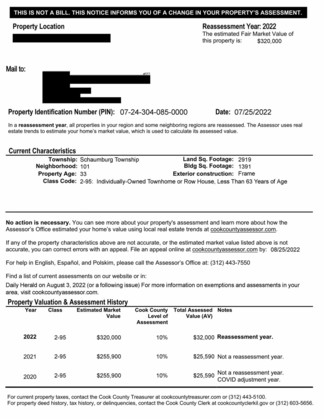
Reassessments continue in the north suburbs of Cook County. Homeowners in New Trier Township were mailed Reassessment Notices on July 19, 2022, and homeowners in Schaumburg Township were mailed Reassessment Notices on July 25, 2022. 

Cook County follows a triennial reassessment cycle, which means one-third of the county is reassessed every three years. When a property is reassessed, the property owner is mailed a Reassessment Notice (example pictured on the left). The Reassessment Notice reflects the estimated Fair Market Value based on sales of similar properties over the past three years. The notice also contains important information such as property characteristics, neighborhood code, and past assessment information. An increase in a property’s value does not indicate the same increase in the property owner’s taxes. The estimated Fair Market Value listed on the Reassessment Notice will be reflected on tax bills in 2023. 

Market Value vs. Assessed Value

After estimating the fair market value of a home, the Assessor’s Office calculates the home’s Assessed Value based on its Level of Assessment.

Levels of Assessment are set by Cook County Ordinance based on the property’s major class. Single-family homes, condos, and all other 200-class properties have a 10% Level of Assessment, so the property’s Assessed Value equals 10% of its estimated Fair Market Value. For example, a home valued at $500,000 has an assessed value of $50,000.

Note that it is not the Assessed Value that is taxed. The taxable value of the home is its final Equalized Assessed Value (EAV). This requires two more numbers:

  • The Equalizer (also called the Multiplier), is calculated every year by the Illinois Department of Revenue. All properties in Cook County have the same Equalizer.
  • Any exemptions, such as the Homeowner or Senior Exemptions. These subtract a fixed amount from the home’s EAV and is the same throughout Cook County. For example, the Homeowner Exemption subtracts $10,000 of EAV, and the Senior Exemption subtracts $8,000.
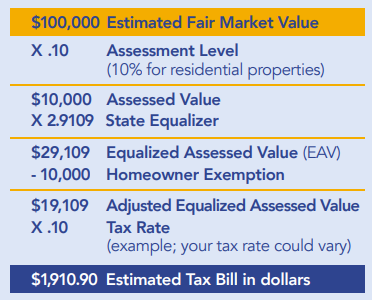
tax calculator

Here's an example of how a tax bill would be calculated, for a home with an estimated fair market value of $100,000, a local tax rate of 10%, and Equalizer of 2.9109. 

How does the model know what my home is worth?

“The model” is a computerized statistical model that uses real estate market data to estimate the value of homes that haven’t sold. These models are often called Automated Valuation Models and are the standard for conducting a computer-assisted mass appraisal.

The goal of the model is to answer this question: “What would the sale price of every home be if it had sold recently in an arms-length transaction?”

To answer this question, we use a two-step process:

  1. Modeling. First, we use computer code to analyze data about home sales. Any two homes may have different characteristics (location, number of bedrooms, etc.) and sale prices. But there are consistent patterns in how characteristics affect sale prices on average. It’s important to detect these patterns accurately. To do that, we use computer code to train a predictive machine learning model, which learns to recognize complex patterns much faster than a human could. The output of this step is a model which can be used to predict any home’s sale price based on its characteristics and these learned patterns.
  2. Valuation. We then use the model to predict values for all residential properties. Estimated values produced by the model are reviewed by software and by our expert analysts, who review assessed value changes by neighborhood and property class and make adjustments as necessary.

Finally, we mail Reassessment Notices to homeowners with their property’s estimated market value, its characteristics, and its assessed value.

Learn more about our modeling process here. 

  • Read: How the model works to produce the most accurate, uniform, non-regressive assessments we can with our current data
  • Watch: Our presentation at Chi Hack Night on an earlier version of the model. Register for an upcoming presentation here.
  • FAQs: about the model

Reassessment Reports

Upcoming Events

Join us for virtual workshops to learn about recent reassessments in the northern suburbs of Cook County. The educational workshops will cover the following. 

•Understand your reassessment notice

•How to determine if an appeal should be filed

•Learn how to file for missing exemptions

•Participate in live Q&A session

To see the full list of events, visit www.cookcountyassessor.com/event-list

August 2

Receive Property Tax Assistance:
Barrington Township
Tuesday, August 2, 2022
5:30PM - 6:30PM
Virtual Webinar

Event Details


August 3

Receive Property Tax Assistance:
Hanover Township
Wednesday, August 3, 2022
5:30PM - 6:30PM
Virtual Webinar

Event Details


August 4

Receive Property Tax Assistance:
New Trier Township
Thursday, August 4, 2022
5:30PM - 6:30PM
Virtual Webinar

Understand Assessment Appeals

Property owners have the right to file an appeal. Appeals can be filed online and are completely free, a lawyer is not required. If the property characteristics listed on your assessment notice are incorrect, or if the estimated market value of your home is significantly more than what you believe your home could sell for in the current real estate market, you should consider filing an appeal. A good rule of thumb is this: If the property characteristics on this notice are correct and the estimated market value is within 10 percent of what you think your home is worth then it is unlikely that an appeal would change your property’s assessed value enough to significantly affect its property tax bill.  


The deadline to file an appeal for properties in New Trier is August 19, 2022 and for properties in Schaumburg is August 25, 2022. 

3 Reasons for filing an Assessment Appeal

1. Lack of Uniformity - Either you or our analysts can look at comparable properties (properties similar to yours) and determine whether the assessed value of your property is in line with the assessed values of other comparable properties.

2. Overvaluation -  Supporting documentation, such as recent closing statements, or information about purchase prices of homes similar to yours can be submitted.

3. Incorrect Property Description - If a reassessment notice lists an error such as incorrect square footage, classification, or an error that may affect market value, an appeal can be filed. Supporting documentation such as property record cards or dated photos may be submitted with your appeal. It is important to remember, however, that a minor error does not necessarily indicate an incorrect assessment.

Download one of our helpful brochures available in English, Spanish, Polish, Chinese, Tagalog, and Arabic to learn more about assessment appeals. 

Download a Guide