Assessor’s Office Releases Comprehensive Report on North Suburban Cook County
New data, charts, and visualizations provide transparent view of county tax base
As part of an ongoing commitment to transparency, Cook County Assessor Fritz Kaegi announced today the publication of a report on the reassessment of north suburban Cook County. The release of the report marks the first time the Cook County Assessor’s Office (CCAO) has provided a comprehensive look at how the property tax base is created in each community. It is also the first time in more than a decade that the CCAO has issued an annual report.
Filled with never-before-seen data, charts, and visualizations, the comprehensive report covers several topics, including the assessor’s role in the property tax system, the effects of the north suburban reassessment on the county’s tax base, and information about exemptions and incentives that can reduce a property owner’s tax bill.
The report also includes real estate trends for homes and commercial properties in the north suburbs, a self-study of assessment quality, data about increases in value of each major property class throughout Cook County, and explanations of how 2019 assessments affected property tax rates and bills. A one-page summary of every reassessed north suburban township is included in the report, providing a detailed look at each community’s assessment roll and assessed value as well as the number of exemptions and appeals there.
Takeaways from the north suburban reassessment report include:
-
In 12 of 13 townships, the CCAO met all three standards for accuracy, uniformity, and equity, using metrics set by the International Association of Assessing Officers (IAAO).
- The creation of an automatic process for renewal of the Senior Exemption led to more than 30,000 senior citizens receiving significant savings on their property tax bills.
- The CCAO granted 291 more commercial property incentives than the previous year – most of them in support of affordable housing – in order to aid with economic development in neighborhoods and communities throughout Cook County.
- Increases in assessed value increase the size of the tax base, which can lead to reductions in tax rates. The work of the CCAO found that from 2018 to 2019 the county’s assessed value grew by $6.3 billion, an increase of 9.5%. Most of this growth ($5.8 billion) was in the reassessed townships in the northern suburbs. (After appeals were processed by the Cook County Board of Review, however, this $6.3 billion growth in the tax base was reduced to $2.7 billion.)
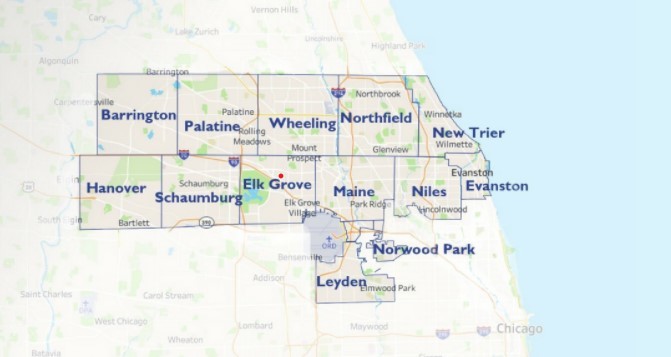 North Suburban Townships Analyzed in the Report
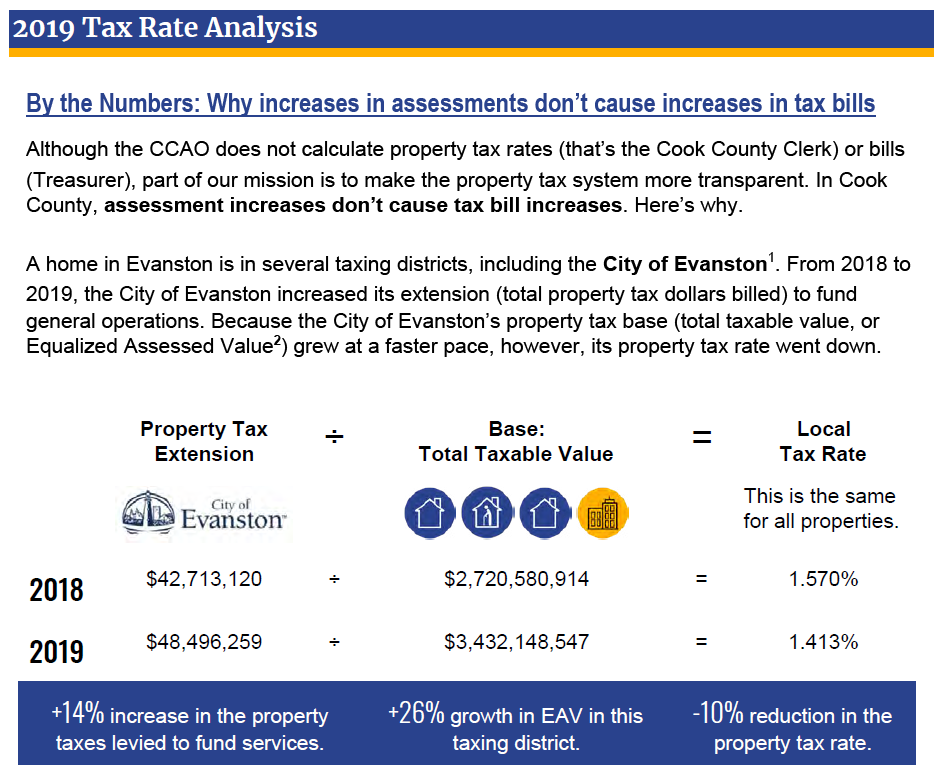 Why Increases in Assessments Don't Always Cause Increases in Tax Bills
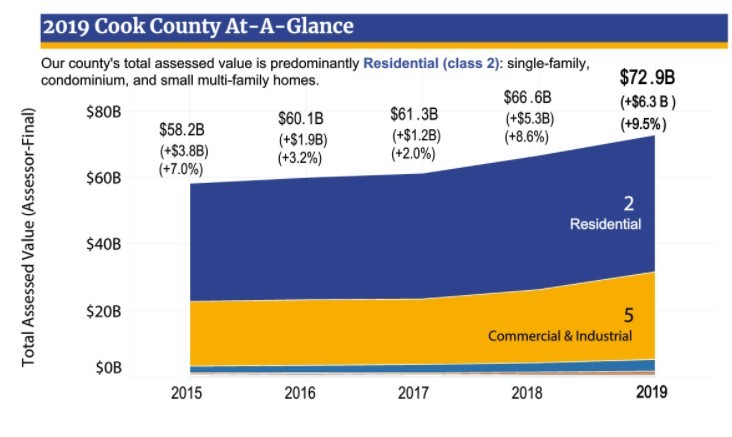 2019 Assessed Values At-A-Glance
|