|
|
Collaboration is moving northeastern Illinois forward — from safer freight and better travel data, to more affordable transit and planning for the next century. Collaboration highlights how public input, shared priorities, and sustained partnership can create more connected communities.
If you have a transportation project, milestone, or resource our partners and readers should know about, send it to msobczak@cmap.illinois.gov for consideration in a future issue.
|
|
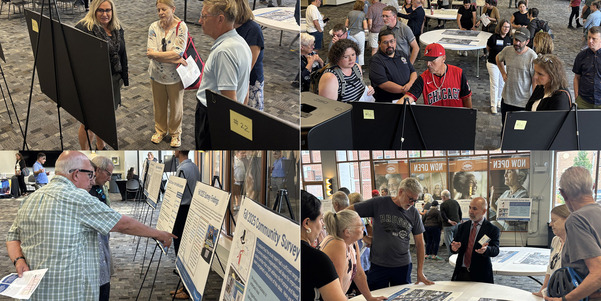 Community members attending the public meeting for the Berwyn–Riverside Railroad Grade Crossing Study.
|
|
Public meeting launches railroad crossing study comment period
Community members gathered at the Berwyn Senior Center in August to review potential solutions for the Berwyn-Riverside Railroad Grade Crossing Study and speak with the project team.
Why it matters: The study examines seven street-level BNSF Railway crossings, from Delaplaine Road in Riverside to Ridgeland Avenue in Berwyn, including Harlem Avenue.
Extended railroad gate closures can affect:
- Travel times and reliability
- Emergency responses and access to MacNeal Hospital
- Access to transit, schools, and local businesses
- Pedestrian, cyclist, and motorist safety
- Connections between neighborhoods
What was shared: CMAP and the Cook County Department of Transportation and Highways presented the study’s evaluation process and the concepts ranked highest for further study. These include possible roadway bridges and underpasses, pedestrian and bicycle connections, short-term improvements at Harlem Avenue, and traffic-management tools such as advance warning signs.
What’s next: A 30-day public comment period is now underway. Feedback will help the project team complete the study and inform which alternatives could advance to an engineering process.
How to comment:
- Email tmurtha@cmap.illinois.gov
- Mail comments to CMAP, Attn: Tom Murtha, Project Manager, 433 W. Van Buren Street, Suite 450, Chicago, IL 60607
|
|
|
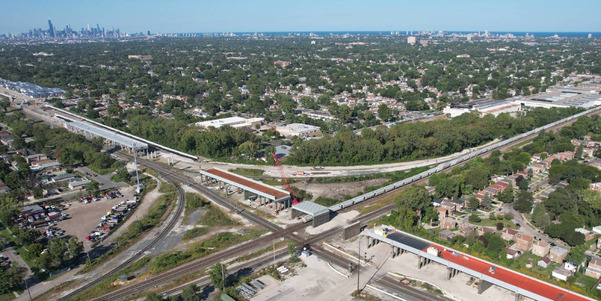
The CREATE Program’s Forest Hill Flyover has earned a 2026 America’s Transportation Award for safety.
The project added an elevated rail corridor and separated trains from people walking, biking, and driving at one of the nation’s worst rail bottlenecks. It has improved safety, reliability, noise, and emissions while helping move an estimated $652 billion in goods through Chicago each year.
The big picture: The award recognizes what sustained public-private collaboration can accomplish for communities and the national freight network.
🏆Read about the award
|
|
One region, one voice on a national freight decision
CREATE demonstrates the value of regional coordination. That same collaboration is central to CMAP Executive Director Erin Aleman’s new Daily Herald op-ed about the proposed Union Pacific–Norfolk Southern merger.
The merger could improve freight efficiency, but national benefits must not come at the expense of Metra reliability, community safety, air quality, or local development.
What CMAP is doing: CMAP will work through its Board, MPO Policy Committee, Transportation Committee, Council of Mayors, and other partners to gather local insights and ensure northeastern Illinois speaks with a strong, unified voice during the federal review.
🚂 Read Erin's op-ed
|
|
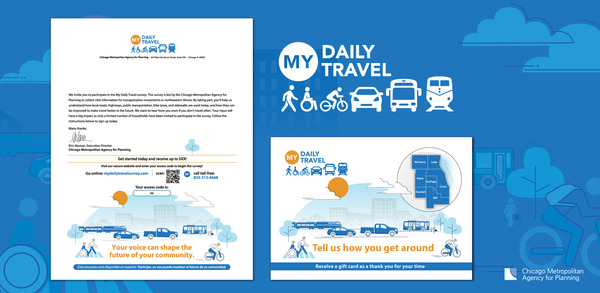 Sample letter and postcard being mailed to invited participants.
|
|
Phase 2 of My Daily Travel hits the road
CMAP has launched the next phase of My Daily Travel, the regional household survey that captures how, when, where, and why people travel.
Randomly selected households across the seven-county region will receive invitations by mail. Participants can record their travel online, by phone, or through a smartphone app, and households that complete the survey will receive a gift card.
Why it matters: CMAP aims to hear from 8,000 households. Their experiences will help guide investments in roads, transit, sidewalks, bicycle networks, and other ways people get around.
The ask: If an invitation arrives in your mailbox, please participate. Every response helps ensure households like yours are represented in future transportation decisions.
📫Learn more about My Daily Travel
📲 What's Up Wednesday: See our feature on LinkedIn, Instagram, and Facebook
|
|
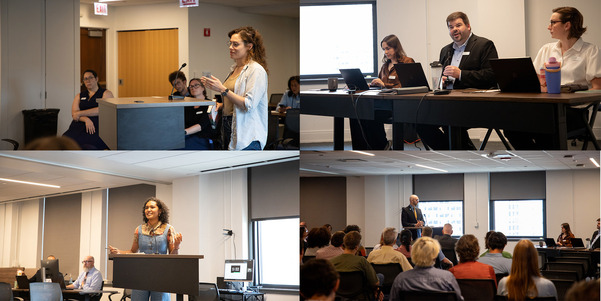 Highlights from the RTP’s August 6 public hearing.
|
|
Public input moves the Regional Transportation Plan forward
Thank you to everyone who reviewed the draft 2026 Regional Transportation Plan and participated in CMAP’s August 6 public hearing.
The public comment period closed July 31 for the draft RTP, FFY 2027–32 Transportation Improvement Program, and Air Quality Conformity Determination.
In total, CMAP received 2,183 written comments and heard 44 oral comments during the public hearing. These comments covered a wide range of topics, from transit access and rail service to active transportation, air quality, roadway investments, and the future of North DuSable Lake Shore Drive.
What’s next: CMAP is reviewing the feedback as it finalizes materials for consideration by the CMAP Board and MPO Policy Committee in October. The final package will include a summary of comments and responses.
🗺️Review the draft plans and next steps
|
|
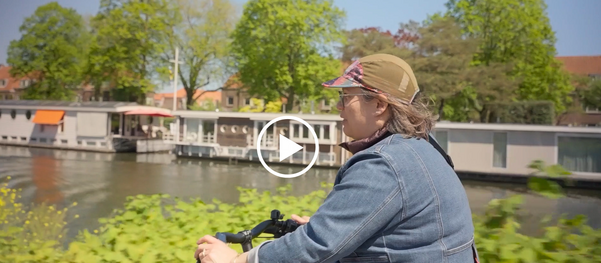
What changes when transportation systems put people first?
Erin Aleman joined transportation leaders from Illinois, Minnesota, and Michigan in Utrecht, Amsterdam, and beyond to experience connected bicycle networks, reliable transit, car-light neighborhoods, safe streets, and restored public spaces.
The takeaway: Good transportation systems do not happen by accident. They are designed, planned, and built intentionally over time.
|
|
Powering and protecting the next century
The Century Plan is examining how northeastern Illinois can coordinate systems that are often planned separately.
In a recent commentary, Erin notes that Illinois electricity use could more than double by 2050 as buildings, transportation, and industry electrify. Meeting that demand will require more than generating additional power. The region needs a smarter and more resilient grid, coordinated with decisions about growth, land use, climate, and economic development.
⚡Read Erin’s commentary
|
|
|
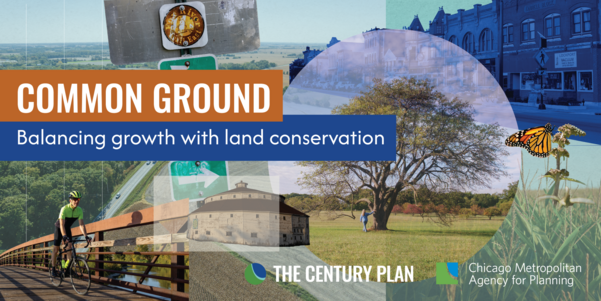
Next in the Catalyst Series: Join CMAP from 3:00 to 6:00 p.m. September 22 at Richardson Adventure Farm in Spring Grove for Common Ground: Balancing Growth with Land Conservation. The conversation will explore how the region can support housing and economic development while protecting forests, wetlands, parks, and agricultural land.
Participants also can preview the farm’s celebrated corn maze before it opens to the public.
🌽 Read the details and RSVP
|
|
|
The CMAP team shared regional insights and practical tools at IDOT’s Fall Planning Conference in Bloomington last week.
On the agenda:
-
Noah Harris, senior policy analyst, highlighted lessons from Greater Chicago’s climate action planning and early modeling of transportation decarbonization pathways — including how state and regional strategies can cut emissions while preparing the electric grid.
-
Kate Evasic, climate resilience program lead, drew on CMAP’s Transportation Resilience Improvement Plan to show how data and targeted investments can help transportation systems withstand increasing flooding and extreme heat.
-
Jaemi Jackson, principal planner, shared lessons from CMAP’s work helping 12 communities complete ADA transition plans, with four more underway. She also highlighted tools and best practices for creating safer, more accessible public rights-of-way.
The takeaway: Planning for the future means reducing emissions, preparing infrastructure for a changing climate, and building accessibility into every transportation decision. By sharing tested tools and implementation lessons, CMAP is helping communities in northeastern Illinois create more resilient, inclusive transportation systems.
|
|
From our partners across the region |
|
NITA begins a new era for public transportation
September 1 marks a new era for our regional transit system as the Northern Illinois Transit Authority (NITA) officially begins operations. We are excited to partner with this new agency empowered to better fund and coordinate the services offered by the Chicago Transit Authority (CTA), Metra, and Pace.
🚌Learn more at nita.illinois.gov
|
|
|
Getting around the Chicago region costs less for eligible K–12 students this school year.
CTA and Pace student fares are now standardized at 75 cents per ride — at any time of day, every day of the year. Students using a Student Ventra Card also receive free transfers between CTA and Pace within two hours. Metra continues to offer reduced student fares at all times.
What this means: Lower, more consistent fares make it easier for students to reach school, activities, jobs, and opportunities across the region. The policy is an early example of how funding through the Northern Illinois Transit Authority Act is supporting more seamless and affordable transit.
Check CTA student eligibility l Explore Metra student fares l Get Pace student fare details
|
|
|
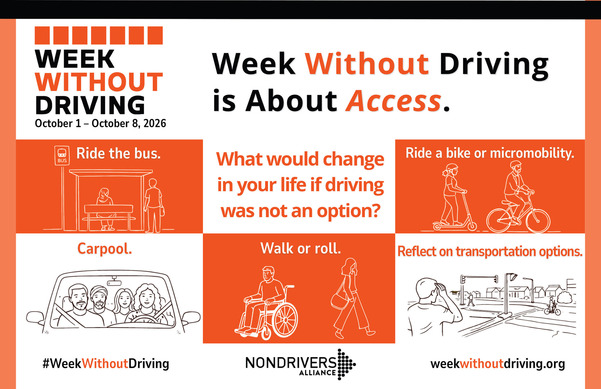
From Thursday, October 1, through Thursday, October 8, try getting around without driving — for one day or the full week. Walk, roll, bike, or take transit.
Launched in 2021, Week Without Driving helps leaders understand the barriers nondrivers face and inspires better transportation policies nationwide. Understanding lived experiences helps us plan for a region where everyone can move freely and safely.
The added benefits: Making the decision to walk or roll for a week has many other benefits too, including improved physical and mental health, reduced climate impacts, and stronger community connections!
🚶Sign up for Week Without Driving and share your experiences using #WeekWithoutDriving.
|
|
$157 million available for local transportation improvements
The Illinois Transportation Enhancement Program is accepting applications through 5:00 p.m. on October 5.
This is ITEP’s largest funding cycle yet, with $157 million available for projects such as walking and biking paths, trails, streetscape improvements, and other investments that encourage safe, multimodal travel. Applicants may request up to $5 million per project, with awards expected in spring 2027.
The bottom line: Communities should prepare applications now.
🔎Explore ITEP eligibility and application resources
|
|
|
|
|