|
Our region's economy shines through challenges in 2025
Season’s greetings! Every year feels like it passes in the blink of an eye. This year that feels especially true. Northeastern Illinois' economy faced challenges — tariffs, a potential transit fiscal cliff, artificial intelligence, and interest rates. These uncertainties could have negatively impacted Chicagoland’s economic well-being. But when we look at our data, there's reason to be proud.
Our region has one of the most globally resilient economies. Established in 1987, the Northeastern Illinois Development Database (NDD) records projects that meet specific criteria, documenting land consumption, number of housing units, non-residential square footage, and land-use types. This year, we recorded more qualifying projects than in 2024, 2023, and 2022. Complementing the NDD is the pro-Chicagoland decision metric, which CMAP's friends at World Business Chicago started in 2021, to refer to any company that relocates, expands, or enters the Chicagoland market. At the time of this writing, the number of pro-Chicagoland decisions (178) was just two away from the record set in 2022.
Looking to 2026, we can look forward to new challenges nationally but locally we should continue to be encouraged. Landmark $1.5 billion investment into public transportation by the Illinois General Assembly will continue to stabilize our economy for years to come. Plus, new programs like the McHenry County Economic Development Corp.'s Entrepreneurship through Acquisition and Lake County’s Housing Lake are positioned to ensure that we are approaching the gaps in our economy with intentional and creative solutions.
I am particularly excited that, in 2026, CMAP will begin our full engagement on The Century Plan. It will serve as our “north star” and define what we must do together and why it matters to our region, and provide policy guidance on how we get there. CMAP will conduct stakeholder sessions to dive deep into themes like housing, land use, and water supply. If you're interested in participating or sharing your expertise, I welcome the chance to connect.
On behalf of everyone at CMAP, thank you for being part of our network and community. We look forward to a promising 2026, and we wish you a holiday season filled with friends, family, and favorite traditions. See you in the new year!
By Kyle Schulz, CMAP's deputy of strategic advancement.
|
|
Job Quality and Access Tool provides key information about employment trends in northeastern Illinois
Do you want to know what the job market is like for education administrators in your county? What work experience would likely be needed for a human resource manager in your community?
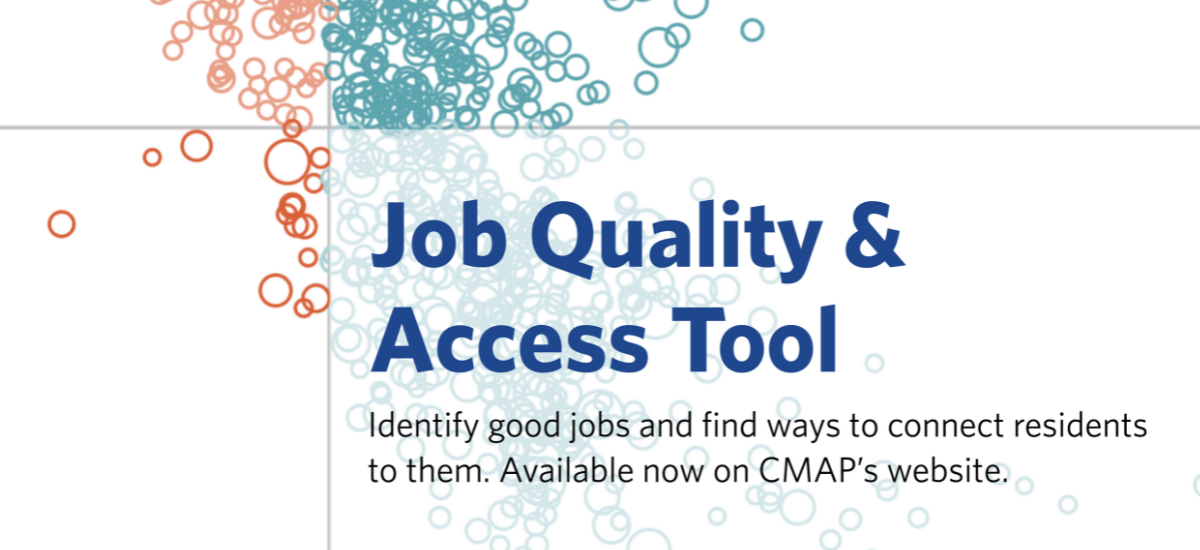
CMAP's award-winning Job Quality and Access Tool puts data about northeastern Illinois' residents and their occupations at your fingertips. It earned the American Planning Association’s 2025 Innovation-Implementation Award.
The tool provides analysis on employment trends, industry clusters, the quality of jobs, and accessibility (such as the level of education required). Job quality includes earnings, opportunity for career advancement, employer-provided benefits, job stability, and more. Job access compares education and experience requirements, workforce demographics, job flexibility, and more. And demographics data compares an occupation's composition to that of the region's overall workforce and the working-age population. If an occupation is dissimilar from the regional population than the overall workforce, it receives a lower access score.
Recent updates — including transit information, living-wage data, and customizable weighting factors — have made the tool more versatile for communities across our region.
|
|
Northeastern Illinois Development Database shows how our region continues to experience growth
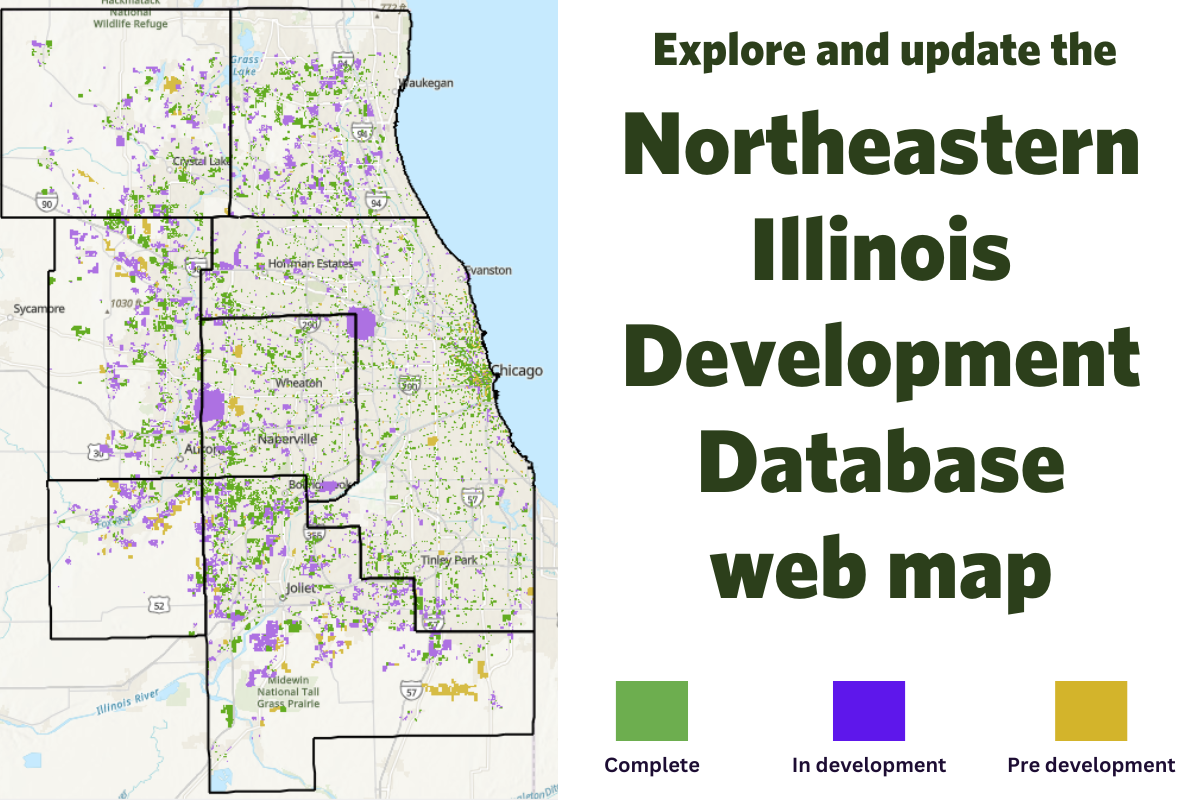
Our region is constantly changing, with some communities experiencing rapid growth, while others experience significant changes to land uses. Since 1987, the Northeastern Illinois Development Database (NDD) has tracked significant developments and redevelopments in the seven-county region. So far in 2025, we have recorded 436 qualifying projects. That's the most since 2021.
Municipalities are encouraged to submit proposed, in-progress, or completed developments, as all phases contribute valuable data for the model. The NDD web map is an opportunity to ensure your community’s growth is accurately represented in regional forecasts. This data informs CMAP’s local forecast model, which predicts household and job placements in developments across the region.
Contributing to the NDD helps CMAP and regional planners better understand current and future development trends. This data:
- Improves the accuracy of land use planning and housing trend analysis
- Strengthens community promotion by showcasing planned growth and investment
- Supports CMAP’s evaluation of conditions for future transportation and infrastructure projects
Local governments that contribute to the NDD can ensure that their community is part of a collaborative effort to shape the region’s long-term development and that growth aligns with local and regional goals and priorities.
|
|
The journey toward housing solutions in Lake County continues; summit coming up
CMAP and Lake County — with support from the Schreiber Philanthropy — are partnering to advance solutions that address Lake County’s housing challenges. Since the launch of the Housing Lake Initiative earlier this year, we’ve engaged with business leaders, elected officials, municipal planners, developers, and community advocates to gather input and set the stage to address the county's need for diverse housing options.
In February, the Lake County task force will share its findings and actionable strategies at a housing summit.
This work will also inform housing solutions for the entire region. As part of developing The Century Plan, the region’s next vision for the future, we will build on Lake County’s critical work in this area and use it to help our region thrive with affordable housing options. Housing and economic vitality are interconnected. Data shows that our region struggles to supply enough good, affordable, and accessible housing that is connected to jobs and services and our region needs more housing choices that meet their needs including rental housing, housing located near public transit, accessible housing for older residents and people with disabilities, and housing near job centers.
Housing Lake County summit
February 11, 2026
Program will include guest speakers and technical experts; dynamic panel discussions on the four foundational pillars that will form the foundation for the next phase of housing work in Lake County; an opportunity to sign a collective commitment to action.
|
|
Fresh start vs. startup: McHenry County's Entrepreneurship Through Acquisition
Instead of facing the uncertainty and failure rate of startups, some are choosing to acquire established companies that already have customers, employees, and revenue.
The McHenry County Economic Development Corporation's (EDC) Entrepreneurship Through Acquisition Program offers insight into how it can be done. Applications are open for the fourth cohort of the program. Learn more and apply.
This eight-week, instructor-led course is designed for business owners and emerging entrepreneurs to learn the ins and outs of acquiring, operating, and growing an existing business — while connecting with peers and gaining hands-on experience.
The cohort runs from Jan. 14 to March 4, 2026, meeting from 6 to 8 p.m. every Wednesday at the McHenry County College Catalyst Campus, in Woodstock.
Applications close January 12, and no business ownership experience is needed.
Strong Transitions Kickoff event
The McHenry County EDC has planned an informational and networking event designed for business owners, aspiring buyers, future sellers, and anyone interested in entrepreneurship in the county.
You can:
- Learn about Transition Advising and Entrepreneurship Through Acquisition programs
- Hear from program graduates and meet advisors
- Connect with local entrepreneurs and business leaders
The event takes place from 4:30 to 6:30 p.m. on January 15. Register now.
|
|
DuPage connections: data to download and explore
You can now download Choose DuPage's third-quarter Economic Indicators Report to explore key trends in office, industrial, and retail real estate. It also includes data about employment patterns, transportation, and more.
Connect DuPage Database
Created by Choose DuPage, the Connect DuPage Supplier Database helps businesses connect with potential partners along their supply chain, encouraging commercial collaboration and opening new doors for small and diverse businesses.
The effort aims to:
- Promote commercial collaboration
- Address current supply chain challenges
- Raise awareness and opportunity for DuPage County businesses
|
|
A year of highlights: Will County celebrates success
In 2025, nearly 2,300 new jobs were created in Will County. Also, retail sales reached about $14 billion, new wages totaled more than $630 million, and population reached 708,583.
More than 400 people came together this month to celebrate the Will County Annual Report. Among the highlights:
- The launch of the Will County Housing Study, which addresses housing supply, affordability, opportunities for development, and more.
- The county's summer internship program placed 75 students with local employers, which was nearly twice as much as in 2024.
- The work of the Imagination Library, a partnership between the Will County Center for Economic Development's Foundation and the Will County Executive's Office. Thousands of children across the county receive free books each month.
|
|
Lake County spotlights significant economic progress
The recently released Lake County Annual Report highlights achievements that support safety, create economic opportunities, invest in adaptive infrastructure and sustainability, provide important services, and promote a healthy and inclusive community.
Lake County saw significant economic progress, with increases in capital investment and visitor spending, and a fine-tuned focus on workforce development and attainable housing.
|
|
Build Better Together means business in Chicago
The latest World Business Chicago Business Pulse on LinkedIn highlights Chicago's Build Better Together program, which accelerates high-impact, cross-departmental projects that strengthen the city's economic foundation.
Build Better Together is helped by two key initiatives — the Central Area Plan 2045 and Cut the Tape for Small Business.
Central Area Plan 2045 sets a course for the future of downtown Chicago as the city's first comprehensive downtown development in more than two decades. It establishes a 20-year framework that outlines more than 250 goals, actions, and strategic projects across the Loop, Near North, Near West, and Near South sides, which targets:
- 100 million square feet of new construction
- 160,000 new jobs
- 100,000 new residents
- 65,000 new housing units
- 13,000 new hotel rooms
Cut the Tape for Small Business focuses on reducing time and cost burdens so entrepreneurs can open and operate more easily.
The Chicago Department of Business Affairs and Consumer Protection conducted regional roundtables with neighborhood business development centers, chambers of commerce, local economic development organizations, and small business owners. Some of the key priorities that emerged from that research include:
- Developing guidance to help business owners navigate pre-licensing inspections
- Simplifying and digitizing licensing and permitting processes
- Streamlining administrative debt checks to reduce unnecessary delays
- Creating an interactive online map showing permitted business activities by location
- Eliminating information silos across departments
- Launching a digital literacy initiative for entrepreneurs to bridge the technology gap
Across the city, Build Better Together signs are more visible — marking developments underway and the projects preparing to break ground. Learn more on LinkedIn.
|
|
Survey asks Chicago's small business owners about growth in 2026
Just under half of small business owners are optimistic about growth in 2026, with 54 percent aiming to pursue a growth type of strategy.
The University of Illinois Chicago and the Chicagoland Chamber of Commerce teamed up to study the small business outlook for the next 12 months. The Institute for Leadership Excellence and Development, housed in the UIC College of Business Administration, developed and distributed an online survey to Chicago’s small business community and analyzed the data.
The 2025 Small Business Outlook Survey included 148 small businesses. The survey also found that 30 percent of those surveyed expect our region's economy to stay the same or become stronger in 2026, down from 57 percent a year ago.
|
|
ComEd tops among peers in reliability, study shows
ComEd ranks as one of the country's most reliable utilities, based on a benchmarking study. Compared to its peers (publicly held utilities serving 1 million or more customers and with transmission and distribution operations), ComEd ranked first in terms of how low the frequency and duration of outages were for customers.
The frequency of outages improved by more than 50 percent, compared to 2012 and earlier. Metrics also showed that duration of outages improved by about 20 percent in the same timeframe, meaning that customers experienced shorter interruptions when service was disrupted.
|
|
|
|
|