|
Welcome to another climate update from your regional planning agency, the Chicago Metropolitan Agency for Planning (CMAP). I'm Joan Smedinghoff, a member of CMAP's communications team, where I focus on climate topics, manage our website, and write this newsletter, among other things. Do you have a project or update to share with the region? Reach out anytime at jsmedinghoff@cmap.illinois.gov. |
|
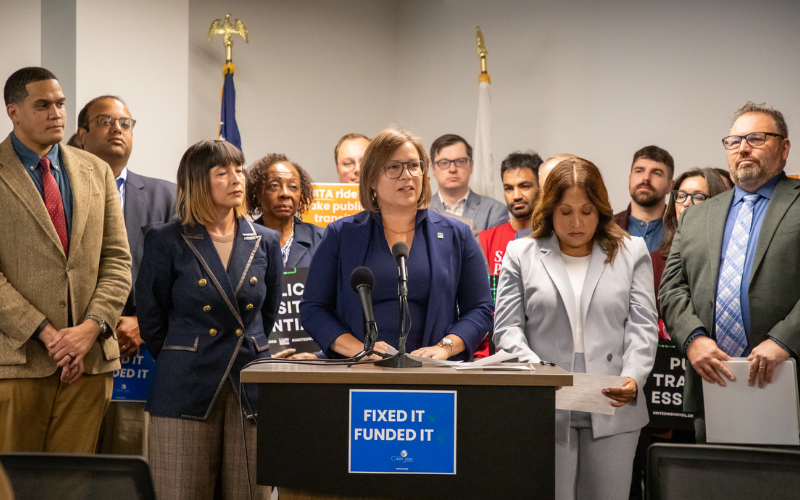 CMAP Executive Director Erin Aleman joins elected officials and transit advocates to celebrate the passage of historic legislation strengthening public transit in northeastern Illinois.
|
|
Historic transit legislation realizes CMAP's vision for a stronger, more integrated system
Illinois has taken a historic step toward a more connected, reliable, and sustainable public transit system. During this fall's veto session, the General Assembly approved Senate Bill 2111, establishing the stable funding and governance reforms needed to sustain and strengthen public transportation across northeastern Illinois. This averts the region's looming transit fiscal cliff — a projected operating shortfall that threatened deep service cuts, fare increases, and economic impacts for millions of riders — and replaces it with a sustainable, long-term solution.
|
|
New bill passes to accelerate transition to cleaner, more reliable energy system
Also during veto session, the General Assembly passed the Clean and Reliable Grid Act (CRGA), which establishes a framework for accelerating the transition to a cleaner, more reliable energy system in Illinois. It expands support for utility-scale battery storage, lifts the state's moratorium on new nuclear development, strengthens energy efficiency requirements for utilities, and gives the Illinois Commerce Commission new planning authorities for long-term energy supply and demand needs. CRGA also advances programs for virtual power plants, time-of-use rates, geothermal pilots, and other tools that help lower costs and increase grid flexibility.
Many of the act's provisions — such as large-scale storage procurement, integrated resource planning, and geothermal network pilots — will help set the stage for implementing key actions identified in the Comprehensive Climate Action Plan for Greater Chicago, like reducing emissions and modernizing energy infrastructure.
|
|
Shaping the next federal transportation bill
With the Infrastructure Investment and Jobs Act set to expire in September 2026, CMAP is working with regional partners, civic and labor organizations, and peer metropolitan planning organizations (MPOs) across the country to outline shared principles for the next federal transportation reauthorization.
Together, we developed One Regional Voice 2025, calling for robust, durable revenues; enhanced safety; efficient transit and rail; maintained bridges; performance-based programming; multimodal freight; technological innovation; resilient systems; and policies that recognize northeastern Illinois' unique needs.
CMAP also joined MPOs from other major metropolitan areas to advance principles for reauthorization, including prioritizing safety; preserving core highway and transit programs; balancing formula and competitive funding; targeting investments to the nation's economic engines; and streamlining project delivery.
These efforts reflect a united call for a strong federal transportation package that ensures stable, predictable funding and empowers regions to meet the nation's evolving transportation needs.
|
|
Climate action plan nearing its final stages
The team developing the Comprehensive Climate Action Plan for Greater Chicago has been hard at work. Over the past month, they shared a draft plan with the Steering Committee and CMAP's Climate Committee for review. Throughout this process, both groups have played an important role in shaping the plan, confirming draft recommendations, reviewing results, and offering valuable guidance.
At their October meetings and workshops, the committees gave detailed feedback on the sectors addressed in the plan: buildings, transportation, industry, energy generation, waste, water and wastewater, agriculture, and natural carbon sequestration. Their input will help the final plan reflect shared and critical priorities, and set up Greater Chicago for implementation success.
CMAP will submit the plan to the U.S. Environmental Protection Agency (USEPA) shortly. The final report will be publicly available in early 2026.
|
|
Share your climate action projects
CMAP wants to spotlight the incredible work happening across our region to cut carbon emissions and build resilience to climate change.
If your organization has completed a project that helps our region cut emissions or prepare for climate impacts, please take a few minutes to tell us about it and share photos.
Your project could be featured in CMAP's reports, case studies, articles, and social media, helping inspire action and share solutions. Thanks to those who have already submitted excellent examples, and we look forward to additional projects that will help us highlight the important climate work happening in our region!
|
|
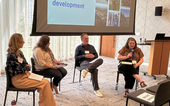
CMAP's work was on display at the American Planning Association Illinois Chapter's State Conference. Multiple presentations featured our team members, including Elizabeth Scott who led a discussion on transit-oriented development, and Kelsey Pudlock who participated in a breakout session on decarbonization. |
|
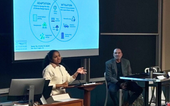
Noah Harris and Jesse Altman presented a webinar, "Electrification alone can't solve our climategGoals: Diverse strategies for a sustainable transportation future," for the University of Illinois Chicago Urban Transportation Center. Watch the recording to learn more about the Comprehensive Climate Action Plan for Greater Chicago. |
|
Prithvi Hegde and Jesse Altman were among the speakers at the Chicago Youth Climate Justice Summit. The event brought together high school students from throughout the Chicago area to focus on climate justice and solutions. |
|
Kate Evasic spoke on a webinar for the Association of Metropolitan Planning Organizations highlighting how peer agencies across the country are advancing resilience planning for transportation infrastructure. |
|
State of the Region event brings together leaders and stakeholders to launch "The Century Plan" — Solving for tomorrow, today
Nearly 1,000 people, including state officials, mayors, and county board chairs, along with transportation, business, and civic stakeholders, came together to kick off The Century Plan — a shared, overarching vision for the seven-county region that will guide policies for transportation, the environment, and the economy for decades into the future.
CMAP hosted a first-of-its-kind State of the Region event in early November to inspire and catalyze a regional initiative to shape the future. The gathering also celebrated CMAP's 20th anniversary and two decades of regional planning progress.
Over the next two years, CMAP will engage with government, business, and civic groups, along with residents and communities to develop The Century Plan, with a targeted adoption by the CMAP Board and the MPO Policy Committee in fall 2027.
|
|
CMAP refines financial forecasts and project evaluations for the Regional Transportation Plan
CMAP continues to advance the 2026 Regional Transportation Plan (RTP) through extensive research, data analysis, and public engagement. We're developing a long-range financial plan to ensure the RTP remains fiscally constrained, transparent, and resilient through 2050. This includes preparing revenue and expenditure forecasts, conducting a financial risk assessment, and exploring new funding strategies such as sales tax modernization, tolling, and a potential road usage charge.
In addition, CMAP — in close collaboration with transportation partners — has identified 137 regional capital projects that are under evaluation for how well they advance regional goals; the draft benefits report and interactive map of these projects are now available online.
|
|
CMAP begins regional freight assessment with release of The Freight Landscape
CMAP launched an assessment of northeastern Illinois' freight system — the network of trucks, trains, ships, planes, and delivery vehicles that keeps the region's economy moving. The first in a series of four reports, The Freight Landscape introduces freight as a key factor shaping the region's economy, environment, and transportation network, providing foundational data and insights about how goods move through the region. In 2023 alone, nearly 700 million tons of goods valued at more than $1 trillion moved to, from, or within the region, supporting over 210,000 jobs across 14,000 establishments.
|
|
CMAP joins summit to share progress, collaborate with national colleagues
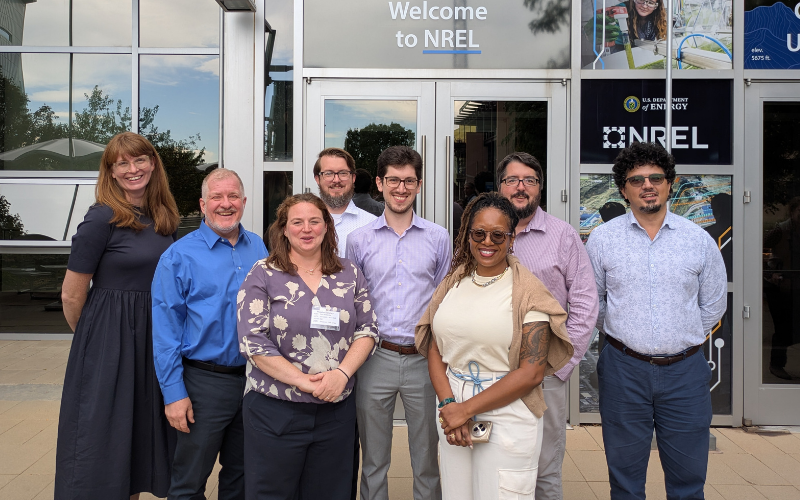
CMAP team members traveled to the National Renewable Energy Laboratory in Golden, Colorado, to participate in the Energy to Communities Summit. They shared CMAP's progress testing different scenarios to reduce emissions from our region's transportation system. This work is in partnership with ComEd and with assistance from the Respiratory Health Association and Argonne and Oak Ridge national laboratories. They also learned from eight other teams addressing similar challenges throughout the country.
Our region is leveraging funds awarded through the 2023 Energy to Communities initiative to better understand what is needed to create a clean transportation system and the potential impacts on the electric grid.
|
|
How to write a request for proposals for urban and community forestry projects
The Chicago Region Trees Initiative released a new toolkit to help communities write a request for proposals for urban and community forestry projects. It offers a powerful, professionally designed resource to help public landowners — such as municipalities, park districts, and community organizations — develop clear and effective requests for urban forestry services. This toolkit also delivers tailored guidance and includes comprehensive templates and community examples for essential services like tree planting, pruning, pest management, and risk mitigation. It enables user-friendly procurement that enhances transparency, fosters contractor clarity, ensures regulatory alignment, and ultimately supports healthier, more resilient urban forests.
|
|
Resources clarify lead and copper rule, examine data center water use
Have you signed up for the Northwest Water Planning Alliance's newsletter? If not, you may be missing out on some helpful water information, including the two resources below from their latest newsletter.
Guidance released on complying with USEPA's Lead and Copper Rule Improvements
The Rural Community Assistance Partnership published new guidance to help small and rural utilities prepare for the USEPA Lead and Copper Rule Improvements. The resource outlines key compliance steps, including inventory development, customer communication, and funding options for lead service line replacements, supporting communities working toward safer, lead-free drinking water systems.
New factsheet examines water use in data centers
A new analysis from Freshwater explores the growing water demands of data centers and the implications for regional water planning. The report highlights how cooling processes can strain local water supplies, emphasizing the need for siting strategies, efficiency standards, and reclaimed water use to reduce impacts. These findings help inform regional planning when it comes to integrating emerging industrial demands into long-term water resource management.
|
|
|
Lake County accepting proposals for wetland mitigation projects
The Lake County Stormwater Management Commission issued a request for proposals for wetland mitigation projects for any public or private landowner whose ownership property lies within the Fox River watershed in Lake County. Submit your proposals by Wednesday, December 3, at 11:00 a.m.
|
|
|
MWRD accepting applications for stormwater partnerships from local governments
Pre-applications will be accepted through Wednesday, December 31, for four Metropolitan Water Reclamation District of Greater Chicago (MWRD) programs:
|
|
DuPage County accepting applications for grants to improve water quality
The DuPage County Stormwater Management Planning Committee is accepting applications though the Water Quality Grants Improvement Program through Friday, January 2. The program awards funding for projects that exhibit a regional water quality benefit, including green infrastructure and ecological restoration projects. Under the program, organizations and individuals may apply for reimbursement of up to 25 percent of construction costs for portions of projects that improve water quality.
|
|
Funding opportunity announced for energy efficiency assessments and projects for housing entities
The Energy Efficiency Assessment Program has $350,000 available for recipients to conduct energy efficiency assessments at properties serving residents who receive housing assistance from a state or federal program.
The Energy Efficiency Trust Fund Program is offering $10 million to implement projects previously identified in an energy efficiency assessment at eligible properties serving residents who receive housing assistance.
Eligible applicants include public housing authorities, units of local governments, and nonprofit organizations that serve residents who receive rental assistance or housing choice vouchers, or who use subsidized housing assistance programs.
Funding awards will be issued on a first come, first served basis for both programs, and will remain open until funding is depleted or until Tuesday, March 31, for the assessment program, or until Tuesday, June 30, for the trust fund program.
|
|
Driving a Cleaner Illinois programs accepting applications
The Illinois Environmental Protection Agency (IEPA) is accepting applications for two funding programs through Driving a Cleaner Illinois. Applications for both programs will be accepted on a rolling basis until funds are depleted.
Through the Volkswagen round 9 electric trucks opportunity, the IEPA will fund a portion of eligible costs associated with the replacement of eligible existing and licensed on-road diesel Class 4-8 medium- and heavy-duty local freight trucks and Class 8 port drayage trucks.
Climate and Equitable Jobs Act EV charging round 3 funding covers the purchase and installation of new direct current fast charging (DCFC) EV charging stations (Level 3) and alternating current (Level 2) charging stations at publicly accessible locations. Additional funding will also be awarded to projects in an area identified as an equity investment eligible community. Projects qualify for the additional points if they are in either an EJ or an R3 community.
|
|
Kane County water conservation, education, and technical assistance program
Attention Kane County municipal officials, public works staff, and water suppliers: Are you interested in implementing innovative water conservation projects in your community? The Conserve Water for Kane program offers technical assistance for water conservation initiatives and guidance on efficient water use and sustainable practices. For questions and support, email mschneemann@cmap.illinois.gov or call 312-386-745. Applications are accepted on a rolling basis.
|
|
|
|
|